The One-Sided Discord Community That Asks More Than It Gives
Founders and product teams can run this simple ledger on their own server to see what members are asked for, what they get back, and how to fix the balance.

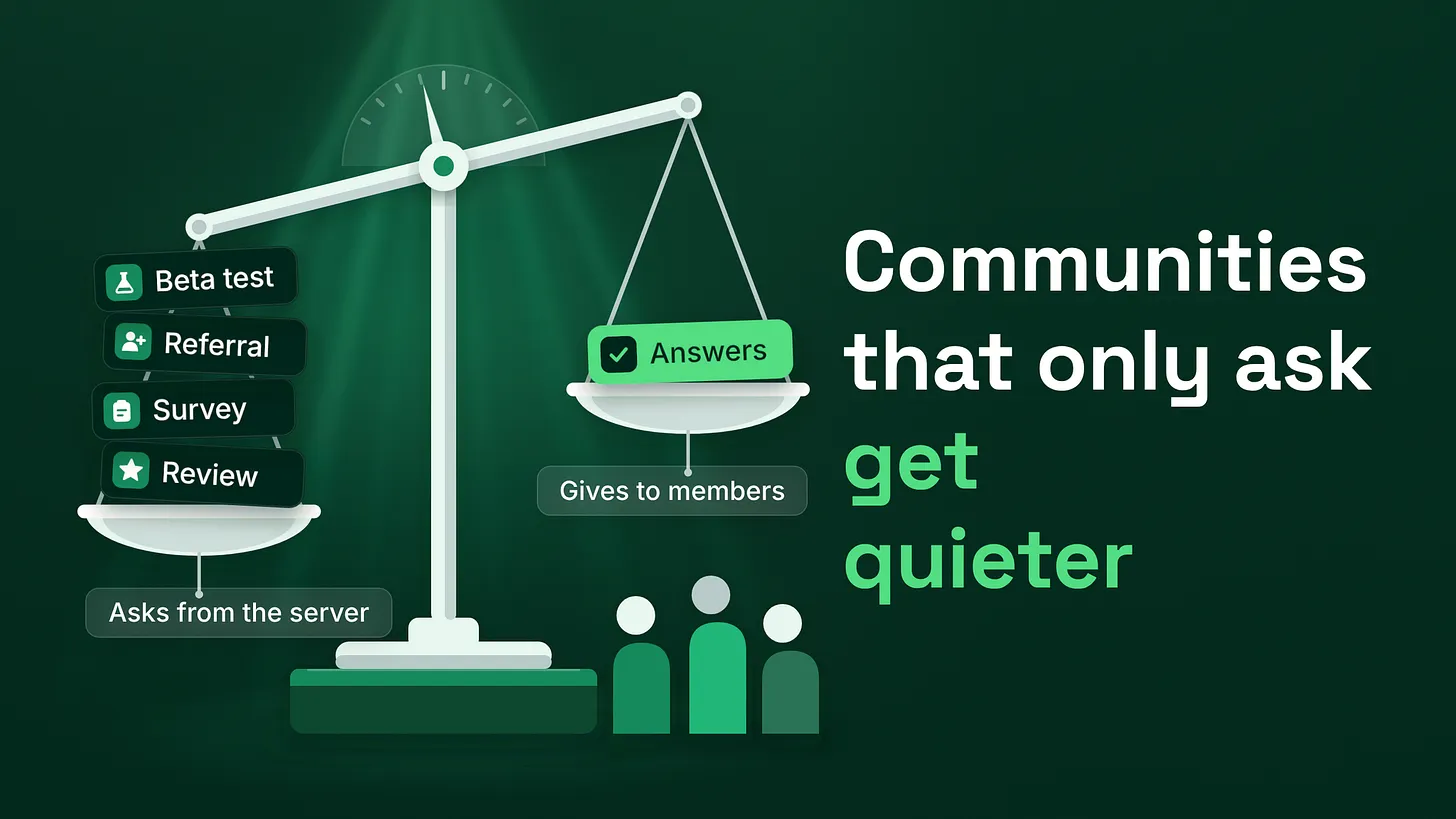
Quiet servers often have an ask problem rather than an engagement problem: members have learned that most posts want something from them. To fix a one-sided Discord community, count what you ask for and what you give back, pair every ask with a give, put a give in front of big asks, and close the loop by posting what you did with members' feedback.
The mistake looks like good marketing. Every week the team posts one more request in announcements: a review, a survey, a referral link, a beta sign-up, a call for screenshots. Every request makes sense on its own, and every week a few more members stop answering. The fix is a simple ledger with four parts. The first three take some planning. The fourth costs nothing at all, and it is the one many teams forget.
Why a better ask does not fix it
When replies drop, the usual response is to improve the ask. Shorten the survey from twenty questions to five. Add a prize draw. Post at a better time. Write it in a friendlier voice. These are real skills and they do help. A bad ask will always do worse than a good one. The trouble is that members are not only reacting to the ask in front of them. They are reacting to the pattern. A member who has seen ten requests in a row, and nothing come back from the last nine, reads the eleventh with a simple question in mind: what happened to everything I already gave you? No amount of polish answers that. Every ask spends trust that a give has to earn first. It works like a friend who only calls when they need a favour. The first few calls get answered. Somewhere around the fourth, the call goes to voicemail, however nicely the message is worded. You can test this against your own server in a few minutes. Open your announcements channel, scroll back thirty days, and mark every post as an ask or a give. An ask wants something from members: a review, an answer, a referral, a purchase, attendance, content. A give helps members without asking for anything back: a fixed bug, a clear answer, early access, a resource, a shout-out. Count both columns. Many teams are surprised by how lopsided the result is.
-
	-
The ask and give ledger
The ledger is a way of running a community's requests on purpose instead of one at a time. It has four parts.
1. Count both sides every month
Keep a simple running list. It can be a spreadsheet, a pinned note in a staff channel or a page in your team's docs. What matters is that both columns are visible to whoever posts in announcements.
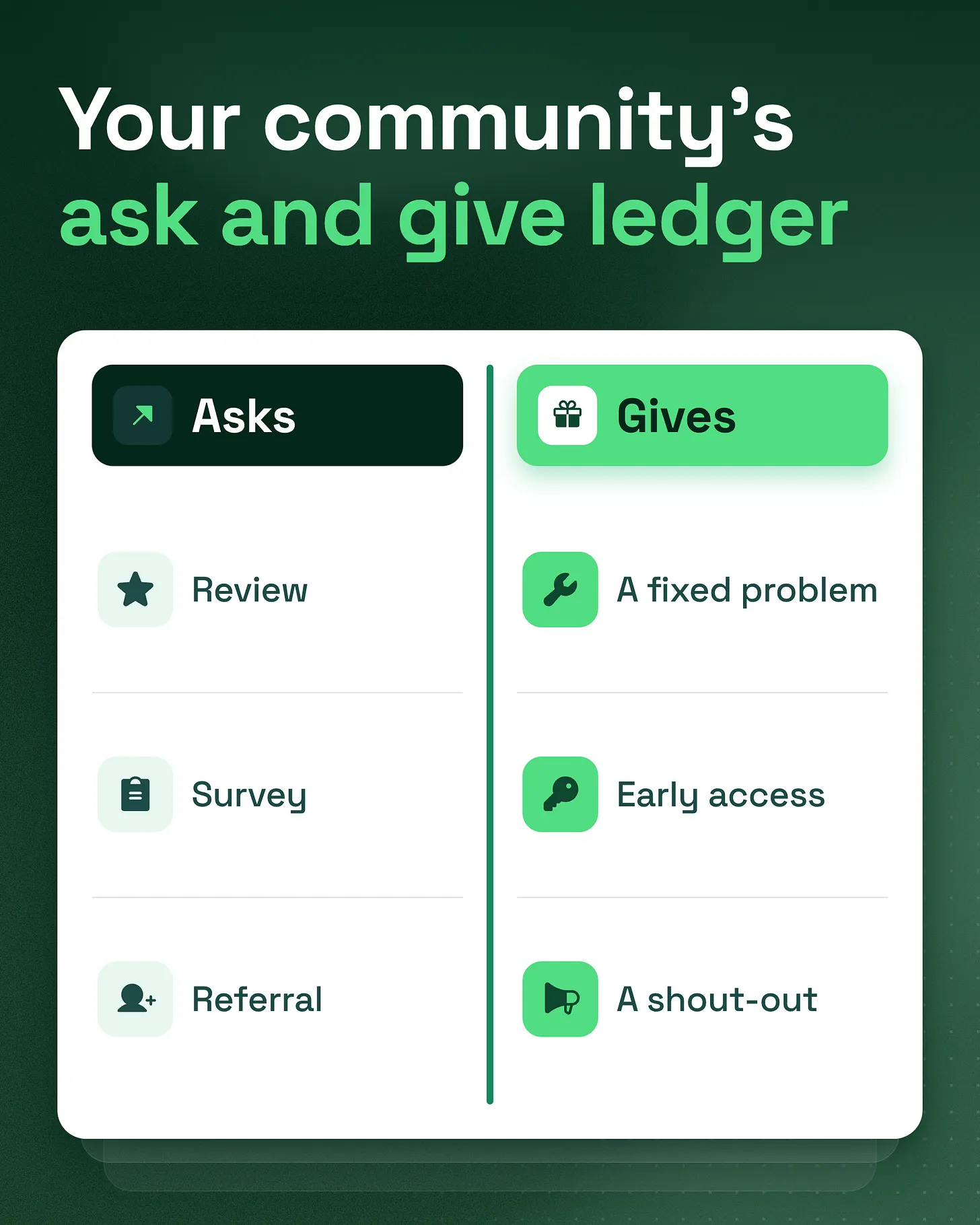
| Asks (members give you something) | Gives (members get something) |
|---|---|
| Leave a review | A fix for a problem members reported |
| Fill in a survey | A clear answer to a common question |
| Refer a friend | Early access to a feature or drop |
| Join a beta test | A guide, template or resource |
| Share screenshots or results | A shout-out for a member's work |
| Come to an event | Time with the team, such as office hours |
The first month of counting usually changes behaviour on its own. Once a team sees a long ask column, it gets harder to post another request without thinking.
2. Pair every ask with a give
Before any ask goes out, decide what it comes with. The pairing does not need to be large. It needs to be real and relevant to the ask.
- A survey comes with a promise of when and where the results will be shared, and then the results get shared.
- A beta sign-up comes with early access and a direct line to the people building the feature.
- A review request comes after a give, such as a fixed problem or a useful resource, not in the same week as a price rise or an outage.
- A call for screenshots comes with a showcase post where the best ones get featured with credit. When a team cannot think of a give to pair with an ask, that is useful information. It usually means the ask is too early.
3. Give before any big ask
Small asks can sit next to their gives. Big asks, such as a review drive, a referral push or a long research survey, work better with a run-up. Spend the week before on gives: answer the open questions, ship or announce a fix members asked for, run a session where the team listens. Then make the ask. Members respond to the request in the context of the last few weeks, so make those weeks worth responding to.
4. Close the loop
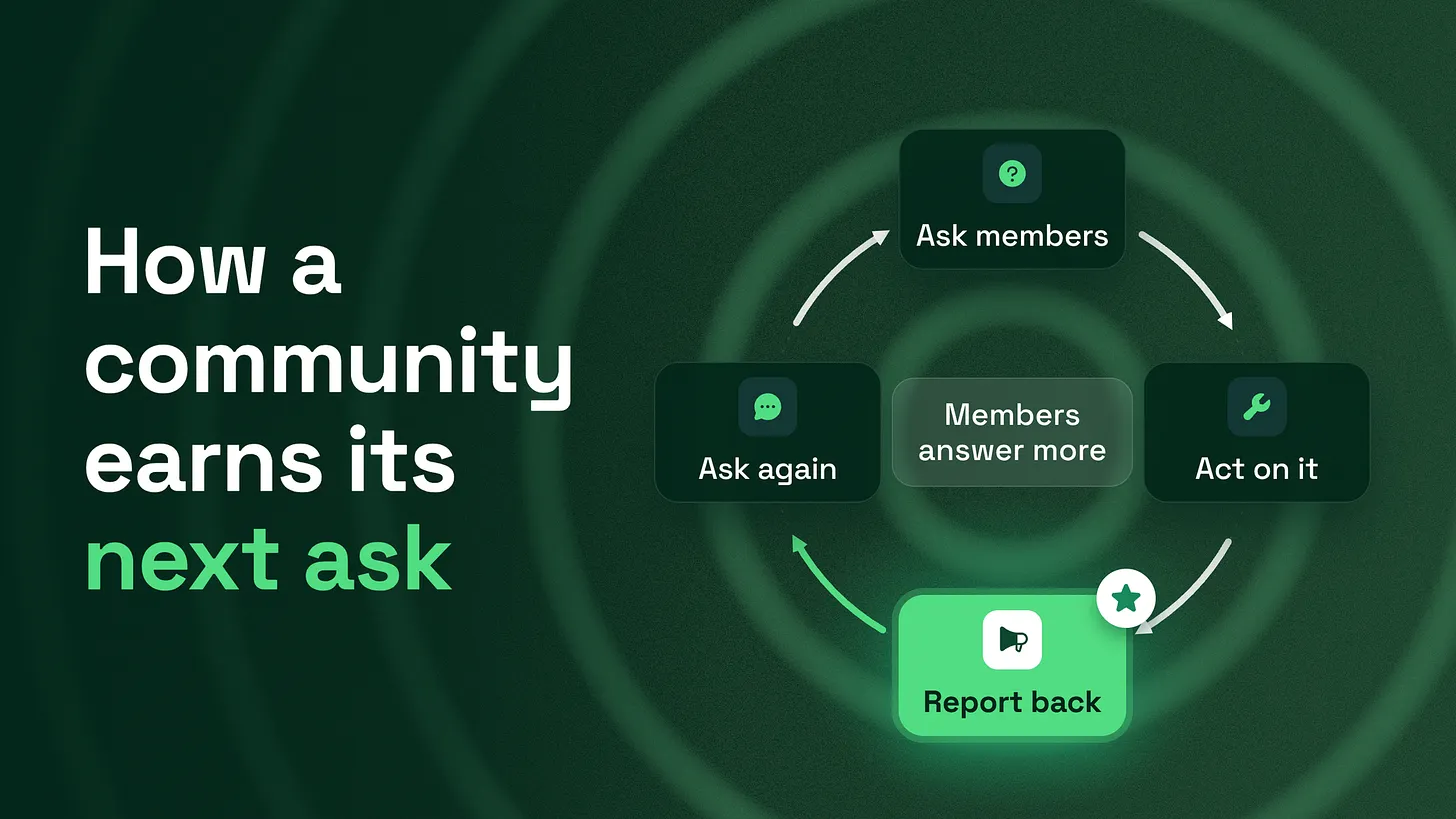
This is the part that costs nothing, and it is the one many teams skip. When members give you something, tell them what happened to it. A short post titled "You asked, we did" turns an old ask into a new give. It shows that feedback goes somewhere, which is the single best reason for members to give feedback again.
The post can be this simple:
📬 You asked, here's what happened Last month you told us exporting was confusing. ✅ The export button now sits on the main dashboard. ✅ We wrote a step-by-step guide, pinned in #help. ⏳ Scheduled exports are on the roadmap, not built yet. ❌ We won't add CSV imports this year. Here's why: ... Thanks to everyone who answered the survey. Keep it coming in #feedback.
Notice that it includes a "not yet" and a "no". Members tend to trust an honest no far more than silence. A closed loop does not mean every request gets built. It means every request gets an answer.
What a give looks like in different communities
Gives depend on what members came for, so a give that works in one server can fall flat in another.
- Software and developer communities tend to value answers, workarounds, clear documentation, early access to features and time with the people who build the product.
- Shopping and product brands tend to value attention and recognition: early looks at new drops, member photos featured in announcements, and staff who reply with warmth rather than scripts.
- Creator communities tend to value feedback on their own work, shout-outs and chances to be featured.
- Learning and trading communities tend to value clear schedules, reliable resources and sessions where their questions get answered live. If you are unsure what your members count as a give, the cheapest way to find out is to look at which past posts got the warmest replies. Those posts were gives, whatever the team thought it was posting at the time.
A month of rebalancing, worked through
Here is how the ledger can play out on a hypothetical server, a product community where replies to announcements have been falling for a few months. In week one, the team counts the last thirty days and finds a long ask column: two surveys, a review request, a referral push and a beta sign-up, with almost nothing on the give side. Nobody posts a new ask that week. In week two, the team posts a "You asked, we did" update covering the last survey, including two things it fixed and one it decided not to build. It also answers every open question in the help channel. In week three, the team runs an open office hours session in a voice channel, where members can ask the product lead anything, and features three members' work in announcements. In week four, the team makes one ask: a short survey about the next feature, with a date for when the results will be shared. The point is not that the survey suddenly gets record replies. The point is that the team now has a way to tell whether the relationship is improving, and a habit that keeps the two columns closer together from then on. The ledger also touches the rest of community work. It depends on feedback routing that gets member input to the product team, on reporting that shows the team what members said and what changed, and on an events rhythm that leaves room for gives. Onboarding plays a part too, because new members learn in their first week whether the server is a place that gives.
Getting an outside read on the balance
If you want to go further, Your Discord Polls Count "Yes" Votes That Cost Members Nothing looks at how to ask members for input in a way that tells you something real, and Does Your Discord Resource Post Give Members a Next Step? covers one of the most useful gives a server can post. For a view of your own server's balance, the free community analysis takes about three minutes to request, and I'll tell you exactly what's working, what isn't, and what to fix first, delivered within 24 hours. If you would rather have someone run the engagement, feedback and monthly reporting side day to day, that is part of the full community management I offer at communitymanagementpro.com. I have passed member feedback on to a product team. If I could protect only one part of the ledger, it would be the report back. Give first, and the asks start working again. Members tend to notice the difference within a month. danieljeong.org