Before Your Executive Sponsor Leaves, Document the Discord
Five steps a community lead can take now so a Discord program survives a leadership change: a one-page purpose, named owners, steady reports and a log of wins.

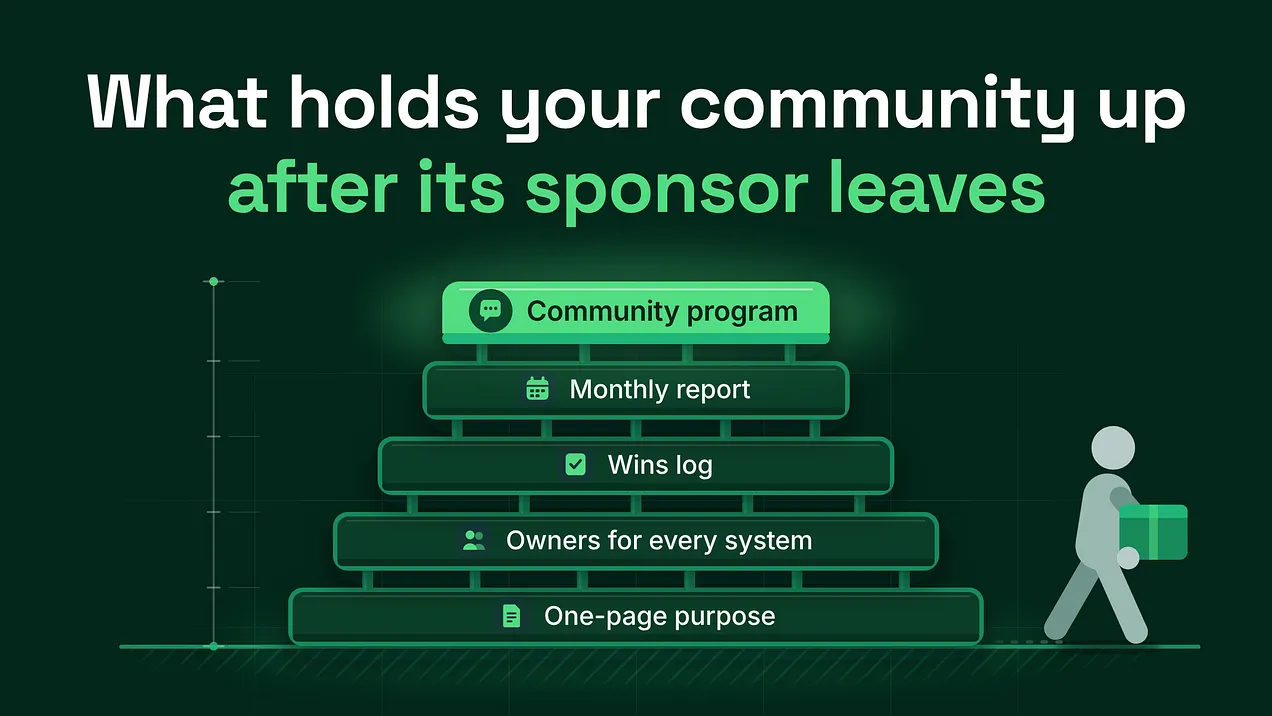
Good results do not protect a community program once the person who saw them leaves, because a new leader judges it by what is written down. To keep a community program after an executive sponsor leaves, write a one-page purpose, give every system an owner and a backup, send a steady monthly report, keep a running wins log, and meet the new leader early.
An executive sponsor is the senior leader who argued for your community, protects its budget and explains it to the rest of the company. While they are around, the program rarely has to prove itself. When they leave, that explanation often leaves with them.
The five steps below make sure it does not. The fourth step is the one that saves programs, and it cannot be started the week the sponsor announces they are leaving.
Why good results are not enough
The usual belief is reasonable: if the community is healthy, members are active and the team is doing good work, the results will speak for themselves. A new leader will look at the server, see it working and keep it.
The problem is what a new leader actually looks at. In their first weeks they inherit dozens of programs, budgets and teams. They do not have time to scroll a Discord server or sit in on events. They read documents, they look at numbers someone has already pulled, and they ask the people around them what each program is for. A program that was explained in the sponsor's head, in hallway conversations and in their own sense of what members said, arrives with nothing attached.
Results nobody wrote down leave with the person who saw them. Think of a house with no deed. You may have lived there for years and fixed every room, but when someone new checks the paperwork, the house belongs to nobody.
You can test where you stand in two minutes. Ask a colleague outside the community team to explain in two sentences what your Discord does for the company. If they struggle, a new leader will too.
Write one page that explains the community
The first step is a single page that a busy leader could read before a meeting. Keep it in plain business terms, because the reader may know very little about Discord.
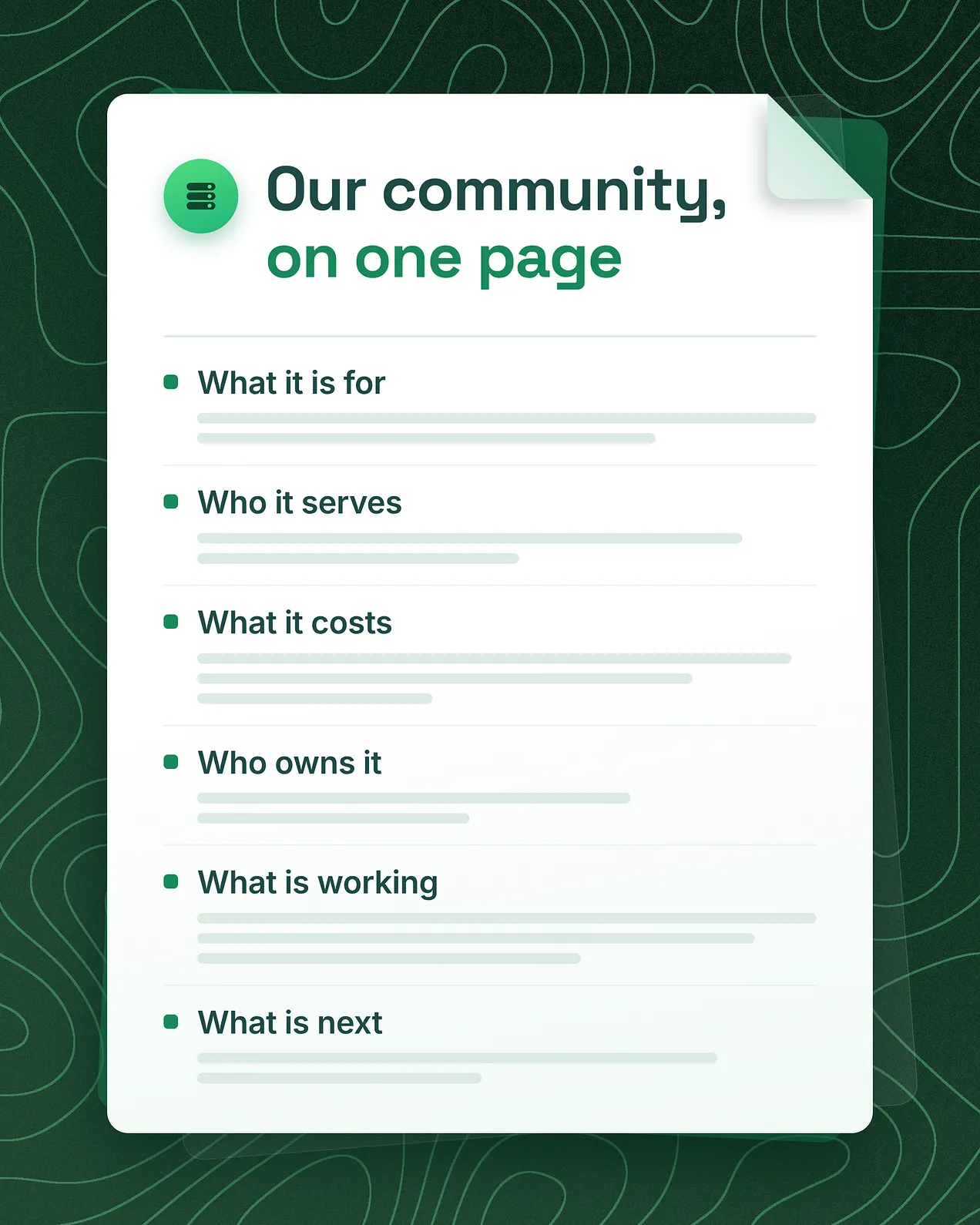
COMMUNITY ONE-PAGER What it is for: the business goal it serves (support, retention, product feedback, launches, sales) Who it serves: the members, in one sentence What it costs: tools, paid bots, and team hours per week Who owns it: the person accountable, and their backup What is working: three short points, each with a real example What is next: the one or two priorities for this quarter Where to read more: the latest monthly report and the wins log
Two rules make the page useful. First, the purpose line names a business goal the company already cares about, not a community goal such as "engagement". Second, every claim under "What is working" points at something real: a feature that shipped from member feedback, a launch members tested, a support question answered by other members. No invented figures, and no claims the team could not show.
Give every system an owner and a backup
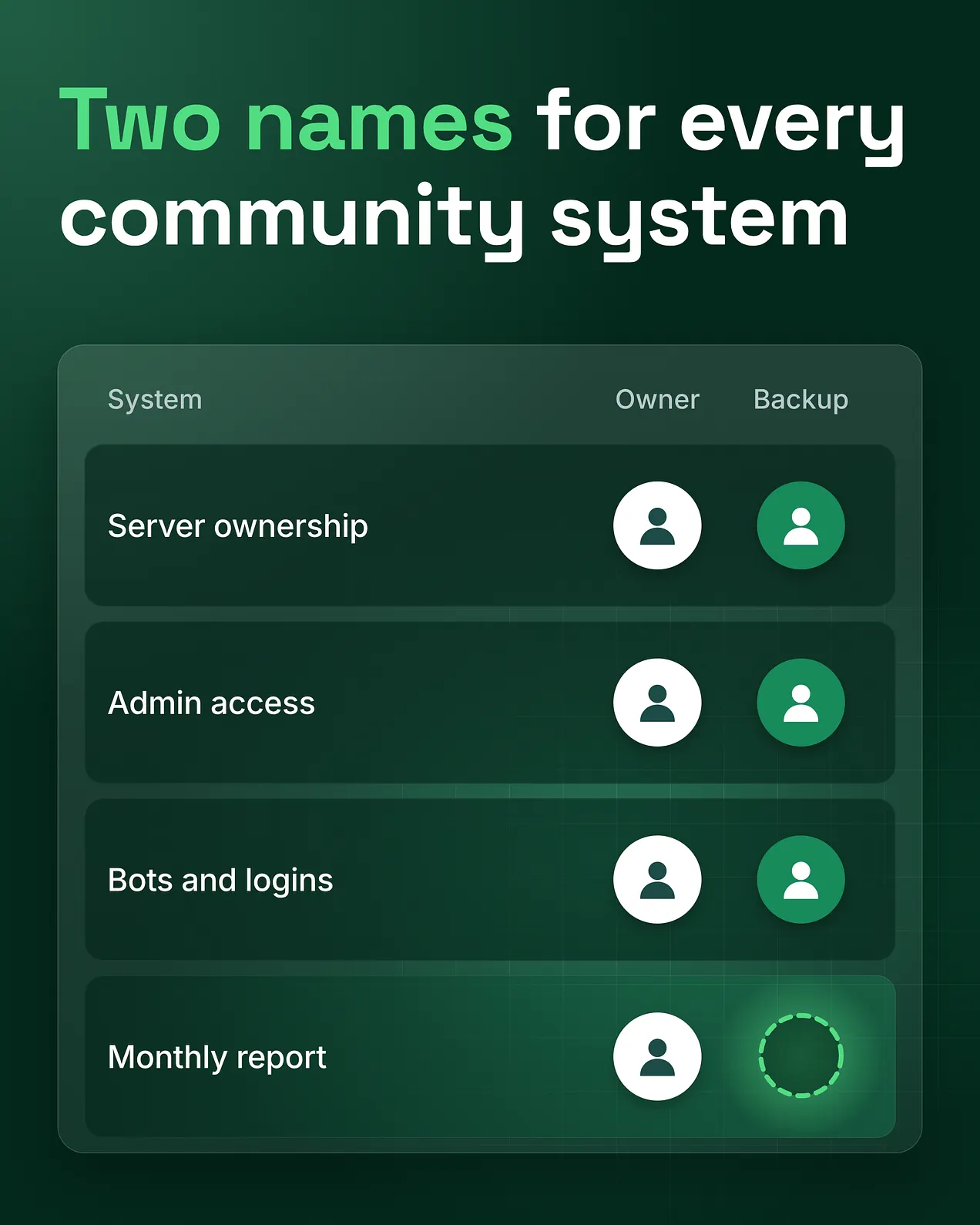
The second step is a list of everything the community runs on, with a name next to each item, and a second name for when the first person is away or gone.
| System | Owner | Backup |
|---|---|---|
| Server ownership on Discord | A named team member | A second team member |
| Admin access | Community lead | Operations or IT lead |
| Moderation team and its playbook | Moderation lead | Community lead |
| Bots and integrations | Whoever set them up | A second admin with the logins |
| Onboarding flow | Community lead | Support lead |
| Events calendar | Events owner | Community lead |
| Monthly report | Community lead | Chief of staff or manager |
The first row matters more than it looks. On Discord, only the server owner can transfer ownership, which they do from the server's Members list by choosing the new owner and selecting Transfer Ownership (Discord's help article on transferring ownership, checked November 2026). Discord Support only steps in under narrow conditions, such as an owner who has not used their account for at least a month (Discord's ownership transfer request article). If the sponsor's personal account owns the server, ask them to transfer it to a named team member before their last day. It takes a minute, and it is very hard to fix afterwards.

Send the same short report every month
The third step is a monthly report in a fixed format, short enough to read in two minutes. Many reports go unread because they change shape every month and bury the point under charts. A busy leader needs to skim it and know what to do next.
Keep five lines, in the same order every time:
- What members did. The two or three things that happened in the server this month.
- What members said. The main themes in their feedback, in their own words where possible.
- What changed because of them. Fixes, features or decisions that came from the community.
- What is at risk. Anything the leader should know before it becomes a problem.
- What is next. The one or two priorities for next month.
The value builds over time. A new leader who receives six of these in a row can see a pattern without ever opening Discord, and the report starts doing the sponsor's old job of explaining the community.
Keep a wins log while the wins happen
This is the step that saves programs, and it is the one teams start too late. A wins log is a running list of moments when the community clearly helped the business. Each entry needs only four things: the date, what happened, who it helped, and a link to the message, thread or document that shows it.
Good entries look like this: a member's bug report that led to a fix, a launch that members tested before release, a support question answered by other members before staff saw it, a customer quote shared with permission, or a member who became a customer after a conversation in the server.
The reason it cannot wait is simple. A month after a leadership change, nobody can rebuild the log. The messages are buried under thousands of newer ones, the context is gone, and the person who remembered why each moment mattered may be the one who left. Ten minutes a week while things happen is worth more than a weekend of digging afterwards.
Meet the new leader in the first two weeks
The last step is a short meeting, early, before the new leader forms an opinion from the budget sheet alone. Bring the one-pager, the last three monthly reports and the wins log. Then spend most of the meeting asking rather than defending: what do they need from the community this quarter, and which business goal matters most to them right now?
New leaders often bring new priorities. If the answer points somewhere different from the old purpose line, update the one-pager together. A community that can show how it serves the new leader's goals tends to get a fair hearing. One that only explains why the old leader liked it tends not to.
Each of these steps belongs to the wider work of running a community well: the documentation that explains how it works, the access and permissions that keep it safe when people leave, the moderation playbook, the onboarding flow, and the reporting that ties all of it to the business.
Before the next leadership change. I have written regular community reports for the teams I work with. For the access side of a handover, Before a Staff Laptop Gets Hacked, Set a Standard for Discord Moderator Accounts covers how staff accounts should be set up, and the articles page has more on reporting and strategy. For an outside view of your own server, the free community analysis takes about three minutes to request, and I'll tell you exactly what's working, what isn't, and what to fix first, delivered within 24 hours. And if your team needs the playbook documented, or someone to run the community with monthly reporting built in, communitymanagementpro.com covers strategy consulting and full community management.
A sponsor can open the door for a community, but paper is what keeps it open after they go. danieljeong.org