Your Team Does Not Know When a High-Value Member Joins. That Is a Systems Problem.
How operational intelligence inside Discord communities turns member data into timely, targeted engagement

The Missed Arrival
Every community that uses an intake form before granting server access is collecting information about the people who join. The form might ask about their role, their company size, their experience level, or their relevant metrics. The data is gathered. The member is approved. They join the server. And then, in most communities, that data sits in a spreadsheet or a form submission log and does nothing. The member who indicated they manage a high-value account, represent an enterprise client, or hold a specific level of expertise walks into the server and receives the same automated welcome as every other new arrival. The team has no signal that this person's join event was different from the others. The member browses for a day or two, does not receive any indication that their presence has been noticed, and leaves. This is not a moderation failure. It is not a content failure. It is a workflow failure. The information required to provide a different, better experience was available at the moment of joining. The workflow to act on it was never built.
What Operational Intelligence Means in a Community Context
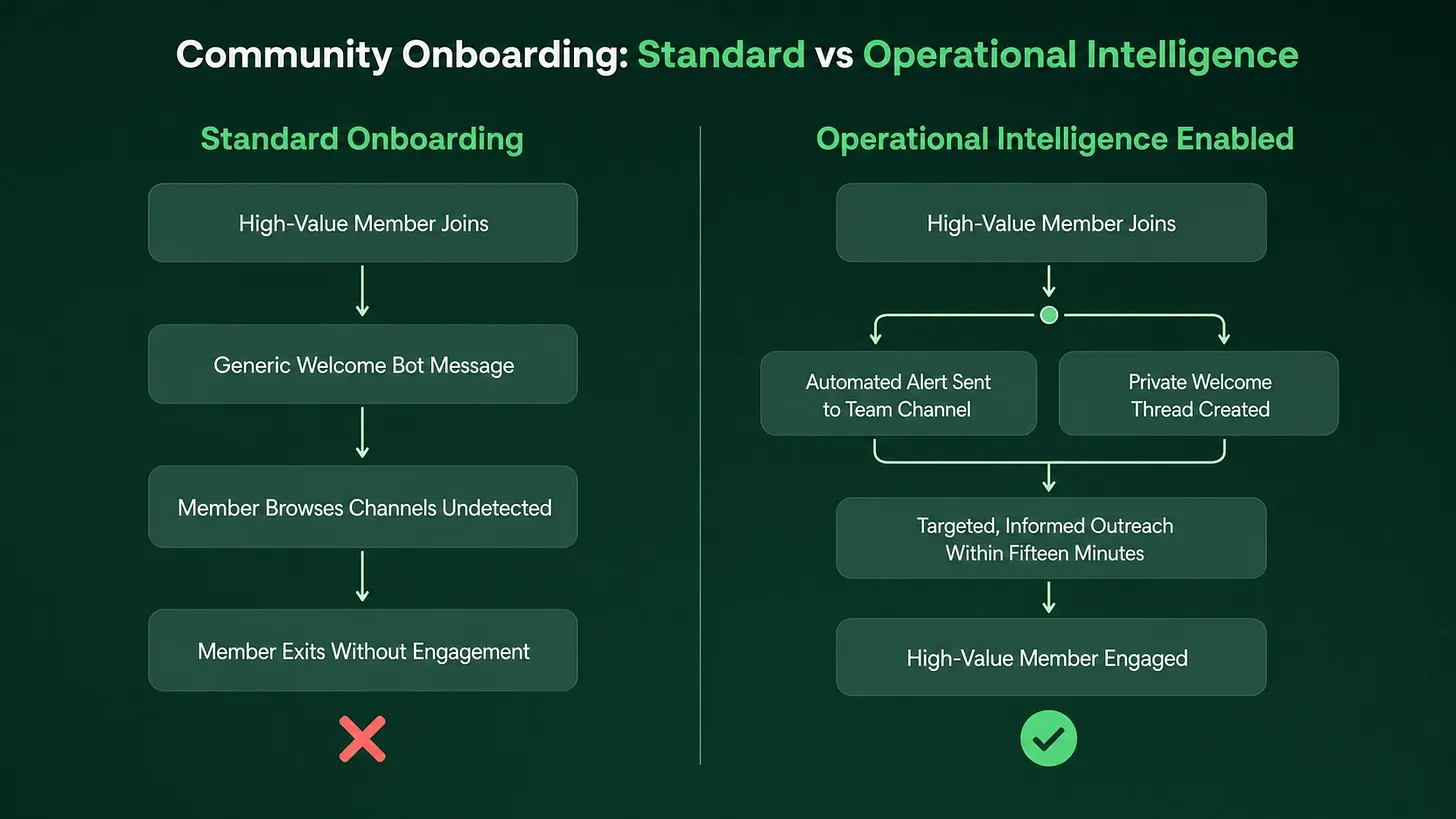
Operational intelligence, in the context of Discord community management, is the set of automated systems that transform member data into timely, actionable signals for the team. At its simplest, it is a bot that reads a field from an intake form, compares the value against a defined threshold, and sends a notification to a designated channel when the threshold is met. A member who indicates they have above a certain level of GMV triggers a Slack notification: a high-value member has joined. Their name. Their Discord username. The relevant data from their application. A team member sees the notification within minutes. They open the new member's private welcome thread and send a message that is not generic. A message that acknowledges who this person is, what they indicated about themselves, and what the community can specifically offer them. That entire sequence can run in under fifteen minutes. The difference in the member's experience is significant. They are not one of fifty new arrivals this week. They are someone the community was ready for.
The Technical Foundation
Building this kind of operational intelligence does not require enterprise-level engineering. It requires deliberate configuration of existing tools. The most common implementation connects an intake form platform to a Discord bot or a webhook. When a new form submission crosses a defined threshold in one of its fields, the webhook fires and sends a structured message to a designated channel. The message includes the member's relevant details and their Discord username so the team member receiving the alert knows exactly who to contact and where to find them. This connection typically runs through an automation platform that links the form tool, the communication channel, and the Discord server. The setup takes a few hours of configuration work. Once it is running, it operates automatically without requiring any manual monitoring of form submissions. The threshold definition is a deliberate operational decision. What level of GMV, what team size, what account type, or what application response constitutes a high-value join? That decision needs to be made explicitly by the community team and encoded into the automation. A threshold that is too high misses members who would benefit from targeted outreach. A threshold that is too low floods the alert channel with notifications that lose their urgency. Finding the right threshold requires some calibration based on the actual distribution of member applications. The goal is for an alert to reliably signal that this particular arrival warrants immediate, personalized attention.
Why Most Communities Do Not Have This
The absence of operational intelligence in most Discord communities is not a technology gap. The tools are accessible. The configuration is straightforward. The gap is workflow design. Someone has to decide that high-value member detection is a priority. Someone has to map out what the signal should be, where it should go, and what the protocol is for responding to it. Someone has to build the connection between the form, the automation, and the notification channel. Someone has to document the response protocol so the team member receiving the alert knows exactly what to do. Most community operators never get to this layer of operational design because they are absorbed in the content, the moderation, and the day-to-day management of the server. Workflow architecture requires stepping back from the operational work to design the infrastructure that makes the operational work more effective. That is a different kind of thinking than most community managers are asked to apply. It is closer to systems design than to community management as it is traditionally understood.
Tiered Detection for Different Member Types
A mature operational intelligence system does not use a single threshold. It uses a set of thresholds that trigger different types of responses. A member indicating the highest level of account value or organizational reach triggers the most immediate and personalized response: a direct alert to a senior team member, an immediate welcome thread opening, and potentially a follow-up outreach for a direct conversation or demo. A member at a mid-tier threshold triggers a standard high-value alert: a welcome thread with personalized messaging that acknowledges their background, without the immediate escalation to senior team involvement. A member at the general population level receives the standard automated welcome and enters the regular onboarding flow. This tiering requires more upfront configuration but produces a more sophisticated and resource-efficient system. The team's attention is directed proportionally to the opportunity represented by each new arrival.
The Retention Implication
Members who receive a personalized, informed welcome in their first minutes in a community form a different initial impression than those who receive a generic automated message. The difference is not just in how they feel about the community. It is in how they behave. Members who feel recognized and valued from the beginning engage more quickly, contribute more actively, and remain for longer. The operational intelligence system that triggered a timely, informed welcome is doing retention work from the first moment of the member's experience. For high-value members specifically, the early impression is particularly consequential. A high-value member who joins a community and receives no signal that their arrival was noticed is likely to conclude that the community is not operating at the level they expected. That conclusion is hard to reverse. A high-value member who joins and receives a message within fifteen minutes that demonstrates awareness of who they are and what they are looking for concludes something different. They conclude that this community is run by people who pay attention. That is a conclusion worth engineering.
Daniel Jeong builds Discord community infrastructure for organizations where high-value member engagement is a business priority, not an afterthought. danieljeong.org