Your Members Cannot Tell Who Actually Runs the Room
Staff visibility is infrastructure, and when it is missing, members stop asking for help long before they leave.

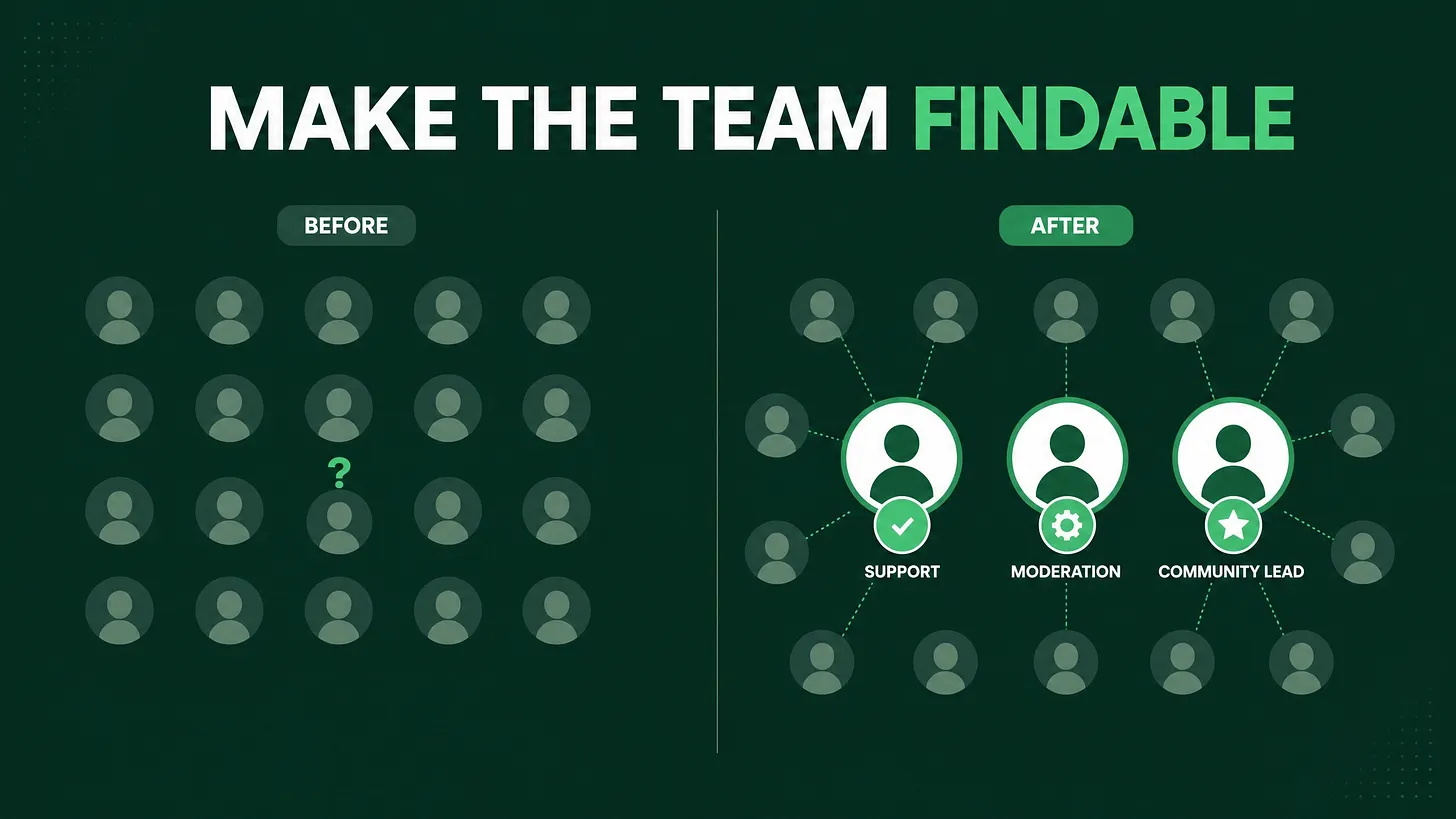
In most communities, a new member cannot tell who works there. That ambiguity quietly suppresses questions, because people will not ask for help when they are unsure anyone is listening. Fix it with four things: a published team list with scopes, one human contact at entry, roles that read as authority, and visible presence on a schedule.
A question that should be easy
Here is a test worth running on any community you are responsible for. Join it with a fresh account and try to answer one question in under a minute. Who works here. In most servers you will fail. The member list is alphabetical noise. Role colors mean something to the team and nothing to anyone else. The staff role sits in the same visual register as the roles people earn for showing up to a movie night. Nobody has posted recently, so presence and absence look identical. The team is real. The team is just not findable, and to a new member those two states are the same thing.
The calculation members run before they type
When someone has a problem, they do not simply post it. There is a short, mostly unconscious assessment first, and it has two parts. Is there anybody here who can actually solve this. And if I post, will a person with that ability see it.
A question is a small risk. People take it when the odds look good and skip it when they do not.
If the answer to either part is unclear, the most common outcome is not a badly worded question. It is no question at all. The member closes the tab with the problem unsolved, and nothing in your server logs records what happened. Unasked questions are the most expensive thing in a community because they leave no trace. Worse, the resulting silence gets filed under the wrong cause. A member who never posted looks like a member who was never interested. In reality they arrived with intent, could not locate a human, and made a rational decision to give up.
Presence is not the same as staffing
Plenty of communities are genuinely staffed and still feel abandoned. The team is in the back end all day, handling fulfillment, moderation queues, ticket backlogs, and internal work that never appears in a public channel. Real effort, invisible location. From the member's side, work that happens off stage did not happen. This is not unfair, it is just how rooms work. If nobody from the team has spoken in the open in three days, the reasonable conclusion is that nobody is watching. The distinction is worth naming clearly.
| What the team experiences | What the member perceives |
|---|---|
| Constant back end workload | An empty room |
| Tickets handled privately | No evidence anyone helps |
| Staff roles assigned correctly | Roles that look decorative |
| Everyone knows who owns what | No idea who to approach |
The four part fix
Staff visibility is a system you build, the same way you build onboarding or escalation. Four components cover it.
1. A published team list with scopes
One pinned, permanent place that names every person on the team and what they handle. Not a role color and not a vague title. Support and access issues, Moderation and reports, Partnerships, Product questions. A member with a problem should be able to read that list and know exactly who to approach in one pass.
The scope matters more than the name. Naming a person without a scope moves the guesswork rather than removing it.
2. One human contact at entry
The single highest leverage version of this is a private thread created the moment someone joins. Inside it, the team introduces itself by name, explains who handles what, welcomes the person directly, and asks whether they have any questions. This does one thing extremely well. Every member now has a human before they need one. When a problem shows up on day nine, they are not searching for an entry point, they are replying to a conversation that already exists.
Most communities give a new member a channel to read. Giving them a person to reply to is a different product entirely.
3. Roles that read as authority
Role design is a communication layer, and most servers waste it. If the team role sits in the same tier as twenty cosmetic roles, it carries no signal. Team roles should be immediately distinguishable, ordered above everything decorative, and few enough that a member can hold them in their head. Two or three staff roles that mean something beat eight that require a legend.
4. Visible presence on a schedule
The last piece is a commitment rather than a configuration. Someone from the team posts in the open every day, deliberately. A greeting to new arrivals, an answer moved from a ticket into a public thread, a short note on what changed.
This is not about performing activity. It is proof of life, and it resets the member's calculation every single day. Presence becomes something they can verify rather than assume.
What changes when the team is findable
The effects show up quickly and they compound.
- More questions surface. Which sounds like more work and is actually the point. A question you can see is a problem you can solve before it turns into a departure.
- Fewer problems are handled privately. Answers in the open teach the next twenty members who had the same question and never asked.
- New members activate faster. A person to reply to lowers the cost of the first message more than any welcome copy ever will.
- Escalation stops depending on luck. With scopes published, members route themselves correctly and the team stops triaging misdirected requests.
The real question they are asking
Members are not evaluating your team against anyone else's. They are asking something simpler and much more consequential. Is anyone home. Every community answers that question whether it means to or not. The only choice is whether the answer is designed or accidental. Publish the team, hand every new member a person, make the roles mean something, and show up in the open where it can be seen.
People will not ask for help in a room where they cannot tell if anyone is listening. Make listening visible and most of your engagement problem was never an engagement problem. danieljeong.org