Your Enterprise Member Has a Question They Will Never Post in General
Silence isn't always disengagement. Sometimes it's a missing path.

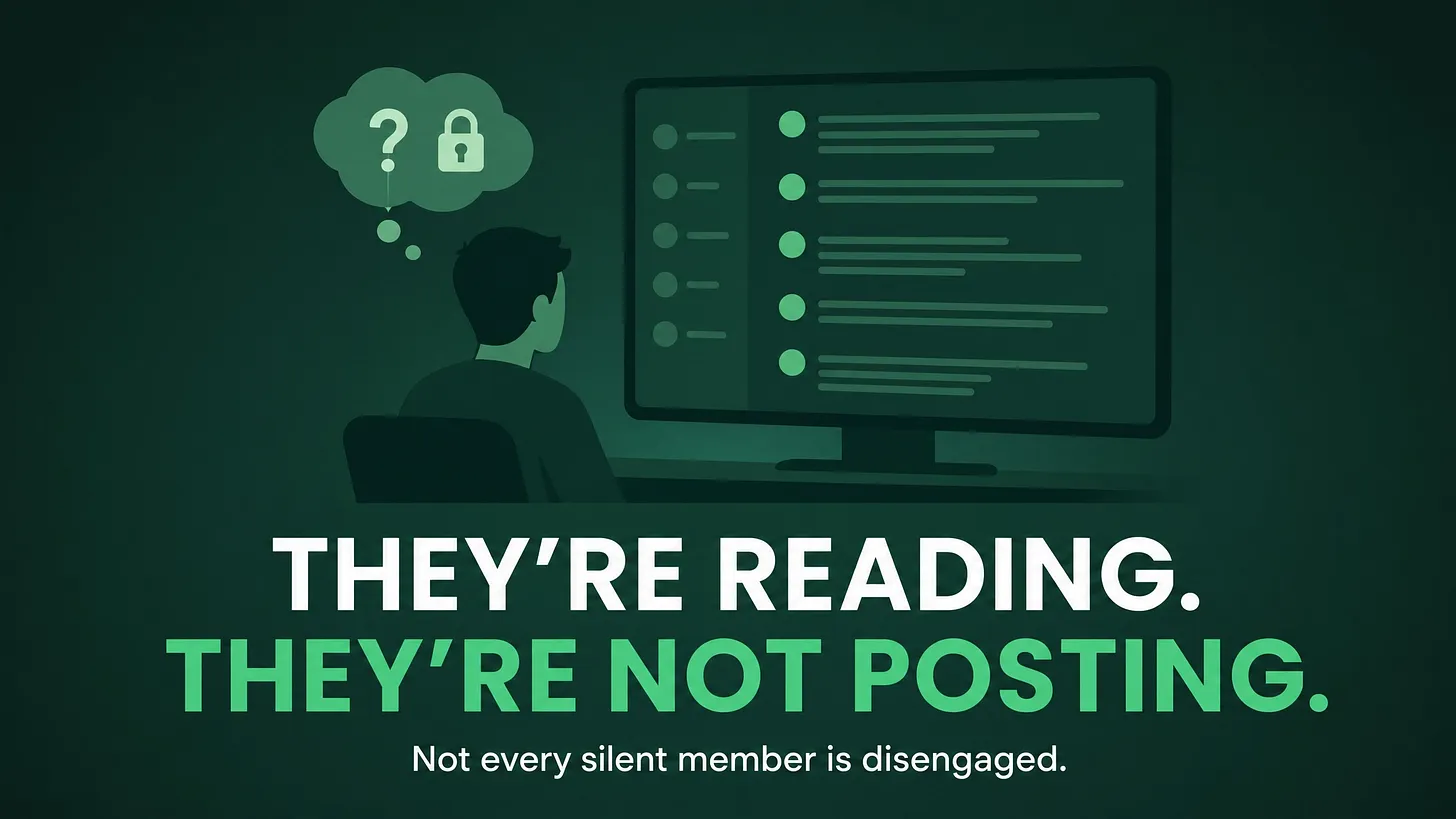
The Member Who Reads Everything and Posts Nothing
Every community has a segment of members who show up consistently, read every announcement, and never post a single public message. Most teams read this as disengagement. In a specific and often high value segment of members, it's the opposite. It's someone who has a real question and no acceptable way to ask it in front of everyone else. This shows up most clearly in developer and B2B facing communities, where a meaningful share of members represent a company rather than themselves personally. An enterprise buyer evaluating a product, a technical lead checking on an integration detail tied to their own company's infrastructure, someone with a question connected to a contract or a security requirement, none of these people are going to type that question into a general channel where anyone can see it.
Why the Question Never Becomes Public
The reason isn't shyness. It's exposure. A public channel broadcasts to everyone currently online, including competitors, including other companies' representatives, including anyone who happens to be watching. A question tied to internal decision making, budget, or a specific integration detail carries real information that a company has no interest in sharing with a room full of strangers, however friendly that room might be. Most Discord communities only offer one path for questions: the public one. If that's the only door available, the members with the most sensitive questions simply don't walk through it. They read, they observe, and if their question doesn't get answered some other way, they either give up or go looking for a direct email address, assuming one is easy to find.
What Persona-Based Onboarding Solves
The fix starts earlier than the moment someone has a question. It starts at onboarding, with a short set of questions that identify who someone actually is: a developer, a creator, an enterprise evaluator, or something else specific to the community's structure. Discord's own onboarding tools support this natively, letting new members self select from a short list of categories before they ever reach the main server. Once that identification exists, routing becomes possible. A member who identifies as an enterprise evaluator can be pointed toward a private ticket option immediately, instead of being left to figure out on their own that one exists. This isn't about restricting anyone. It's about making sure the private path is visible to exactly the people who are most likely to need it, at the moment they're most likely to be looking for it.
Building the Private Path
The mechanism itself doesn't need to be complicated. A clearly labeled channel, described plainly enough that members understand what it's for, connects to a ticket system that opens a private thread between the member and the right person on the team. Automation can trigger this based on the onboarding answer someone gave, or a member can open it manually if they realize partway through their experience that they need it. What matters most is that the option exists somewhere visible, described in language that doesn't require guessing. "Contact support" is vague enough that a hesitant enterprise buyer might not trust it applies to their situation. "Talk to us about enterprise integration questions" removes that ambiguity entirely.
The Cost of Not Having One
The cost of skipping this isn't visible in any dashboard, which is part of why it gets overlooked. It doesn't show up as a complaint, because the member never says anything. It shows up as a deal that quietly stalled, a renewal conversation that never started, or a champion inside a company who stopped advocating internally because their question sat unanswered long enough that they moved on to a competitor's community instead. Communities that build around consumer engagement can sometimes get away without this, because the stakes of a single unanswered question are lower. Communities built around B2B products, developer tools, or enterprise sales cannot, because the members most likely to stay silent are frequently the ones closest to a purchasing decision.
What This Means for Growth
Treating every member the same, with the same single public channel as their only option, feels like simplicity. It's actually a growth constraint hiding inside what looks like a clean structure. The members with the highest value questions are the ones most likely to need a different path, and without one, they don't ask at all. Persona-based onboarding paired with a private ticket system costs relatively little to build and almost nothing to maintain once it's running. What it protects is a category of revenue-adjacent conversation that most communities never realize they're losing, because losing it looks exactly like silence.
Generalized from onboarding structures built for developer and B2B communities. danieljeong.org