You Cannot Improve a Community You Only Measure by Member Count
The three leading indicators that tell you whether a community is alive, long before the member count does.

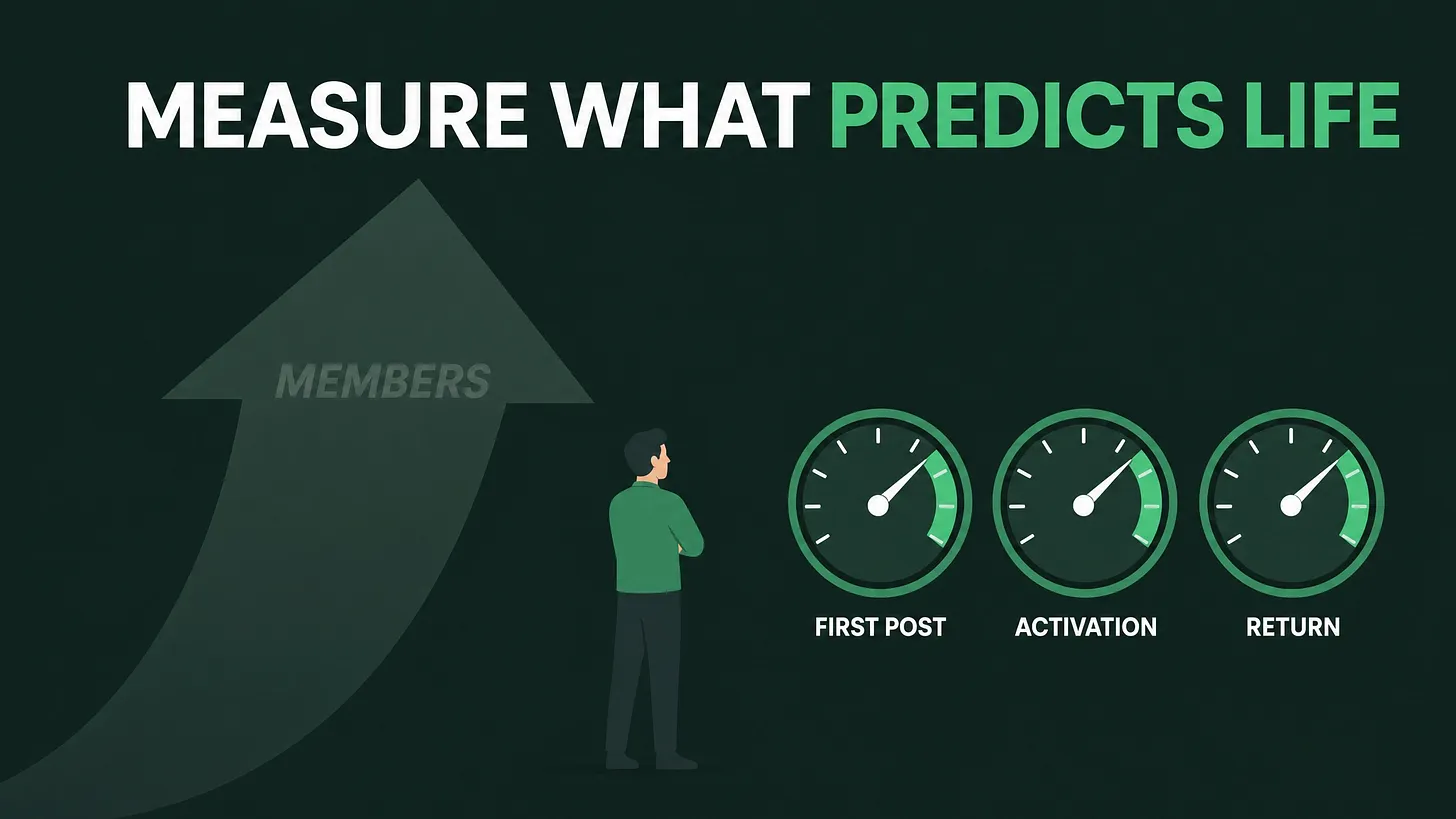
Member count is a lagging vanity metric that can rise while a community quietly dies. To actually improve community health, track three leading indicators instead: time to first post, activation rate, and repeat participation. They are easy to measure and they tell you what size never will, which is whether people are staying, acting, and coming back.
The number that lies to you
Ask most community leaders how their community is doing and they will tell you how many members it has. It is the number on the dashboard, the number in the pitch, the number that feels like progress. It is also the number that tells you the least about whether the community is actually alive. Member count is seductive because it almost only goes up. People join and rarely formally leave, so the line climbs no matter what is happening inside. A number that only rises cannot tell you when something is going wrong. That makes it comforting and nearly useless as a health signal.
Why size hides decay
Here is the trap. A community can add a thousand new members over a few months and feel deader at the end of it than at the start. The count went up. The life went down. Both are true at once, and the count is what hides the decay.
Growth measures who walked through the door. It says nothing about who stayed in the room.
The member count only records the moment of joining. It is blind to everything that matters afterward: whether people spoke, whether they came back, whether they found a reason to care. A community is not the sum of who joined. It is the sum of who stayed and participated, and size cannot see that.
Leading indicators beat lagging ones
The fix is to stop staring at the lagging number and start watching the leading ones. A lagging indicator tells you what already happened. A leading indicator tells you what is about to. Member count, revenue, total posts, these are lagging. By the time they move against you, the damage is months old. Leading indicators are the early signals of health or decline, visible while you can still act on them. For a community, three of them do most of the work. None require special tooling. All of them can be tracked with what you already have.
Metric one: time to first post
The first is time to first post. How long does it take a new member to say something, anything, after they join.
This matters more than almost anything else, because the first contribution is the moment a person crosses from spectator to participant. A member who has posted once is far more likely to post again and to stay. A member who lurks for weeks without a single message is quietly deciding they do not belong here. Time to first post is your earliest read on whether onboarding is actually pulling people in or just letting them in.
Metric two: activation rate
The second is activation rate. Of the members who joined in a given period, what share took a first meaningful action in their first week. Introduced themselves, joined a conversation, reacted, showed up to an event, whatever counts as real participation in your space. Activation rate separates people who joined from people who arrived. Joining is a click. Arriving is doing something that signals intent to be part of the place. A high count with a low activation rate is a warning that you are collecting members, not building a community. This one metric will tell you whether your front door leads anywhere.
Metric three: repeat participation
The third is repeat participation, and it is the truest signal of the three. How many members who participated last week also participated this week. It measures the habit, not the impulse. Anyone can generate a spike of activity with a launch, a giveaway, or a big announcement. Impulse is easy. Habit is hard, and habit is what a real community runs on. Repeat participation cuts straight through the noise of one-time bursts and tells you whether people are weaving your community into their routine. When this number is healthy, the community is alive. When it slides, you are in trouble long before the member count admits it.
What to do with the numbers
Measuring is only half of it. Each indicator points to a specific fix when it drops.
| Indicator | What it reveals | What to fix when it drops |
|---|---|---|
| Time to first post | Whether onboarding invites contribution | Add a low-stakes first action early in the journey |
| Activation rate | Whether joining leads to arriving | Strengthen the first-week experience and prompts |
| Repeat participation | Whether the community is a habit | Build a reliable recurring reason to return |
Notice that none of these fixes involve chasing more members. They involve making the members you have stay, act, and return. That is what improving a community actually means.
Measure what you want to grow
The old line is true here. You improve what you measure. If the only number you watch is member count, you will optimize for joins and quietly tolerate a hollow room. If you watch time to first post, activation, and repeat participation, you will build a place people actually live in. Size is the score you show other people. Health is the game you are actually playing. Keep your eyes on the members who come back, not just the ones who show up, and the community you are measuring will be one worth measuring.
Big numbers feel good and hide the truth. Watch the quiet ones that tell you whether people came back, and build for those. danieljeong.org