When to Use Forum Channels in Discord (and What Breaks at Each Size)
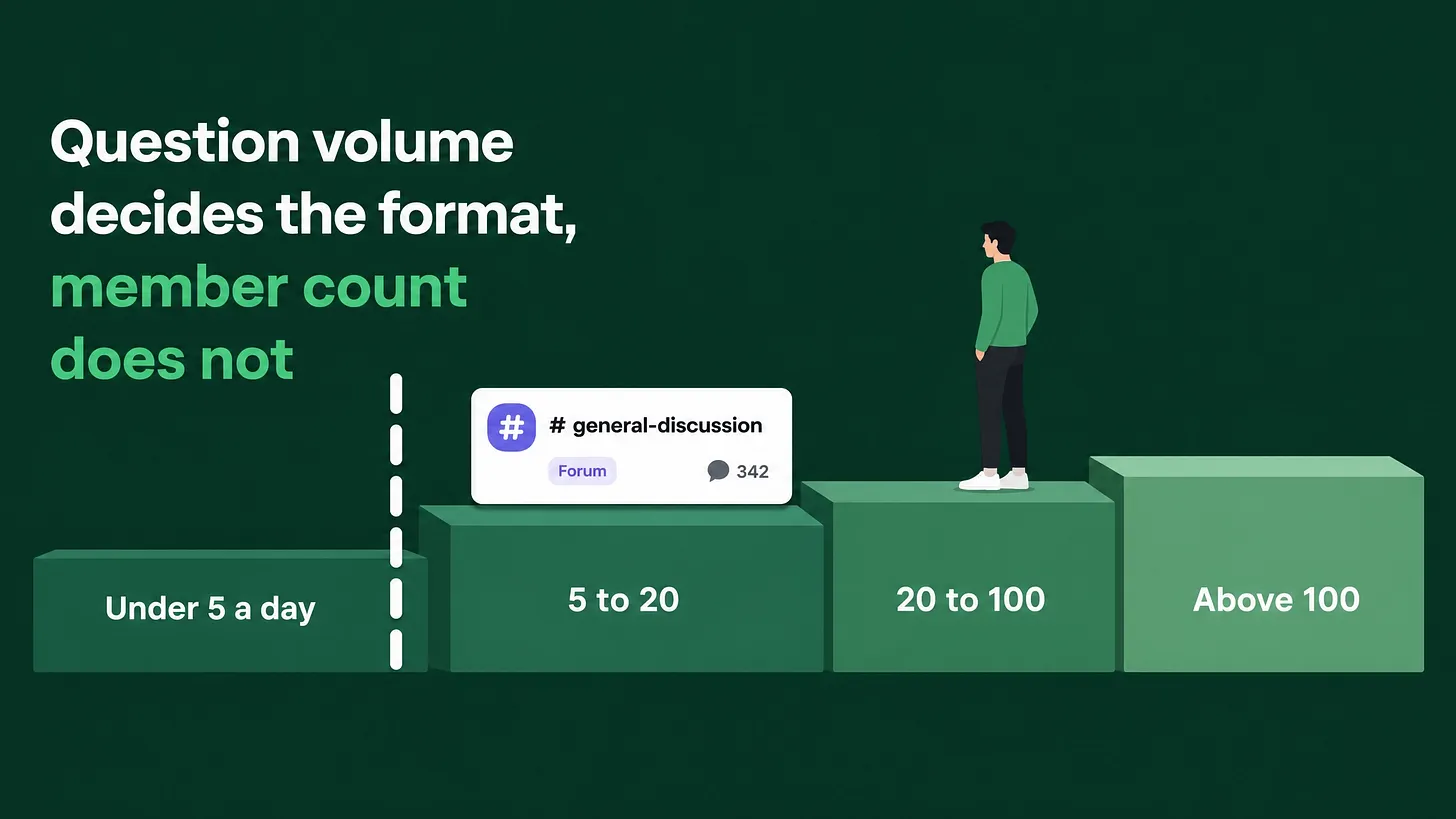
The thresholds are set by how many questions arrive each day, not by how many members you have, and every tier changes what the format demands from your team.

| Convert a help channel to a forum when it takes about five questions a day and somebody can read it every morning. Below that, a forum broadcasts your silence. Above twenty a day, triage becomes a named job and answers must be marked. Never convert a social channel, and seed ten answered posts before you open the doors. |
|---|
The switch point is five questions a day
Use forum channels in Discord when your help channel receives roughly five questions a day and you have somebody who reads it each morning. Below that volume, keep one text channel. Above it, questions begin burying each other and the format is costing you answers. Member count is the wrong trigger and it is the one most teams use. A room of eight thousand quiet observers produces fewer questions than a room of four hundred developers mid-integration. Count the questions for one week and decide from that number.
Why forums punish quiet rooms
A forum changes what failure looks like, and this is the part that catches teams by surprise. In a text channel, an unanswered question disappears upward within the hour. The person who asked notices, and nobody else does. In a forum, that same question sits at the top of a list with a reply count of zero beside it, visible to every person who arrives for as long as it stays unanswered.
A forum is a public record of how your team responds. Open one before you can staff it and you have published a record you would rather not have.
This is also the strongest argument in favour of forums once you are ready. Visible response times create pressure that improves them, and a well tended forum reads to a new developer as evidence that questions get answered here.
Under five a day: one text channel
At this volume, a single help channel outperforms a forum on every dimension that matters. Conversation is easier. A question and its answer sit next to each other, and bystanders learn from traffic they did not ask for. Casual replies are cheap, and cheap replies are what keep a small room feeling occupied. A forum here creates a room that looks like a shop with the lights off. Three posts from last month, two with no replies, and a prompt inviting a stranger to be the fourth. Almost nobody accepts that invitation. What to do instead: pin the recurring answers, keep the channel single purpose, and start counting questions so you know when the ground shifts.
Five to twenty a day: convert, with five tags
The symptom that tells you the moment has arrived is collision. Two people ask within a few minutes of each other, one gets answered, and the other quietly leaves. Convert the help channel into a forum. Keep it deliberately plain at this stage:
- Five tags at most. Name them for what the asker has, meaning product area or topic, rather than for internal team structure.
- One post template. Three fields, no more. What you tried, what happened, what you expected.
- One named person on morning triage. Their job is not to answer everything. It is to ensure no post is sitting at zero after a working day.
- General chat stays a text channel. Social conversation dies in a forum because it depends on speed and low stakes.
- What to do with the old channel after conversion Keep it, set it to read only, and rename it so the name says where questions go now. Deleting it destroys searchable history and confuses everyone who bookmarked it. A read only archive with a clear pointer in its description costs nothing and answers the migration question for months.
Twenty to a hundred a day: triage becomes a job
At this volume the forum stops being a channel and starts being a queue, which changes three things. Tags become navigation rather than decoration. Members now browse by tag before posting, so tag names have to match the words your members use, not the words your engineering team uses internally. Answer marking becomes mandatory. Without a resolved marker, your forum accumulates into an undifferentiated pile where nobody can tell a solved problem from an abandoned one. The marker also gives your triage owner a working queue: everything unmarked and older than a day. And triage becomes a rota with hours attached. One person each morning, a defined window, and a rule for what they do with a post they cannot answer, which is to route it to a named human rather than leaving a sympathetic reply.
Above a hundred a day: the forum is a support record
At this scale the forum functions as public support infrastructure and needs the governance that implies. Stale posts need closing on a schedule, or the front page becomes archaeology. Escalation needs a written route into whatever ticketing system your support organisation runs, including who copies what and when a public thread becomes a private ticket. Tag governance needs an owner, because tags multiply without one and a forum with twenty tags is a forum with no navigation. A second forum earns its existence only when a single tag consistently outgrows the rest and its audience is distinct. Splitting earlier fragments an audience that was working.
Tag design that survives contact
The most common forum failure after launch is a tag list that grew to eighteen entries and stopped meaning anything.
Good tag set (five, mutually exclusive, named for the asker's situation)
install-setupapi-usagebilling-accountbug-reportfeature-requestOne status tag, applied by staff only
answeredRules
- New tags require removing an existing one
- Tag names use the member's vocabulary, not the internal team name
- Never create a tag for something that occurs less than weekly The constraint that keeps this healthy is a fixed ceiling. Deciding in advance that the set holds at five forces the conversation about what actually matters, and it is much easier to hold that line at launch than to reclaim it later.
Two rules that hold at every size
Never convert a social channel to a forum, and never open a forum without naming the person who reads it every morning The first rule protects the part of your community that has nothing to do with support. Casual conversation depends on low friction and immediate visibility, and a forum removes both. The second rule protects your reputation, because an unstaffed forum is a published list of questions your team did not answer.
How to run the conversion in one afternoon
Seed first, announce second, archive third. Seeding means posting ten real questions with real answers before anybody else arrives, pulled from the history of your old channel. A forum with ten answered posts on day one teaches arrivals what a good post looks like and removes the cost of going first. Announce with a single message in the channel people already read, naming the new location, the tag set, and the person who watches it. Then set the old channel to read only with a pointer in its description. Watch it daily for two weeks. The tags you got wrong will announce themselves through misfiled posts, and fixing them in week one is cheap.
What to measure
Three numbers, none of them post volume. The share of posts that receive a reply inside your target window tells you whether the format is staffed. The share of posts marked answered tells you whether it is working as a record. And the repeat question rate, meaning how often the same question arrives despite an answered post existing, tells you whether the forum is findable, which is usually a tag and titling problem rather than a search problem.
Where this sits in the larger system
Choosing a channel format is one layer, and for a support-heavy developer community it is a layer with unusually high leverage. The system around it is what makes the format work: channel and role architecture that puts the right people in front of the right questions, onboarding that tells a new developer where to ask before they need to, support routing with a written escalation path into your ticketing tools, moderation coverage across the hours your members are awake, an engagement rhythm somebody owns, and reporting that connects response times to retention. A forum sitting on top of none of that is a well organised place to be ignored. Count your questions this week. If the number lands above five a day and you have somebody for the mornings, convert on Friday.
Formats do not create answers. They decide how visible it is when answers do not arrive. More on building rooms that hold at danieljeong.org.