When to Move Your Community From WhatsApp to Discord: The Four Signals
A decision rule for founders who are tired of platform debates and want to know whether their room has started to need staffing.

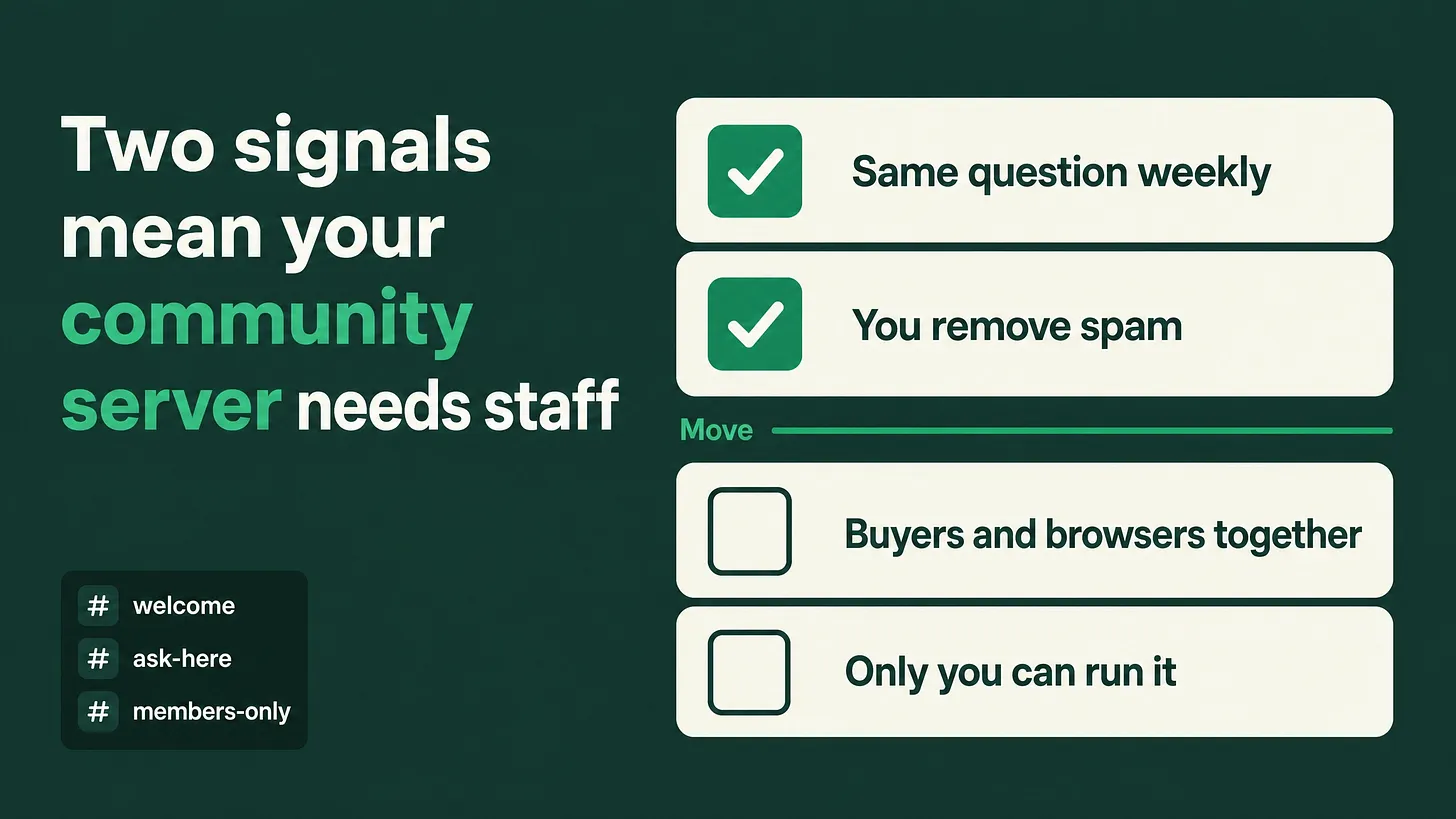
| Move your community from WhatsApp to Discord when two of four signals are true: the same question every week with nothing to point at, spam you remove by hand, one room shared by buyers and browsers, and no way to hand the room to anyone else. One signal is an annoyance. Two means the room needs staffing, and a group chat cannot be staffed. |
|---|
The four signals that decide it
Move your community from WhatsApp to Discord when two of the following four are true.
- You answer the same question more than twice a week and cannot point anyone to a written answer.
- You remove spam and bad actors with your own hands.
- Paying members, prospects, and staff sit in one room and read the same messages.
- Somebody other than you needs to be able to run the place. One signal is friction you can absorb for another quarter. Two signals mean the room has started to need staffing, and staffing is the thing a group chat cannot do. Four signals mean you have been paying for the delay for months without putting a name to the cost. The platform comparison that usually eats the decision is a distraction. Both tools carry messages perfectly well. Only one of them lets you divide a room, restrict a door, log a decision, and put a named person on duty.
Signal one: the same question, every week, with nothing to point at
A group chat has no memory that anybody can reach. The answer you typed in March is somewhere above four thousand messages about something else, and the person asking in September has no way to find it. So you answer it again. Count the repeats for one week. Write down every question you answer that you have answered before. Most founders running a busy chat land somewhere between four and a dozen, and every one of them is a small tax on the only person in the room who can collect it.
The cost of an unanswerable room is not the answering. It is that the only place your community knowledge exists is inside one person's day.
A server fixes this with something plain: a room where answers live, and a habit of updating it when the answer changes. pinned messages and a single reference channel handle more of this than most teams expect. The mechanism matters less than the fact that a link now exists.
Signal two: you are the moderation system
If you personally remove the scam links, you do not have moderation. You have a person who is awake. This is the signal that turns urgent fastest, because it scales with attention rather than with headcount. A group chat gives you almost nothing that runs on its own. A server gives you rules that check every message before a human sees it, an entry step that filters accounts that joined minutes ago, and a record of what was removed and by whom. The difference shows up at three in the morning. One setup waits for you. The other one does not.
Signal three: everyone reads everything
One room means one audience. The moment you have people who pay and people who are deciding whether to pay, one room stops being enough. You cannot run a members-only session without advertising it to people who are not members. You cannot ask your staff a blunt question about a member in front of that member. You cannot hold a quiet space for the people who bought, which is exactly where the next purchase usually starts.
| Signal | What it looks like on a Tuesday | What it actually costs |
|---|---|---|
| Same question weekly | You retype an answer you have given before | Founder hours, and nothing accumulates |
| Manual moderation | You delete a scam link yourself | Coverage stops when you sleep |
| One shared room | Members and prospects read the same message | No offer can be made to one group |
| No delegation | Nobody else knows the rules or the history | The room is a single point of failure |
Signal four: nobody else can run it
This is the signal founders notice last and feel hardest. Ask what would happen to the room if you took two weeks away from it. If the honest answer is that it would drift, or that somebody would have to ask you before removing a member, the room is not a system yet. Delegation needs three things a group chat cannot give you: permissions that limit what a helper can do, a written route for what happens when something goes wrong, and a visible record so you can review decisions after the fact rather than during them.
The threshold, and why it is two
One signal is worth solving inside the tool you already have. Pin a message. Ask a friend to watch the chat while you travel. Those patches work. Two signals interact, and that is the part people underestimate. A room with no memory and no delegation means every repeat question routes to you forever. A room with manual moderation and mixed audiences means your quiet paying members watch you fight spam in the only space they have. The second signal is where patching stops being cheaper than building. Below two signals, a move usually costs you more than it returns. The typical failure is a new server with thirty empty channels, and a community that walks into silence and quietly goes back to the chat they liked.
What to build before you move
Five things, and the whole set fits in one afternoon.
- Three rooms, and hold there. One for announcements, one for questions, one for the people who paid. You can always open more once you can see where conversation actually lands.
- One question at the door. A single entry step that asks what brought the person in and grants a role from the answer. This is the highest leverage thirty minutes in the entire build.
- One place where answers live. A reference room that you update when an answer changes, and that you can link to instead of retyping.
- A named owner for every room you open. Not a team. A person. An unowned room is a room nobody notices going quiet.
- A closing date on the old chat. Announced, dated, with the history exported first. The entry question is the piece worth writing down before you touch anything else, because it decides what you are able to offer later: Door question: "What brought you here today?"
| Option | Statement | Grants Role |
|---|---|---|
| A | "I am using the product" | member |
| B | "I am deciding whether to buy" | visitor |
| C | "I work here" | staff |
Each role sees a different first room. Nobody has to be told where to go.
How the move actually runs
Do not ask everybody to move at once. Move the reason to be there and let the people follow it. For the first two weeks, keep the old chat open but stop starting anything in it. Announcements, member sessions, and answers happen in the new rooms only, with a link each time. The old chat becomes a place where people find out what they are missing, which does more for migration than any amount of persuasion. At the end of the second week, close it. Announce the date twice before you do, export the history, and post a link to the archive so nobody feels robbed of two years of conversation. The people who matter to your business will move for one reason: the thing they came for now happens somewhere else. Expect a share of the room not to follow, and expect that share to be mostly people who never spoke. Judge the move on whether your active members arrived, not on the headcount you had before.
Where this sits in the larger system
Choosing the moment to move is one layer. It is the layer that makes the rest possible, and it is genuinely the whole job for a community under a few hundred people. The layers above it are what a full community build actually contains: role and channel architecture that survives ten times your current size, an onboarding sequence that runs past the first day, support routing with a defined escalation path, moderation coverage that holds through the night, an engagement rhythm somebody owns week to week, and reporting that tells the rest of the business what the room is producing. None of that can be built on a group chat, which is why the move comes first rather than last. Run the four signal check this week. If two are true, block an afternoon and open three rooms.
Every community reaches a point where good intentions stop being infrastructure. Recognising that point early is most of the skill. More on building rooms that hold at danieljeong.org.