What You Let Into the Room Becomes What Your Community Stands For
Reputation is built by repeated association, which makes access, role grants, and enforcement brand decisions rather than moderation chores.

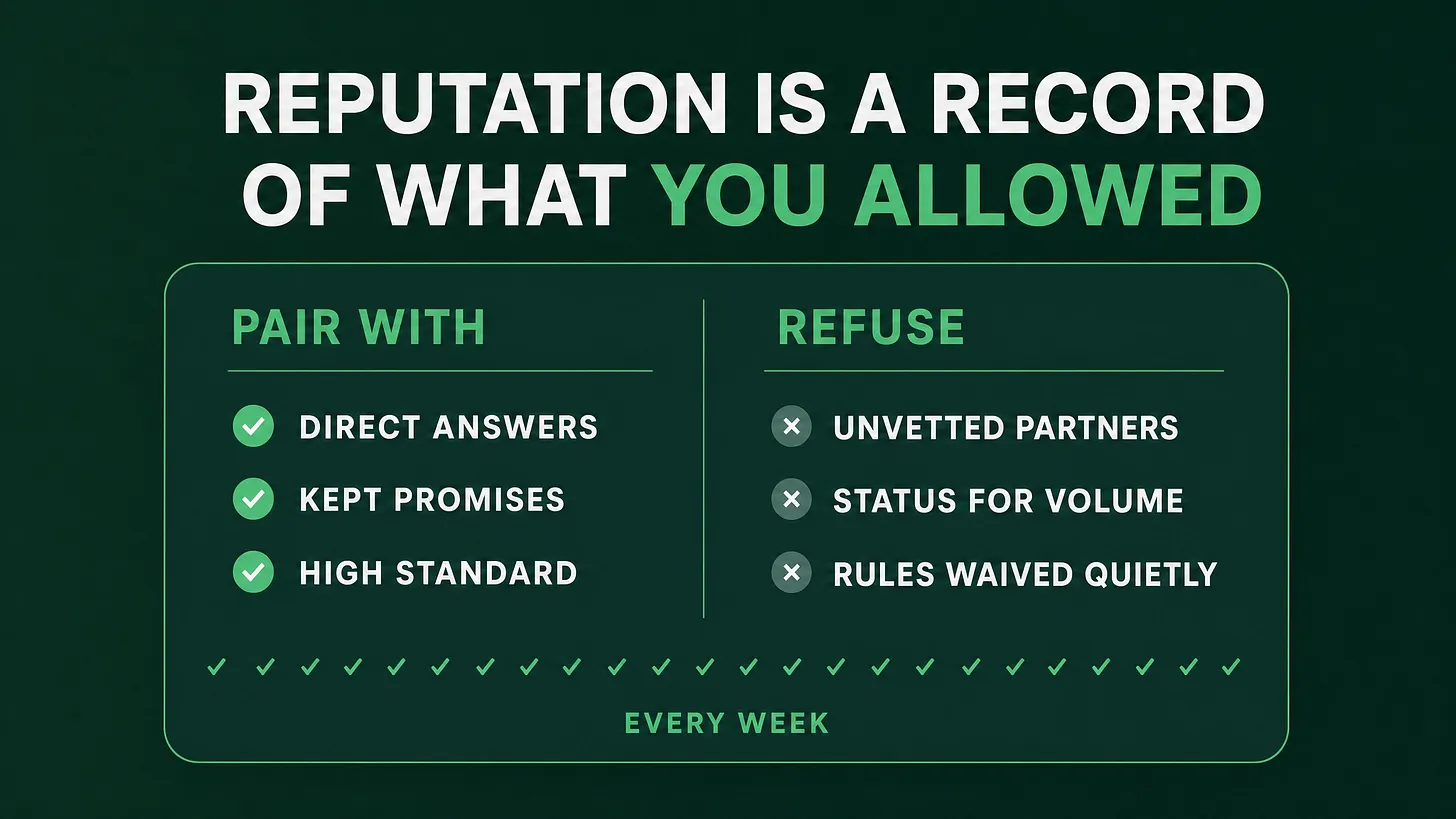
A community's reputation comes from repeated association, not from messaging. Four surfaces build it: partnerships, role grants, pins and recurring programming, and enforcement. Decide what you want to be paired with, name what you refuse, and write both into a standard someone else can apply without you.
The reputation you did not choose
Every community already has a reputation. Ask ten people in your space what your server is and each of them will hand you a phrase. The phrase will be specific. Whether it is the phrase you picked is the only open question. Most teams assume reputation follows messaging. They write the welcome copy, publish a mission statement in a rules channel, announce values at launch, and consider the identity settled. A year later members describe the place as something else, and nobody can name the week it changed. Reputation accumulates from what members repeatedly see inside the room. Members trust the pattern over the paragraph. They watch who gets welcomed, who gets elevated, what gets protected, and what gets ignored, then build a definition out of that evidence.
Association is built by repetition
Branding, reduced to its mechanism, is a pairing. Put one thing beside another often enough and an audience stops seeing two things. Consider how an athlete and a shoe brand fuse into a single idea in public memory. The pairing held because it was total. Every game, every night, not only the championship. The audience already felt something about the athlete, and repetition let the brand borrow that feeling. Break the consistency and the transfer never happens.
A pairing done once is a coincidence. A pairing done every week is a definition.
Communities conduct this effect unusually well, because members are not passively receiving a message. They are inside the room, talking to each other, comparing notes. In a feed, an inconsistency slides past unremarked. In a community, someone points at it in public and forty people read the thread.
The four surfaces where pairing happens
Four surfaces do the real work of association, and none of them are announcements. Each one fires whether or not anyone intended it. A community that has never held a single conversation about its brand is still producing one, one decision at a time.
| Surface | What members read from it | Why it carries weight |
|---|---|---|
| Partnerships and cross promotion | Who we consider acceptable company | Members meet the partner directly, inside the room |
| Roles and access grants | What earns status here | A private thank you is a public standard |
| Pins and recurring programming | What this place is actually for | Repetition outweighs any single announcement |
| Enforcement decisions | What we will tolerate | Anything left standing reads as endorsed |
Partnerships put someone else's reputation in your room
Every project you host, co-run an event with, cross promote, or hand a spotlight to arrives carrying its own reputation, and that reputation does not stay outside. Members are standing in the room when it walks in. This is the surface where the cost of a careless decision runs highest, because your members experience the partner directly rather than reading about the association secondhand. A team building the room where nobody gets burned can undo a quarter of careful work with one event alongside a project people already distrust.
Roles read as a standard, not a favor
A badge feels like recognition to the person receiving it and like a published standard to everyone watching. When a member who talks constantly and makes newer members hesitant to speak gets elevated, the room learns what earns status here. Volume earns status. Nobody announced that, and everybody now knows it.
Programming is the claim you are actually making
Whatever sits at the top of a channel and whatever happens on a predictable schedule is the operating claim about what matters. An announcement declaring the community a place for serious practitioners competes poorly against a weekly ritual that rewards jokes. The schedule wins, because the schedule repeats.
Enforcement is the surface most teams forget
Anything permitted to stand in a public channel becomes something the community now tolerates. A rule enforced on Monday and ignored on Friday does not read as inconsistency to members. It reads as the real rule finally showing itself.
The refusal list matters as much as the target list
Identifying what you want to be paired with is the easier half. The harder half is naming what you refuse. A community grows strong as much from what it stays away from as from what it moves toward. If the target association is trustworthiness, the refusal list has to include the partnerships, the spotlight slots, the role grants, and the tolerated behavior that would contradict it.
Contradiction outweighs confirmation. Every accepted pairing that cuts against the target does more damage than the matching good pairing does good, because members forgive a missing feature and remember a broken standard.
Access is a brand control, not a moderation chore
The practical consequence is that access decisions are brand decisions. Who gets into the room, who gets a role, who gets a spotlight, and what gets allowed to stand belong to the same category of choice as a partnership announcement or a press statement, and they happen far more often, usually without review, frequently by whoever is on shift. Most organizations already run partnership decisions through some kind of approval. Very few run role grants and enforcement calls through anything at all, even though those fire hundreds of times more often and shape the association just as directly.
Turn it into a standard someone else can apply
The fix is not more meetings. It is a written standard that lets a colleague make the same call you would make.
ASSOCIATION STANDARD
| Pair with | direct answers, kept operational promises, a high bar for contributions |
| Refuse | unvetted partners, status granted for volume, rules waived quietly |
| Exception | requires named owner approval, logged with a one line reason |
| Refusal script | "We keep partner slots to projects our members already trust. It is not about you, it is a standing rule. Happy to revisit later." |
That last line is the piece teams skip, and it is why standards collapse. A moderator holding a policy with no script will approve the borderline request at two in the morning rather than invent a refusal on the spot. Give them the sentence and they will hold the line. None of this requires new tooling. It requires deciding once, writing it down, and applying it the same way on a slow Tuesday as during a crisis.
Measure the association you already have
Before designing the association you want, it helps to measure the one you have, and the audit is uncomplicated. Read the last thirty role grants and ask what quality each one rewarded. Read the last month of pins and write down the theme they add up to. List every partner, guest, and spotlight from the last quarter and note what each is known for. Then ask a handful of members to describe the room in one sentence, without prompting them and without offering options. The gap between their sentences and your intended sentence is the size of the drift. Most teams discover the drift is not random. It points somewhere specific, usually toward whatever was easiest to say yes to.
Repairing a drifted reputation
Correcting a drifted association takes longer than creating one, and it does not respond to announcements. A post declaring a renewed focus is a single pairing competing against a year of accumulated ones, and it loses. The correction has to be a change in the pattern itself, held long enough that the new pattern outweighs the old one in members' memory. Practically, that means the next several partnership decisions, role grants, and enforcement calls all have to point the same direction, including the inconvenient ones. The first few will feel disproportionate. Declining a partner who brings real reach in order to protect an association is the kind of decision that only makes sense if you believe reputation is an asset, which is exactly what makes it a leadership decision rather than a moderation one.
Generic values pair with nothing
There is a version of this work that produces nothing, and it is worth naming so it can be avoided. A list of values that any community in your category could claim generates no association at all, because a pairing only transfers meaning when the thing being paired carries meaning. Trustworthy, welcoming, and helpful describe most rooms' intentions and distinguish none of them.
The associations that hold have an edge, usually the ones that imply a tradeoff. A room known for direct answers is implicitly a room where feelings get bruised sometimes. A room known for a high bar is implicitly a room where beginners work harder to belong. Naming the tradeoff makes the association legible, and legibility is what lets members repeat it to someone else.
That repetition is the point. An association that members can state in their own words travels without you, and it travels most reliably when it is specific enough to be worth mentioning.
What this looks like on a balance sheet
For leadership, the useful reframe is that a community's reputation behaves like an asset with a maintenance cost. It appreciates through consistent pairing and depreciates through contradiction, and the depreciation is not visible on any dashboard until members start describing the room in language nobody chose. Treating access, roles, and enforcement as the maintenance schedule for that asset puts the work in a category executives already know how to fund and review. Reputation is the accumulated record of what a community allowed. That record is being written right now, by decisions nobody logged, and it is readable by anyone who spends a week inside. The teams who end up with the reputation they wanted are the ones who treated every small permission as a line in that record.
A room is defined by what it lets in, over and over, long after anyone remembers the announcement. Choose the pattern and the reputation follows. danieljeong.org