What to Do When the Biggest Community About Your Product Is One You Do Not Own
Fan run groups keep companies out for a reason that is usually sound, and the decision about whether to push comes down to one question you can answer honestly in a minute.

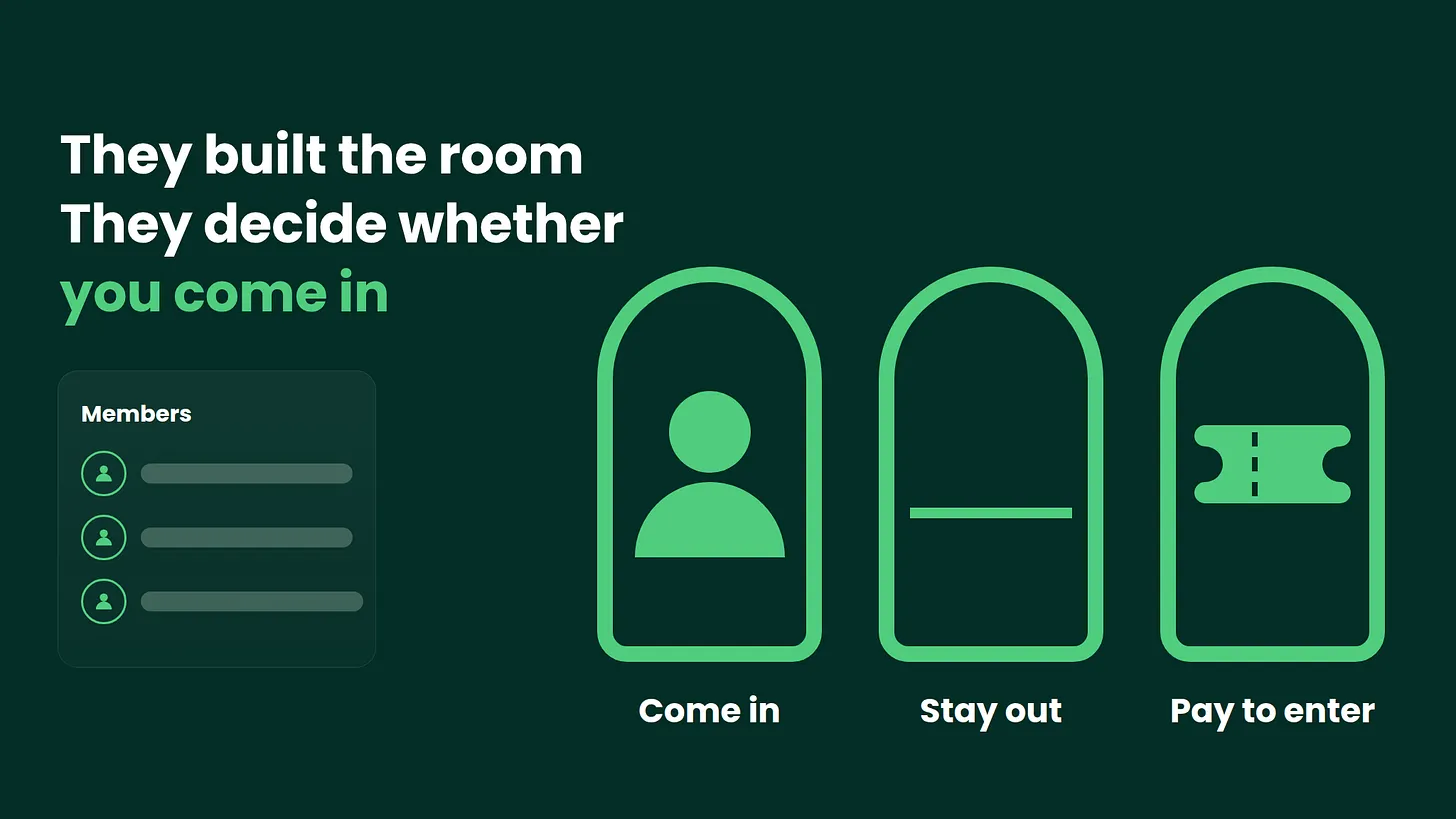
| When the biggest community about your product is one you do not own, ask the moderators once and prepare for three answers: an invitation, a refusal, or a price. Decide by whether your presence improves the room for the people already in it. If the honest answer is no, stay out and build your own room instead. |
|---|
The situation, stated plainly
Somewhere there is a group of your customers talking to each other about your product every day. It has more members than anything you run. You did not build it, you do not moderate it, and when you asked about having an official presence the moderators said they would rather you did not. That refusal is the part teams handle badly, usually by treating it as a problem to route around.
A fan group that keeps the company out is protecting exactly the thing that made it worth joining.
Members speak differently when they believe a company representative is reading. Not dishonestly, just more carefully. Complaints get softened, workarounds go unshared, and the frank comparison of your product against a competitor stops happening in public. The moderators know this, which is why they guard the door.
Ask anyway, once
The refusal is not a reason to skip the question. Ask once, per group, and be specific. Say who you are, what you would like to do, and what you would not do. Then ask directly what they allow. Three answers come back, and each one has a correct response.
Answer one: they invite you in
Take it, and settle the terms before you post anything. Write down what you will do and what you will not, and send it to the moderators so it exists in writing. A workable version looks like this:
- You answer questions. When someone asks something factual about the product, you reply.
- You do not announce. Launches, releases and promotions go in your own room unless the moderators specifically request them.
- You do not moderate. Not your room, not your threads, not your call what stays up.
- You do not redirect conversations. A discussion happening there stays there. That list reads restrictive and it is the entire reason the arrangement survives. The moderators took a risk letting you in and the fastest way to end it is to gradually expand what you do.
Answer two: they say no
Accept it the first time. Do not send a second request through someone else. Do not have a team member join quietly on a personal account to do the thing the company was refused. That is the move that converts a temporary no into a permanent one and usually into a warning passed between moderator teams of other groups. What you do instead is stay a member and read. Not as surveillance, as research. What people struggle with, what they have built workarounds for, what they recommend to newcomers. Route that into product decisions and into the documentation you control.
⚠️ A group that trusts you not to push is worth considerably more than a group that tolerates you pushing. The first one keeps telling the truth in front of you.
The refusal also tends to soften over time, but only for companies that respected it. A moderator team watching a company behave well for a year is a different audience than the one that answered the original message.
Answer three: they quote a price
Some large groups sell brand access. An arrangement is offered, a monthly figure is attached, and what you get is presence. Evaluate that as advertising, because that is what it is. It is not a community relationship, it is a placement, and it should clear the bar you hold every other placement to. The additional consideration is that members can usually tell. A brand presence that appeared without any history in the group, immediately running giveaways, reads as purchased, and purchased presence does not generate the trust that unpaid presence does. Sometimes the numbers still work. Often they do not.
The question that decides all three
One question, and it works for every group, every platform, every size. Does your presence make this space better for the members already in it, or only for you? Better for them looks concrete. Questions get answered faster because someone with access to the real answer is there. Wrong information gets corrected. Problems reach the company without anyone having to file a ticket. Only for you also looks concrete. Reach. A place to announce things. Members you can retarget. A number in a report. Most teams know which one applies before they finish reading the question. When the honest answer is only for you, stay out. You will get more from that group by being absent and useful, through product changes and better public documentation, than by being present and promotional.
Build the room you do own
The reason none of this has to be a loss is that a fan group and a company-run community do different jobs and neither substitutes for the other.
| The group they built | The room you build |
|---|---|
| Members talk to each other | Members talk to you |
| Frank comparison and criticism | Official answers and announcements |
| Their rules, their moderators | Your rules, your staff |
| You are a guest or absent | You are accountable for it |
The healthy arrangement between the two is a referral rather than a merger. When someone in the fan group needs an official answer, a moderator points them to your room. When someone in your room wants unfiltered opinion, they find the fan group on their own. The connection between the two is a moderator relationship, not a shared channel. That relationship is worth building even where you have no presence. A moderator who can reach someone at your company when something goes wrong is more valuable to both sides than an official account posting in their space.
Where this sits in the bigger picture
External community relationships are one layer of the operating system a community programme runs on, and this article covers that layer completely enough to act on without help. The layers around it are separate builds: onboarding and the first forty eight hours, response time, role and channel architecture, support routing, moderation load, escalation paths, documentation, automation coverage, engagement rhythm, and the reporting that tells leadership what changed this month. The room you own is where most of those layers live. The rooms you do not own are where you find out whether any of it is working.
What to do this week
List every space where your product is discussed and write the name of whoever runs each one beside it. Send one message to each moderator team you have never contacted. Then wait, and take whichever of the three answers arrives at face value. The strongest position a company can hold with a community it does not control is being the organisation those moderators would actually contact if something went wrong. That is not built by getting in. It is built by being easy to reach and not pushing. More at danieljeong.org.