What an AI Support Bot for a Discord Community Needs Before You Turn It On
A bot pointed at unowned documentation becomes a confident source of outdated answers, and members stop asking anything at all.

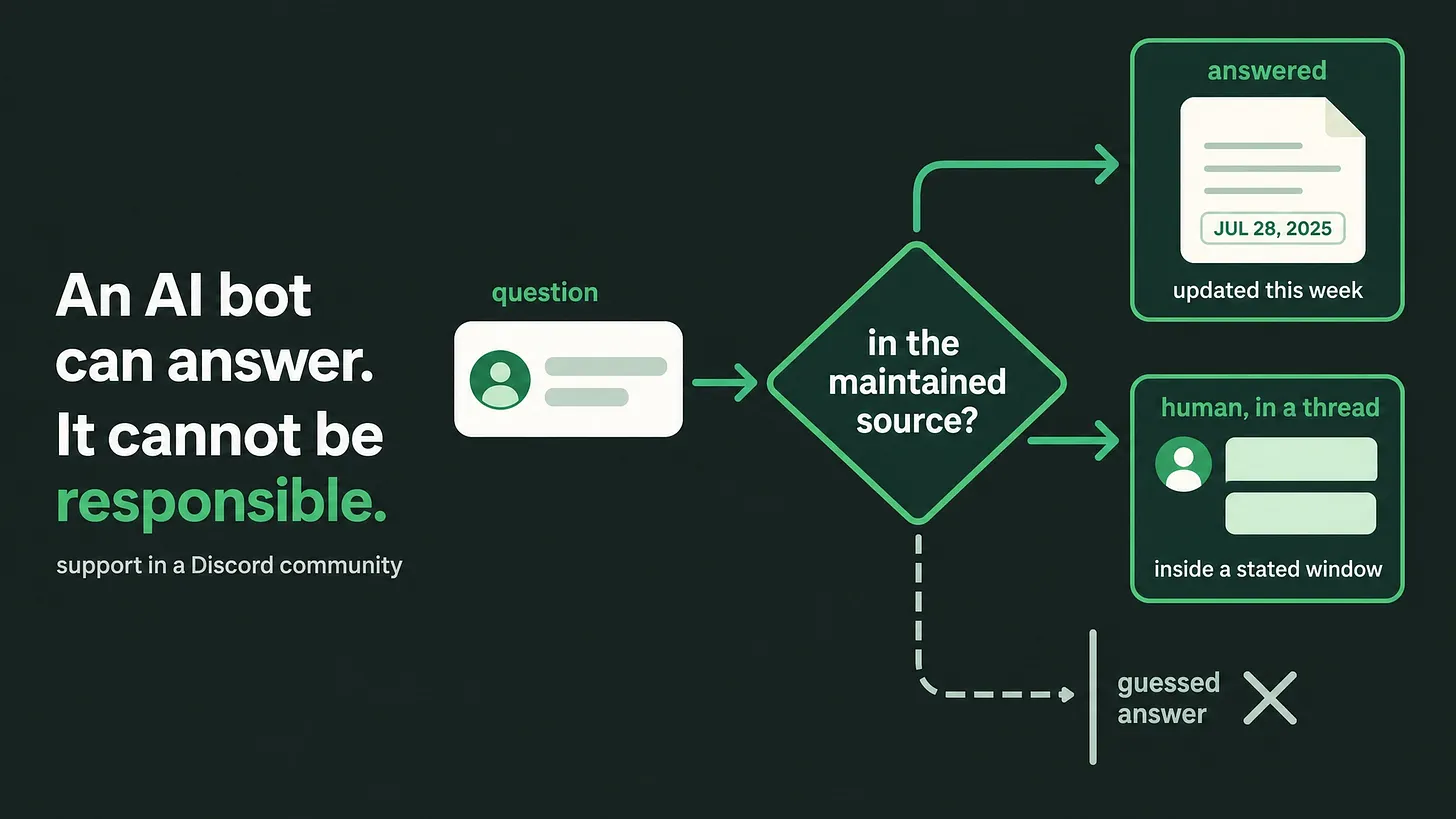
📌 An AI support bot for a Discord community is only as current as the source it reads. Before turning one on, name a single source of truth and restrict the bot to it, give that source an owner and a weekly refresh, write a handoff rule that opens a thread and pings a human when there is no answer, and log every unanswered question. Measure resolved and abandoned questions rather than deflection.
The practice worth arguing with
The common move looks sensible. Install an AI bot in the community, point it at the help centre and a few pinned messages, let it answer everything, and free up the team. I want to argue against that specific version, because I have watched what it turns into. The problem is not automation in support. Automation in support is the only way a small team covers a large community. The problem is deploying a confident answering machine on top of documentation that nobody has been asked to maintain.
What it looks like six weeks later
The bot is still fast. It is still polite. It is now quoting a price that changed, an endpoint that was deprecated, a program that closed and a limit that was raised. A member asks about something specific to their situation. The bot answers with the closest thing it can find, which is nearly right and functionally useless. The member replies that this did not work. Nothing happens, because no rule exists for that reply. The conversation ends there.
The expensive outcome is not the wrong answer. It is the member who stops asking.
That member had a question about your product. Now they have a conclusion about your company, and it is that you do not know how your own thing works. In a public channel, other members read that exchange too.
Where the fault actually sits
Models answer from what they are given. Given a stale corpus and no permission to refuse, a bot will produce the most plausible thing available. That behaviour is predictable and it is a setup decision, not a surprise. So the useful question is never which bot to install. It is whether your organisation can hold up the four commitments underneath it.
Four requirements before you switch it on
One named source of truth. Pick the single place your answers come from. A help centre, a docs site, a maintained internal page. The bot reads that and only that. Pinned messages from last year, old announcement channels and screenshots in general chat are not sources, and a bot indexing them will confidently repeat whatever a member said wrongly in a thread eight months ago. An owner and a weekly pass. Somebody by name is responsible for reconciling that source against what shipped, what got priced differently and which programs opened or closed. A short weekly pass is the whole job. Without it, decay is not a risk, it is a schedule. A written handoff rule. Decide in advance what happens when there is no answer in the source. The version that works: the bot says plainly that it does not have this, opens a thread, pings the responsible role, and the team answers inside a stated window. A dead end with no route to a person is the single most damaging configuration you can ship. A log of unanswered questions. Every question the bot could not answer goes to a list a human reads weekly. That list is the highest quality documentation backlog your team will ever be handed, because it is written by the people actually using the product.
If you can only commit to one of the four, choose the handoff rule. A slow human answer keeps a member. A confident wrong answer with no exit loses them quietly.
Questions a bot should never take
Scope is where teams get greedy. The bot is fast, so it gets pointed at everything, including the questions where being nearly right causes real damage.
| Question type | Who answers | Why |
|---|---|---|
| Documented product behaviour | Bot | Stable, written down, high volume |
| Account specific state | Human | The bot cannot see the account |
| Pricing exceptions and billing | Human | A wrong answer becomes a commitment |
| Program eligibility | Human or the program board | Dates and criteria change faster than any index |
| Anything a member is upset about | Human | Speed is not what is being asked for |
The deflection trap
Deflection is the metric that ruins community support. It counts a conversation that ended as a conversation that was resolved, and those are not the same event. Track two things instead. Resolved, meaning the member confirmed it worked or stopped needing help for a visible reason. Abandoned, meaning the thread went quiet after an answer nobody accepted. Read the abandoned list weekly with the same seriousness you read a churn report, because it usually is one. A third number is worth watching once the system runs: time from handoff to human reply. That single figure decides whether your handoff rule is real or decorative.
Say that it is a bot
Label the account clearly and let members know they are talking to software and how to reach a person. Members are not annoyed by bots. They are annoyed by discovering, three exchanges in, that nobody was ever going to help them. A visible team role in the member list does the other half of this work. When a member can see which accounts belong to staff, the bot becomes a first step rather than a wall.
What good looks like on a Tuesday
A member asks about a limit. The bot answers from a page that was checked four days ago and links the source. The member asks a follow up that depends on their plan. The bot says it cannot see account details, opens a thread and pings the support role. Someone replies within the window. The question and its resolution go into the log, and the docs page gets a new section on Friday. No part of that is impressive. All of it is repeatable, and repeatable is what a support system is.
Where this sits in the larger system
AI support is one layer of a community operating stack that also includes onboarding and the first forty eight hours, role and channel architecture, support routing and response time, moderation coverage, and the reporting rhythm that turns all of it into something an executive reads. This layer sits directly on top of support routing, which means a server where questions are already landing in the wrong channels will not be fixed by adding a bot. It will be automated. Get the routing and the source of truth right, then add the bot. In that order it removes real load. In the other order it manufactures a new kind of silence.
Automation carries load. It does not carry responsibility. Every automated answer still needs a person whose name is attached to it being true. More at danieljeong.org.