Three Questions Every Line in Your Community Playbook Has to Survive
How to tell a principle from a tactic, and why anything a moderator cannot act on during an incident is taking up space.

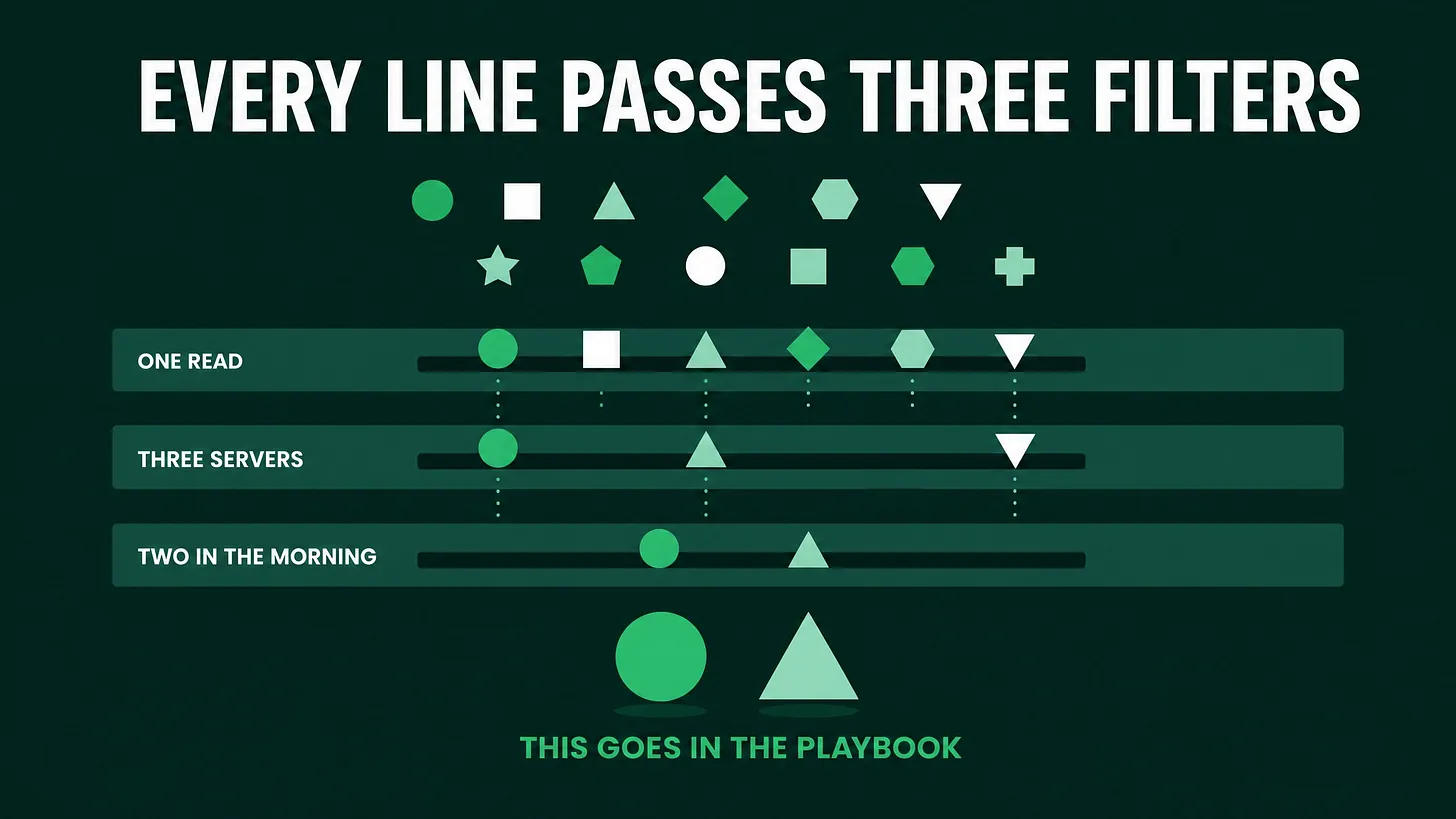
A line earns a place in a community playbook by passing three tests: a moderator understands it on the first read, it holds in at least three unrelated kinds of server, and someone can act on it during a live incident. Lines that fail the third test are decoration, and they make the useful lines harder to find.
The document everyone praised and nobody opened
Every community team eventually writes a playbook. Escalation steps, tone notes, server guidelines, a section on culture, a philosophy of moderation. It gets shared in a private channel, the team says it looks great, and then a raid starts at two in the morning and nobody opens it. The cause is rarely laziness. The document was written for the wrong reader. Playbooks get drafted for an imagined audience of peers, people who will appreciate the thinking. The actual reader is a moderator with thirty seconds and a decision to make, and that reader needs something else entirely. Three questions separate what belongs in that document from what belongs in a blog post.
The reader you are actually writing for
Picture the moment a playbook gets used. Something is going wrong. Someone is posting links faster than anyone can delete them, or a long-standing member is arguing with a newer one in a public channel and the temperature is climbing, or a request has arrived that nobody has authority to answer. The person reading has partial information, no time, and an audience watching them decide. Every line in the document either helps in that moment or occupies space a helpful line could have used. Once you accept that reader, most of what feels worth writing stops qualifying.
Filter one: does it land on the first read
Simple means a moderator understands a line once, without a follow-up. That is measurable, and the measurement is uncomfortable. Send the line to someone on the team and watch whether they ask a clarifying question. If they do, the line is not written yet, because the follow-up you would have sent is the real instruction and the document is holding a summary of it. Complexity hides in a few reliable places. Terms the writer defined in their own head and never on the page. Conditions stacked into one sentence. Guidance that describes a desired outcome without naming the action that produces it. Politeness that softens an instruction into a suggestion, leaving a moderator unsure whether they are permitted to act or expected to. The difference is easy to see side by side. BEFORE
"Moderators should aim to de-escalate conflict in public channels wherever possible, using judgment about tone and community context."
AFTER
"Two members arguing in a public channel: reply once with a short redirect. If either replies to you instead of each other, move it to a thread. If it continues in the thread, time out both for one hour and post the reason. You do not need approval for any of this."
A useful discipline is to read every line as though you are tired and slightly panicked. Anything that needs a second pass gets rewritten.
Filter two: does it hold in three different servers
The second question sorts principles from tactics, and it is the one most documents skip entirely. Check whether a line holds true in at least three genuinely different communities. Not three servers in the same category. A gaming community, a product support community, a trading community, a brand community. Holding across all of them makes it a principle. Surviving in only one makes it a tactic. Two lines make the difference concrete. Pin a poll in general at two on Tuesday afternoon. That works in exactly one kind of server, with one audience, in one timezone, on one rhythm. Move it anywhere else and it stops meaning anything.
Engagement is a member spending attention they could have spent somewhere else.
That holds in a gaming server and in a support server. It holds in a trading community and in a brand community. It holds at forty members and at a million. Nothing in the definition depends on category or size, which is exactly what makes it a principle.
| Line | Where it holds | Verdict |
|---|---|---|
| Pin a poll in general at two on Tuesday afternoon | One audience, one timezone, one rhythm | Tactic |
| Engagement is attention a member could have spent elsewhere | Any category, any size, any stage | Principle |
The distinction carries weight because principles and tactics have different shelf lives and different authority. A principle tells a moderator how to think when the document does not cover the situation in front of them, which describes most situations. A tactic tells them what to do in one situation that may no longer exist.
Principles and tactics both belong, labeled differently
None of this argues for deleting tactics. Specific instructions are often what a new moderator needs most, and a well-chosen tactic saves real time in the first week.
The failure is leaving them unlabeled. An unlabeled tactic gets treated as a rule, and a year later a team is still running a Tuesday poll nobody attends because the document says to and nobody remembers why. When the tactic stops working, a moderator with no principle behind it either improvises or freezes.
Two clearly marked sections handle this. Principles, which explain how to think. Practices, which are current and expected to change. Date the practices and review them on a schedule.
Filter three: will anyone act on it
The first two questions produce material that sounds intelligent. The third question is where most of that material dies. Ego writes a great deal of playbook content. There is real pleasure in articulating something subtle about community, and a line that captures a genuine truth feels like it has earned a place. Then you sit with the moderation team and ask what someone does with that line during an incident, and the answer is nothing. They read it, they agree with it, and they take no different action because of it. When no behavior changes, the line is decoration. Correct decoration, occasionally insightful decoration, still decoration.
The two in the morning standard
The sharpest version of the third question is what a moderator does with this at two in the morning while the server is being raided.
At two in the morning there is no client to impress and no peer reading over anyone's shoulder. There is a person, a problem, and a document.
That framing works because it removes the audience. Whatever survives the scenario is operational. Whatever does not survive it belongs somewhere else, and there are good places for it, including a blog post, a client deck, or a training session. The mistake is letting both categories share one document.
One principle replaces a dozen tactics
There is a compression effect worth understanding, because it explains why the second question is worth the trouble. Hold the definition of engagement as attention a member could have spent elsewhere, and a whole category of decisions resolves without further instruction. Whether to run an event at a time when most members are asleep answers itself. Whether a channel that generates activity while costing members nothing to skim is actually working answers itself. Whether a giveaway that pulls attention from people who were never going to stay counts as a win answers itself. None of those situations need their own line in a document, because the principle covers all of them. Tactics do not compress. Each one covers a single case, so a playbook built mostly from tactics grows until nobody can hold it, then gets ignored for being long. That is the quiet reason long playbooks fail. Length is the symptom. Missing principles are the cause.
The trap that catches capable teams
Content that sounds impressive in a meeting and content that works during an incident are produced by different instincts, and the first instinct is stronger. Explaining community dynamics well to a stakeholder is a genuine skill, and material built for that purpose belongs in the deck where it was needed. Moving it into the operational document feels like consolidation and functions as dilution. The tell is easy to check. Read a line and ask who it was written to satisfy. Some lines exist to help a moderator decide. Others exist to demonstrate that the author understands community, and those are the ones that survive every review because nobody wants to argue with something true. Truth is not the standard. Usability is. A line can be entirely accurate and still have no business in a document meant to be read under pressure.
Auditing a playbook you already have
Running this on an existing document takes an afternoon. Read it aloud with the moderation team, line by line, and stop after each one.
- Did anyone need a follow-up to understand it, and if so, rewrite it using the answer you gave.
- Would it hold in a community with nothing in common with this one, which decides whether it is a principle or a practice.
- What does a moderator do differently because it exists, and if the answer is nothing, cut it. Mark every line as principle, practice, or cut, and resist the urge to preserve something because it took effort to write. Most teams cut more than they expect, and the remainder gets used for the first time.
What a shorter document changes
A shorter playbook is not merely tidier. It changes behavior, because moderators read short documents and skim long ones. Every line that survives the test increases the odds that the next line gets read too, and a document people actually finish is the only kind that influences a decision under pressure.
The cost arrives at handover
There is a second benefit that shows up later. Handover is where an unusable playbook becomes expensive. A new moderator inherits the document without the reasoning that produced it, and every decorative line becomes something they have to interpret while still learning the room. Principles transfer cleanly because they explain how to think. Decoration transfers as confusion.
Why this is an operating risk
For a leadership audience, the relevant point is that playbook quality is an operational risk rather than a documentation preference. A community running on a document nobody uses is running on whoever happens to be awake, which means response quality varies by shift and nobody can predict it. Applying these three questions turns the document into something a team can be held to, and that is the difference between a policy and a hope. Write for the moderator at two in the morning. Everything else in the document is there for someone else's benefit.
The best operational writing disappears into the decision it produced. Nobody compliments it, and it works anyway. danieljeong.org