The Trading Community Generating Six Hundred Thousand Dollars a Year Did Not Get There by Accident
What membership revenue in a financial Discord community actually depends on

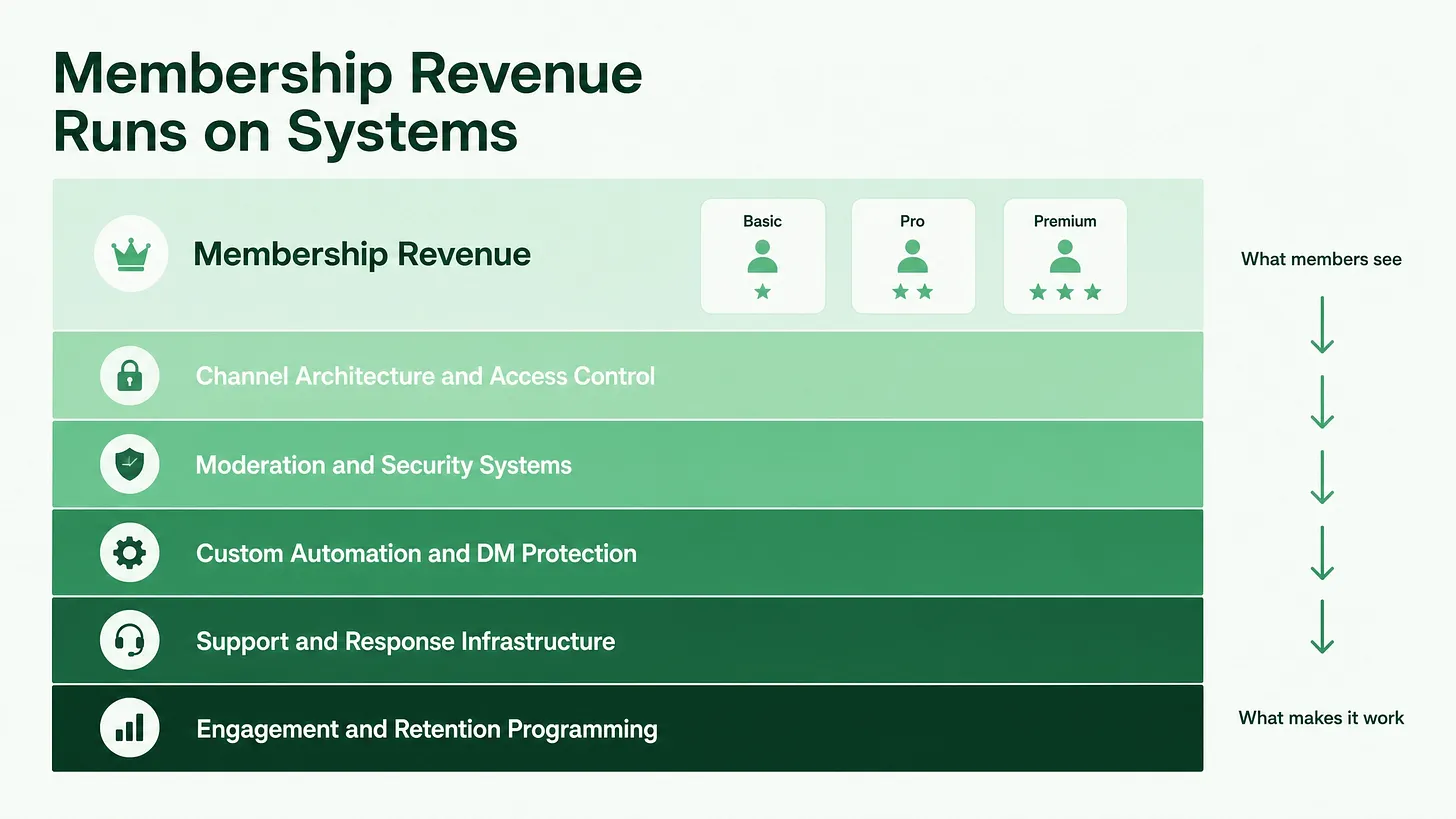
The Visible Part Is Not the Hard Part
When people look at a Discord community generating significant recurring membership revenue, they tend to study the visible elements. The channel names. The tier structure. The content the server owner posts. The quality of the educational material. Those elements matter. But they are not what sustains the revenue. A trading community generating fifty thousand dollars a month in membership fees is operating at that level because of what is underneath the content layer. The infrastructure running behind the experience is what makes it possible for the content layer to be perceived as worth paying for. This distinction is not abstract. It has direct operational implications for any server owner who wants to build a community with real recurring revenue, particularly in any niche where members are paying to access information, expertise, or a network with financial implications.
Why Financial Communities Carry a Higher Operational Burden
Every Discord community requires operational infrastructure. Financial communities require more of it than most others. The reason is stakes. In a general interest community, a bad moderation decision or a slow support response creates mild friction. Members are annoyed, maybe temporarily disengaged. In a financial community, the same failure can cause meaningful harm. A scam that reaches paying members who are making real financial decisions damages trust in a way that is difficult to repair. A question about a trade or an investment that goes unanswered because the support system is understaffed can translate into a direct negative experience for someone with real money involved. The moderation standard for a financial Discord must be meaningfully higher than for other server types. DM security is not optional. The most common fraud patterns in financial communities involve bad actors who join legitimately, gain some social proof within the community, and then begin reaching out to members directly through DMs to run schemes. Blocking DMs at the server level, setting up word filters that catch common manipulation language, and running automated moderation that identifies suspicious behavior patterns are baseline requirements, not advanced features. Beyond security, the support infrastructure has to be responsive. Members paying monthly for access to a financial community have an implicit expectation that their questions will receive timely, accurate answers. If the support channel sits with unanswered questions for hours, the perceived value of the membership drops. If it happens repeatedly, members cancel.
Channel Architecture as Revenue Infrastructure
The way a financial Discord is structured at the channel level is not a design decision. It is a revenue decision. Members paying for premium access need to immediately understand what they are getting and where to find it. If the channel structure is confusing or disorganized, the first impression is that the community is poorly managed. That impression affects retention even if the content quality is high. A well-architected financial server typically separates content by function and by member tier. Free or lower-tier members have access to a limited set of channels that demonstrate the quality of the content and community without giving away the full experience. Higher-tier members have access to deeper resources, more direct communication with the server team, and content that is explicitly tied to the premium value proposition. This architecture requires deliberate planning. Which channels belong to which tier. What the natural upgrade path looks like from a member's perspective. How the tier structure communicates value without making lower-tier members feel excluded. These are operational decisions with direct revenue implications.
Custom Automation in a Financial Context
Financial Discord communities benefit from automation more than most other niches, and also require more careful implementation of that automation. The automation use cases are extensive: role assignment upon verification, access grants tied to payment confirmation from the membership platform, automated alerts when content is posted to specific channels, DM blocking for new members during a quarantine period, and moderation triggers for flagged language. The careful implementation piece is important because automation in a financial community can create compliance-adjacent concerns if not configured properly. Automated messages that could be interpreted as financial advice, for example, need to be written and reviewed carefully. The distinction between educational content and actionable financial guidance matters in a community where members are making financial decisions based in part on what they read. The server owner and the team managing the community need to have a clear understanding of where those lines are and how the automation supports the community without creating exposure.
What Testimonials and Social Proof Do Operationally
One of the consistent patterns in high-revenue Discord communities is a structured approach to member testimonials and visible success stories. This is not marketing instinct. It is operational infrastructure. In a financial community, social proof serves a specific retention function. Members who are considering whether to renew their membership are more likely to stay when they can see recent evidence that other members are achieving results. A steady cadence of testimonials, wins posted by members, and community-recognized milestones creates an ambient environment of demonstrated value. Running this as a system requires someone responsible for curating and posting that content consistently. Not occasionally. The communities doing it well post member wins on a regular cadence, with a consistent format and placement that members come to expect. This is another layer of the operational infrastructure that makes the revenue sustainable. Members are not just paying for access to information. They are paying to be in an environment where outcomes are visible and celebrated. That environment requires active management to maintain.
Why You Cannot Template This
Every financial Discord community operates in a different niche with different regulatory context, different member demographics, and different content type. A cryptocurrency trading community has different operational requirements than a stock trading community. A community focused on options strategies has different moderation considerations than one focused on general investment education. Attempting to apply a standard template to a financial Discord community produces a server that works adequately for none of these contexts. The channel architecture needs to reflect the actual information hierarchy of that niche. The moderation setup needs to address the specific fraud patterns that are common in that space. The support infrastructure needs to anticipate the actual questions members will ask. Custom builds take longer. They require more discovery work upfront. They result in a community that actually works for the specific audience it is serving rather than a generic structure that was installed and left to operate without ongoing adjustment. The communities generating real recurring revenue from Discord membership are operating custom-built infrastructure tuned to their specific context. That is not a coincidence. It is a design principle.
The Operational Reality of Maintaining It
Building the infrastructure is one phase of the work. Maintaining it is another. A financial Discord community that is running properly is not a set-and-forget system. It requires ongoing moderation, regular review of the channel structure as the community grows and the content library expands, periodic audits of the automation to ensure it is still functioning as intended, and active management of the member experience. The server owner's role in a well-run financial community is strategic. They set the direction, define the tier structure, create the educational content, and make the high-level decisions. The operational infrastructure underneath that runs the community day to day without requiring the owner's direct involvement in every interaction. That separation between strategic leadership and operational execution is what allows these communities to scale. The owner is not answering every support question. They are not managing every moderation escalation. They are running a business where the community infrastructure handles the operational layer so they can focus on the product. Getting to that separation requires building the infrastructure first.
Daniel Jeong is a Discord community infrastructure consultant working with financial communities, SaaS products, and high-growth technology teams that need Discord to function as operational business infrastructure. danieljeong.org