The Speed of Your First Reply Is a System, Not a Personality Trait
Why response time belongs in your community architecture, not in your notes about who works hard.

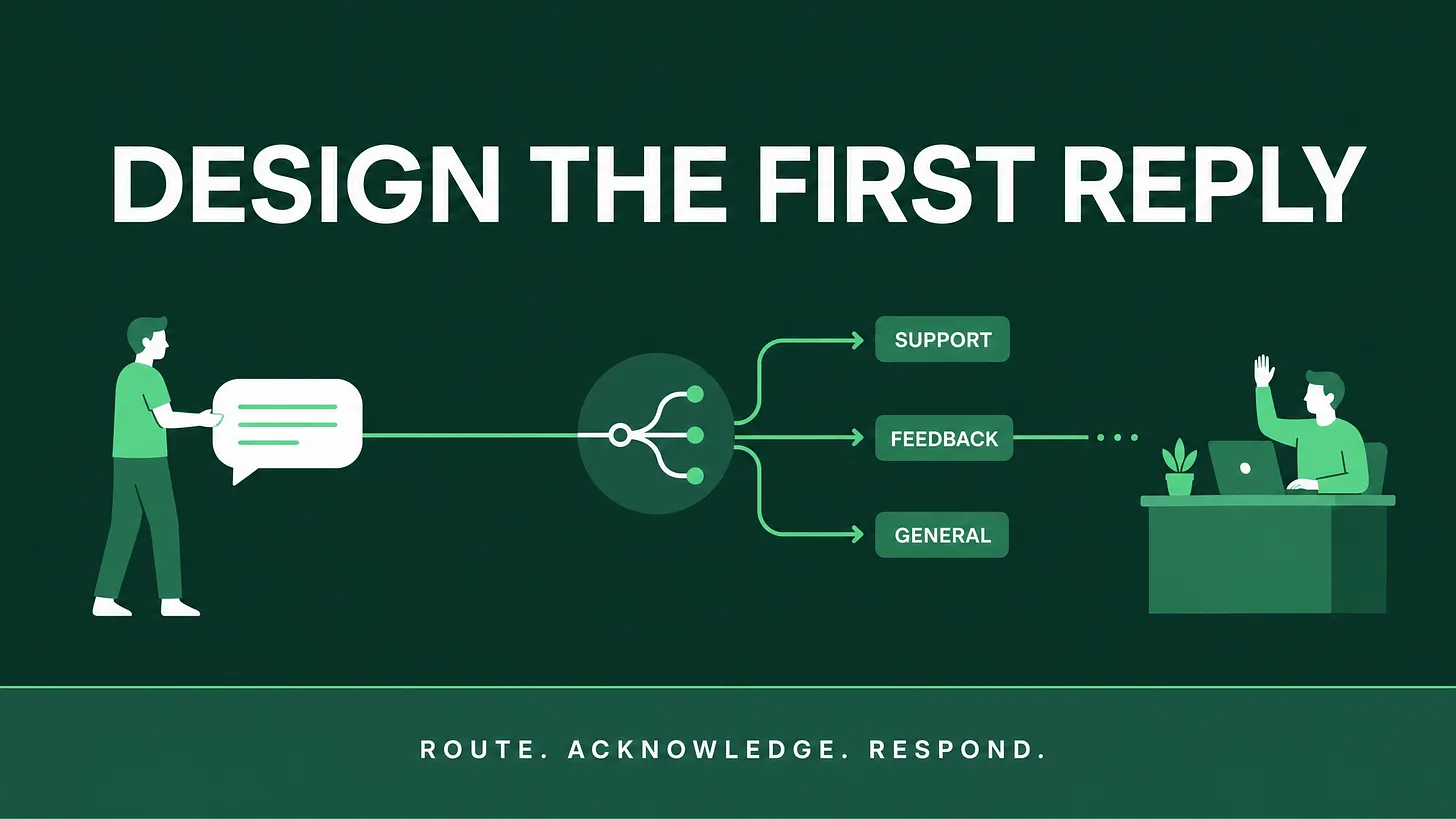
Communities rarely lose members because a team is careless. They lose members because nobody designed where questions go or how quickly the first reply should arrive. Response speed is infrastructure. Route each request to an owner, set an internal standard for the first reply, automate the acknowledgment, and keep humans on the real conversation.
The quiet moment that decides everything
There is a small moment that repeats thousands of times inside every healthy community, and almost nobody measures it. Someone types a question, pauses, and presses enter. For the next few minutes they watch the screen. What happens in that window teaches them how this place actually works. If a reply lands, even a short one, they learn that showing up here pays off. If nothing comes back, they learn the opposite lesson just as fast. Most people run that test exactly once. They do not post a goodbye. They stop opening the app, and the room goes quiet in a way no report flags on the day it begins. That moment is where retention is won or lost. Not in the welcome message, not in the rules channel, not in the fifteen carefully named categories. In the gap between a question and the first human response.
Speed is an output, not a virtue
We talk about fast responders as if speed were a fixed trait. Some people are just on top of things, we say, and some people are not. So we praise the attentive ones and quietly hope the rest catch up. That framing is comfortable and wrong. It hides the real variable. When one person answers in two minutes and another takes six hours, the difference is rarely effort. It is clarity. The fast responder usually knew the message was theirs to handle. The slow one was never sure it was.
When everyone owns the reply, no one does.
A community where speed depends on who happens to be looking is a community running on luck. Luck does not scale, and it does not survive a vacation.
Trace one question through your server
Watch a single real question move through your space and the gaps show themselves. A member drops it in #general because that is the first channel they see. Three people glance at it. One assumes a teammate has it. Another is not sure of the answer and stays silent rather than guess. The third never saw it because the channel moves too fast. The question scrolls away. The member does not forget.
Nothing here was caused by a bad team. It was caused by a missing design. There was no rule for where that message should have gone, no name attached to it, and no shared sense of how quickly the first reply should arrive.
The cost of the gap, in slow motion
The damage from slow first replies does not arrive as one dramatic event. It arrives as a drift you only notice once it is expensive. A member who felt ignored does not file a complaint. They lower their expectations, post a little less, and eventually treat your community as a place they used to check. Multiply that by every quiet exit and you get a server that looks populated on the member count and feels empty in the channels. This is why response speed is so easy to underrate. The wins are invisible and the losses are delayed. A reply that lands in two minutes never feels like a save, because you never meet the version of that member who would have drifted away. The absence of churn is hard to celebrate. It is still the whole game.
Build the routing layer
The first fix is to stop treating your community as one undifferentiated inbox. Different requests need different homes, and every home needs an owner.
Separate the streams. Support questions do not belong in the same place as product feedback, and neither belongs in casual conversation. A dedicated #support space with a clear owner will always beat a busy #general where responsibility dissolves into the crowd.
Give each stream a name and a person, not a committee. When a specific human knows that a specific channel is theirs, reply time drops without anyone working harder. You did not add effort. You removed ambiguity.
Here is the shift in plain terms:
BEFORE
All questions →
#general→ "someone will get it" → often no one AFTER Support question →#support→ Owner A → acknowledged, then resolved Product feedback →#feedback→ Owner B → logged, then routed Everything else →#lounge→ community → social, no target needed
Set a standard the team can see
Speed becomes real only when it is written down. Not as a promise to members, but as an internal target the team measures itself against. The goal is not to publish a service guarantee. It is to give your team a number, so that fast stops being a mood and starts being a job. A tiered standard beats one blanket rule, because not every message deserves the same urgency.
| Request type | First response target | Owner |
|---|---|---|
| Support or access issue | Within the first hour of the workday | Support owner |
| Product feedback or bug | Same day acknowledgment | Product liaison |
| General conversation | No target, human pace | Whole community |
The word that carries that table is acknowledgment. A first response is not a full solution. It is a signal that a human saw the message and owns it now. That signal is what the member is actually waiting for.
Automate the acknowledgment, never the relationship
This is where teams tend to overcorrect. They feel the speed problem, reach for a bot, and let automation answer everything. The result feels worse than silence, because now the member is being ignored by something that pretends to listen. Draw the line clearly. Automation should carry the acknowledgment. Humans should carry the conversation. An automated first touch can confirm a message was received, point to the right resource, and set an expectation for when a person will follow up. That removes the silence. What it must never do is stand in for the human relationship that keeps someone around. Use automation for the repetitive load: routing, first acknowledgment, simple answers, reminders. Keep people on anything that involves judgment, trust, or a real problem. The test is simple. If a member would feel dismissed by the automated reply, it is doing a human's job, and it will cost you.
Why this is a leadership problem, not a staffing one
When response time slips, the instinct is to blame the person who was slow or to add another body to the team. Both miss the point. If speed depends on individual attentiveness, you have not built a system. You have hired a personality and crossed your fingers. Leaders own the design. That means deciding where each type of request lives, assigning a clear owner to each, writing down the internal standard, and choosing where automation ends and humans begin. Do that once and the team stops guessing. New members get a consistent experience whether they arrive on a Tuesday morning or a Saturday night. The quality of the community stops riding on who happened to be awake.
What it looks like when it works
A healthy response system is almost invisible. A member posts, and within moments something lets them know they were heard. A named person picks it up. The conversation happens at human pace, but it never starts with a void. Over weeks, the effect compounds. People post more because posting reliably leads somewhere. The community feels alive because it responds, and responsiveness reads as care. None of that depends on any single person being online, which means it holds when your best responder logs off. That is the real goal. Not instant replies. A community where no one ever has to wonder whether they were heard.
The test to run this week
Pick one recent question in your busiest channel and trace it. When was it posted, who was responsible for it, and how long until the first human reply. If you cannot answer the middle question, that is your leak. Not the speed itself, the missing owner behind it. Fix the ownership and the routing, and speed stops being something you hope for from good people. It becomes something your community produces on purpose.
Response time is not a talent you hire for. It is a system you build, and once it is built it protects every conversation that comes after. danieljeong.org