The Reason Every Discord Server I Build Starts from Scratch
Why a template-based approach to Discord setup produces communities that never quite fit their actual purpose

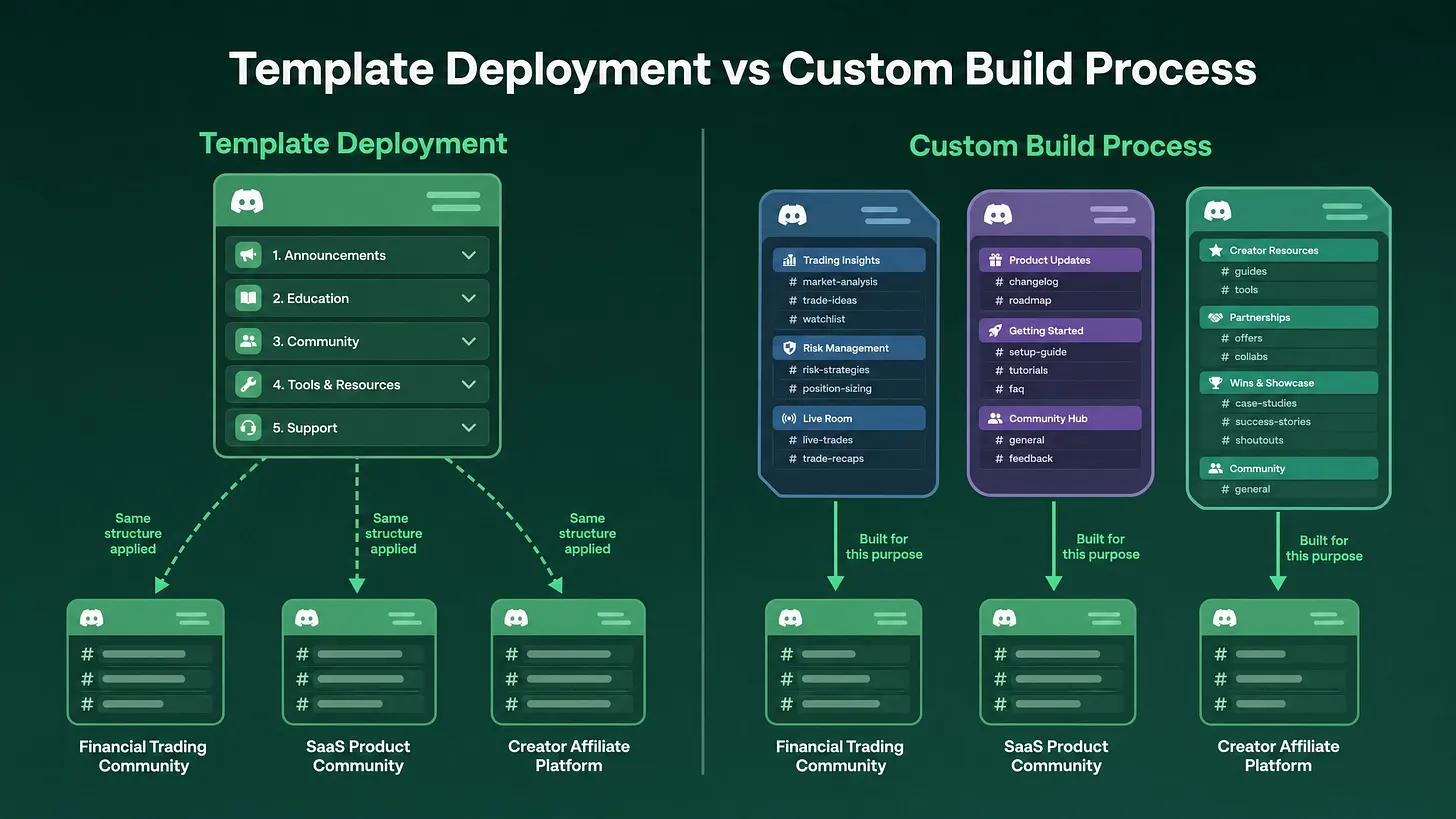
What a Template Gets Wrong Before You Launch
A Discord template is a structural decision made in the absence of information. The category names, channel hierarchy, and default settings in a template were chosen to be applicable to a broad range of server types. That breadth is the feature being sold. It is also the problem. A financial trading community has moderation requirements that are specific to financial communities. DM blocking, word filters for manipulation language, rapid escalation protocols for fraud attempts, verification flows tied to membership platform confirmation. A SaaS product community has different requirements: structured onboarding tied to the product's own user journey, channel architecture that mirrors the support and education structure of the product itself, engagement programming tied to product milestones rather than community milestones. A template cannot hold both of these simultaneously. It can hold a version of both that is accurate for neither. The communities that are deployed from templates and adjusted afterward spend months correcting structural decisions that should have been made correctly from the start. The adjustment process is disruptive because the server already has members. Restructuring channels, changing onboarding flows, and updating moderation settings on a live server requires communicating changes to existing members, managing confusion during the transition, and accepting that some members will disengage during the disruption. Building correctly from the beginning avoids that entire cycle.
The Discovery Process Behind a Custom Build
A custom Discord build begins with a discovery conversation. The conversation covers the same territory every time, but the outputs are always different. The first question is purpose. Not surface-level purpose — not "we want a community for our product users" — but the operational purpose. Is this server primarily a support environment? An education platform? A networking space? A retention mechanism for an existing audience? A revenue-generating membership community? The answer changes the channel architecture, the moderation priorities, and the onboarding flow in fundamental ways. The second area is member profile. Who is actually joining this server, and what do they need within their first hour? A server for enterprise software clients has members who want immediate access to structured documentation and support channels. A server for individual creators has members who want community, recognition, and quick access to resources specific to their growth stage. The onboarding logic that serves one group does not serve the other. The third area is existing team friction. What problems does the team already experience operationally? What questions does support receive repeatedly? Where do member disputes typically arise? What does the moderation team spend most of its time on? The automation priorities and workflow design in the custom build are built around the actual friction points of this specific community, not a generic estimate of what friction looks like. The fourth area is niche-specific risk. Every category of Discord community has threat patterns that are specific to its context. Financial communities face fraud and impersonation. Web3 communities face phishing and token scheme promotion. Creator communities face unauthorized cross-promotion and predatory outreach targeting members. The moderation setup and security infrastructure are designed around the actual risk profile of this community's niche. The fifth area is success definition. What does a good interaction look like in this community? What would the server owner point to and say: this is exactly what we want to be happening here? The engagement programming, the events calendar, the community recognition systems — all of these are built around the answer to that question.
Why Templates Persist
Template-based builds are faster. That is their real advantage, and it is worth being honest about. A template can be deployed in a few hours. A custom build requires discovery work, structural planning, documentation, and configuration that takes longer. For a server owner who wants something usable quickly, the template gets to usable faster. The cost is paid later, in the adjustment cycle described above and in the ongoing misfit between the server's structure and its actual purpose. Communities that were deployed from templates often plateau in engagement because the structure does not support the specific behaviors that would make that community successful. The channel architecture sends members in directions that do not match how they actually want to interact. The moderation setup misses the specific risks of the niche. The onboarding flow does not reflect the actual journey new members in this context need to take. These mismatches are not catastrophic at launch. They compound over months as the community grows and the places where the template does not fit become increasingly visible.
What a Custom Build Enables
A server built from a genuine understanding of its purpose, its members, and its operational context can do things a template-based server cannot. The onboarding system reflects the actual journey a new member in this specific context needs to take to become an engaged community participant. The channel structure puts the right information in front of the right members at the right stage of their involvement with the community. The moderation and automation setup handles the actual threat patterns of this niche rather than generic defaults. The engagement programming is designed around what actually creates value for this specific member population. These are not small differences in execution quality. They are structural differences in what the server can accomplish. A server that was designed for its actual purpose is a different kind of tool than one that was built for an imaginary average community and adjusted toward a specific use case around the edges.
The Six-Month Marker
The real difference between a custom build and a template-based one typically becomes visible around the six-month mark. At launch, both can look competent. The channels are organized. The bot is running. Members can join and find their way around. The template-based server and the custom-built server are not obviously different in their first weeks. At six months, the communities have diverged. The custom-built server has been receiving members into an onboarding flow that was designed for them. The moderation team has been working within a system that anticipated the actual friction points of their niche. The engagement programming has been generating the specific types of interaction that create value for this community's member population. The template-based server has been accumulating adjustments. Small structural changes made to address problems that were not anticipated at launch. Automation workarounds for moderation scenarios the original setup did not account for. Channel reorganizations to fix information architecture that was not designed for this community's actual content. Onboarding revisions to correct a flow that was never right for this specific member profile. The six-month marker is when the compounding cost of template-based builds becomes legible. It is also when the communities that were built correctly from the start have their advantage.
Daniel Jeong builds Discord communities from scratch for technology companies, financial communities, creator platforms, and organizations that need community infrastructure designed for their specific purpose. danieljeong.org