The Quiet Weeks After a Launch Are the Real Test
A launch borrows attention from an event. What is left standing four weeks later is the community you actually built.

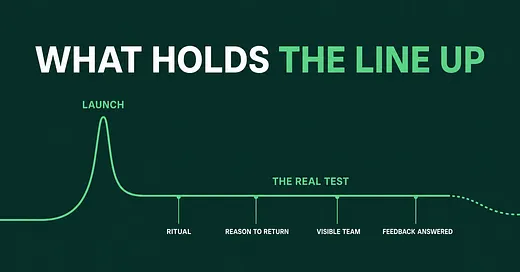
A launch spike measures your announcement, not your community. The four weeks after it are the real test, because an unoccupied room turns negative on its own while a programmed one settles into rhythm. Hold the flat weeks with a fixed ritual, a reason to return, visible staff, and feedback answered in public, then measure conversation depth rather than message volume.
The most misleading week of the year
Launch week feels like validation. The member count climbs, the main channel scrolls, people are introducing themselves, and everything you built appears to be working exactly as designed. It is the least informative week you will have. A launch borrows attention from an event, and events are temporary by definition. The activity you are watching belongs to the announcement, not to the community. The honest reading comes later, in the flat stretch nobody screenshots.
The drop is not the problem
First, remove the panic from this. A decline after a launch is not a failure, it is arithmetic. Anyone who arrived because of a moment will behave according to that moment. The question worth asking is what remains once the event stops carrying the room.
| What you see in week one | What it actually tells you |
|---|---|
| Sharp rise in joins | Your announcement worked |
| Fast moving main channel | Curiosity is present |
| Introductions arriving | Entry is not broken |
| Activity in week four | You built something |
Only the last row is a finding about the community itself. Everything above it is a finding about your marketing.
Silence after a spike is louder
Here is what makes the quiet stretch genuinely dangerous rather than merely disappointing. An empty room does not remain neutral. It fills with whatever is left, and what is usually left is the small group of people who wanted something they did not get.
In a busy room a complaint is one voice among many. In an empty room it becomes the description of the place.
The mechanics are simple. Disappointed members find each other quickly because there is nothing else in the channel to read. One frustration gets restated, then agreed with, then extended. Somebody new arrives, reads the last twenty messages, and forms their entire impression from them. An unoccupied community does not stay neutral, it drifts toward its most dissatisfied member. Active programming solves this without moderating anything. When there is something to do, complaints stay in proportion, because they sit alongside conversation instead of replacing it. Most communities do not have a negativity problem. They have a vacancy problem that looks like one.
What holds the flat weeks
Four supports, none of them exciting, all of them load bearing.
A ritual that never moves
One recurring thing on a fixed schedule. Same day, same time, indefinitely. A weekly thread, an open session, a standing prompt, a roundup. The consistency is the mechanism. A ritual whose timing shifts is an event, and events require promotion every time. A ritual that never moves becomes a habit, and habits survive the weeks when nobody is paying attention.
A reason to return that is not an announcement
Announcements pull attention once. A reason to return has to exist inside the community, not be pushed at it. Ongoing discussion worth reading, help that arrives faster here than anywhere else, access to people, a thread that is still developing. If the only new thing in your community is your own broadcasting, members will treat it as a feed and check it like one.
Visible staff presence
The flat weeks are exactly when teams disappear, because launch cleanup and delivery work consume everything. From inside the community, that reads as the team leaving after the party. One deliberate public appearance a day is enough. A greeting, an answer moved from a ticket into the open, a note on what changed. It is proof of life, and it is cheap compared to what its absence teaches.
Feedback answered where it can be seen
Post launch is when the most useful feedback of the entire cycle arrives, from people using the thing for the first time with no accumulated tolerance for its rough edges.
Read the feedback surface daily during the flat weeks and answer in public. A visible answer converts a complaint into evidence that this place responds.
An unanswered complaint in a quiet channel does not stay one complaint. It becomes the room's conclusion about how much you care.
Measure the right thing
The temptation after a launch is to watch message volume, since it moves the most and is easiest to pull. It is also the least useful reading you can take, because launch traffic is dominated by curiosity that has not decided anything yet. Three better signals.
- Are members answering each other. Peer to peer replies are the clearest indicator that a community exists rather than an audience. When every answer comes from the team, you have a support channel with extra rooms.
- Are threads lasting. Depth beats breadth. Twenty messages spread across twenty topics is noise. Twenty messages inside three conversations is a community forming.
- Do people return unprompted. Returns without a ping are the honest version of retention. Anyone can be summoned back once.
Plan the after, not just the launch
Most launch plans are detailed up to the day and vague afterward. That allocation is backwards, because the launch is the easy part and it mostly runs on borrowed energy. Before you launch anything, write out the four weeks that follow. Which ritual starts in week one and who runs it. Who is visibly present each day. Who reads feedback and answers it in public. What exists in week three that gives someone a reason to open the app. Filling a room for a day is a marketing skill. Keeping it worth entering on a slow Tuesday is community work, and it is the only part that compounds.
The launch tells you whether people will show up. The month after tells you whether you built something worth showing up to. danieljeong.org