The Person Who Opens Your Discord Every Day Is the User You Forgot to Design For
Every community has two users. We design carefully for the one who visits and almost never for the one who lives there.

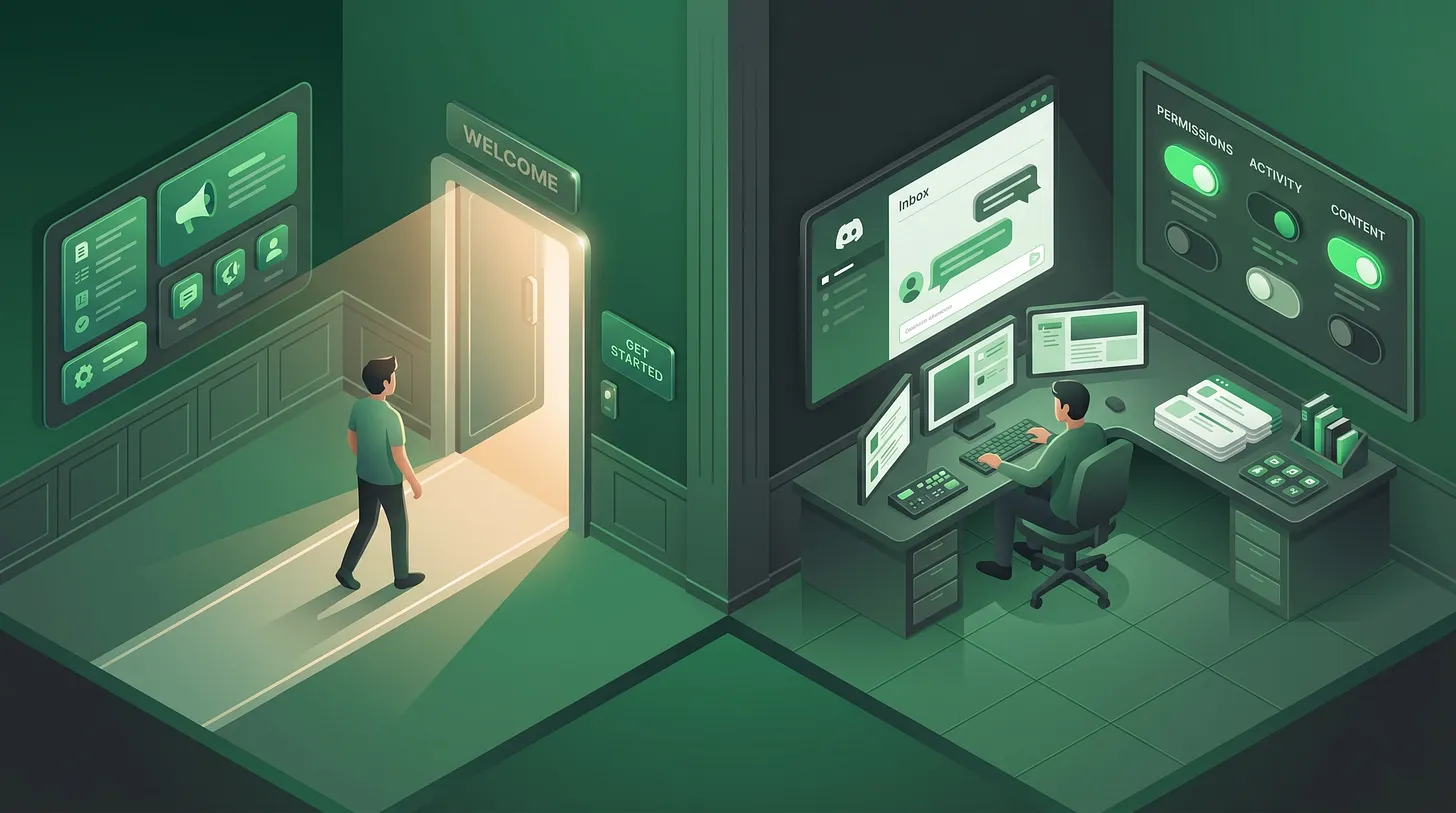
Every community has two users: the member who visits and the operator who runs it daily. We design for the newcomer and leave the operator with scattered tools, missed questions, and ten click chores. Design the operator's daily control surface with the same care as the welcome, or the person who sustains the community burns out.
The sentence that flipped the project
Midway through a build call, a client said something ordinary that changed how I saw the whole server. Looking at the layout we were shaping, he mentioned, almost as an aside, that he would be the one using it almost every day. He was not describing a feature request. He was describing his life with the thing we were building. Up to that point I had been designing entirely for the members. The welcome, the first channel they see, the path that carries them from arrival to their first action. That work is real and it matters. But this client was about to live inside the server, opening it more often than any member ever would, and nothing in the design accounted for him at all.
Every community has two users
We talk about the member as if they are the only user of a community. They are the obvious one. They arrive, they browse, they participate, they leave. Almost every piece of community design advice is aimed at their experience, and for good reason, because a bad member experience empties the room. There is a second user we rarely name. The operator. The person who opens the server daily to run it, answer questions, post updates, grant access, watch for problems, and keep the place alive. They use the server more than anyone, and they use it differently. The member visits. The operator works. Designing only for the visitor leaves the person doing the work to fend for themselves in a space that was never shaped around their tasks.
What a neglected operator experience looks like
When nobody designs for the operator, the server slowly turns hostile to the one who depends on it most. The tools they need are scattered across places they have to remember, so every session starts with hunting. Member questions arrive with no system to catch them, so some get answered late and some get missed entirely. Routine tasks that should take one action take ten, because the shortcut was never built and nobody noticed the cost. Each of these is small on its own. Stacked across every day, they become a tax the operator pays constantly. The server stops being a place they run and becomes a place they fight. And that fight is not invisible. It leaks into the community as slower responses, inconsistent moderation, and the low grade burnout that members can sense even when they cannot point to it.
Why this gets missed
The operator experience is easy to overlook because the operator is usually the person building or commissioning the server, and they are focused on the members they want to impress. They imagine the community through a newcomer's eyes because that is who they are trying to win. Their own daily experience is an afterthought, something they assume they will just figure out. There is also a timing problem. On day one, the server is small and quiet, and running it is easy no matter how it is arranged. The cost of a bad control surface only appears once the community is active, questions are flowing, and the operator is doing the same awkward tasks dozens of times a day. By then the layout is set and the friction feels like just how it is, rather than a design choice that could have gone differently.
Designing for the daily open
Fixing this starts with treating the operator as a real user with real tasks, and designing their surface with the same care you give the welcome. Map what the operator actually does in a normal day. Answering questions, granting or checking access, posting updates, spotting and handling problems. Those tasks are the operator's product, and they deserve to be fast. Put the common tasks within reach instead of scattered. Catch member questions in one place the operator will actually see, rather than hoping they notice them across a dozen channels. Collapse the routine multi step chores into something quick. Arrange the control surface so that opening the server every day feels like sitting down at a well organized desk, not digging through a cluttered drawer. The goal is simple. The person who lives in the server should find it built for them, too.