The Operating Model That Works at a Thousand Members Breaks at Ten Thousand
Communities scale in thresholds, not in a straight line. Build for the stage above you before you reach it.

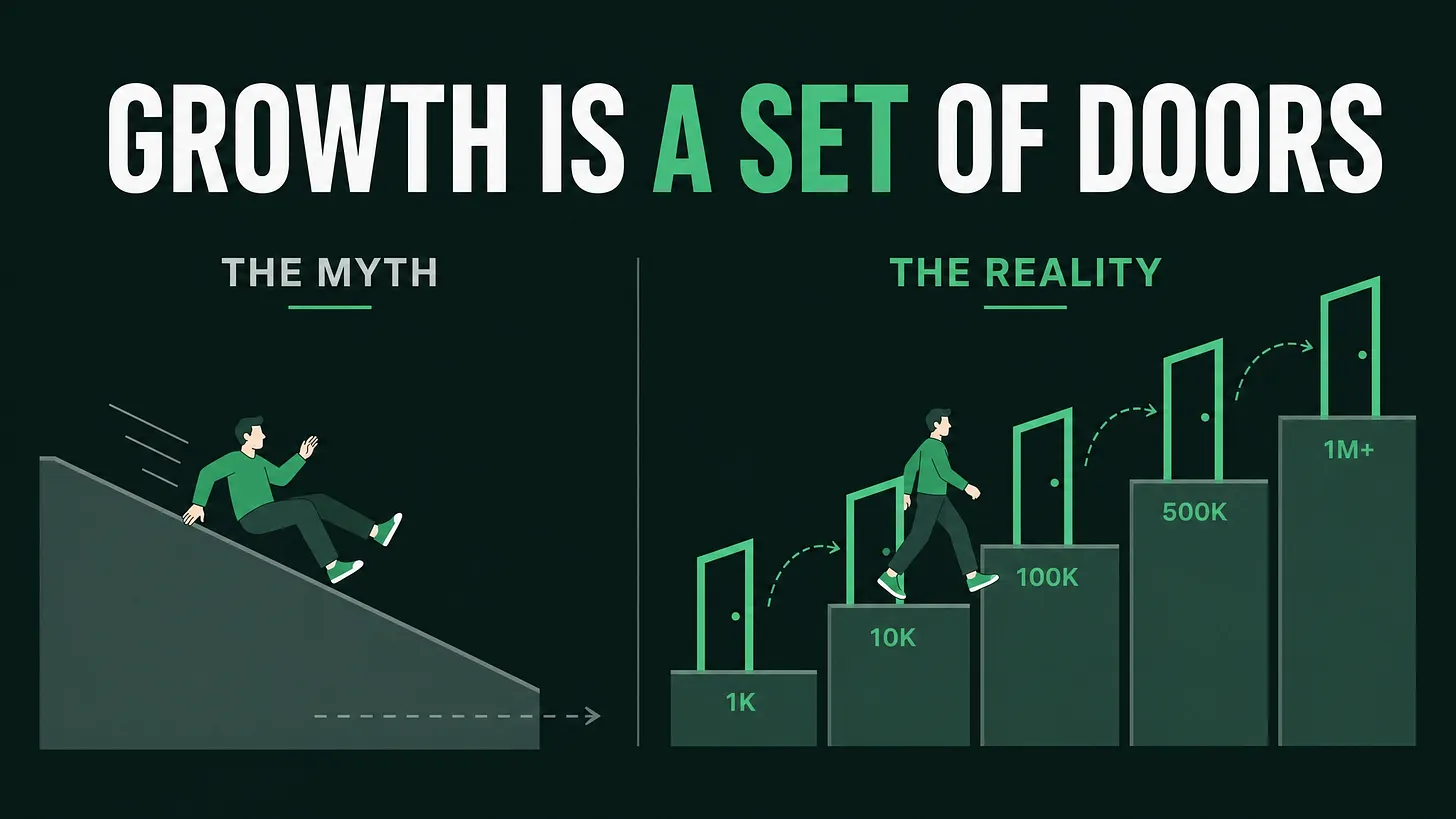
Communities do not grow in a straight line, they cross thresholds. Around a hundred members relationships carry everything. Around a thousand you need structured onboarding. Around ten thousand, documentation. Around a hundred thousand, automation and moderation frameworks. The failure is never growth itself, it is carrying the habits of the last stage into the next.
Growth is not a ramp, it is a set of doors
Most people picture community growth as a smooth ramp. Add members, add a little effort, repeat. That mental model is exactly why so many communities feel like they are coming apart at the moment they are succeeding. Growth is not a ramp. It is a series of doors. On one side of a door, your current way of running things works beautifully. On the other side, those same habits quietly stop working, and the room starts to feel harder to hold even though nothing obvious went wrong. The community did not break. It outgrew its operating model. Each door sits at roughly an order of magnitude. The exact count varies by niche, but the pattern is dependable, and knowing the pattern lets you prepare for the next stage instead of being ambushed by it.
Around a hundred members: relationships carry everything
At the smallest scale, you are the system. You recognize every name, you catch every message, and you welcome new arrivals personally because there are few enough of them to welcome. It feels effortless and warm, and it should. The trap here is believing this will always work. It will not. Everything good about this stage depends on a number that is about to change. Enjoy it, but do not mistake it for infrastructure. It is a phase, and it has an expiration date.
Around a thousand members: structure replaces the personal touch
This is the first painful door, and it is the one that catches the most founders. You can no longer greet everyone. The personal welcome that defined your early community becomes physically impossible, and if you cling to it, new members start slipping through unnoticed in the first day.
The warmth that made you special at a hundred is what quietly kills you at a thousand, unless you turn it into a system.
The fix is structured onboarding. A guided entry, a clear first action, roles that place people where they belong, and an immediate sense that they landed somewhere real. You are not removing the human feeling. You are building a machine that reliably produces it when you cannot be there yourself.
Around ten thousand members: memory becomes documentation
At this scale, the bottleneck moves from greeting to knowing. The same questions arrive again and again, and your team answers them from memory, one message at a time, forever. It works until the volume buries them. The answer is to move knowledge out of heads and into documentation. A findable knowledge base, canned responses for the recurring questions, a clear place to look before asking. Think of it as the difference between a team that re-solves the same problem daily and a team that solved it once and wrote it down. Here is the whole progression in one view:
| Scale | What carries it | What breaks first | What to build |
|---|---|---|---|
| ~100 | Personal relationships | Nothing yet | Nothing, enjoy it |
| ~1,000 | Structured onboarding | The personal welcome | Guided entry, first action, roles |
| ~10,000 | Documentation | Memory and repeat answers | Knowledge base, canned replies |
| ~100,000 | Automation and moderation | Manual support and mod | Role automation, escalation, triggers |
| ~1,000,000+ | Operational infrastructure | Everything manual | Specialized teams, layered systems |
Around a hundred thousand members: automation and moderation frameworks
Now the manual model collapses entirely. No human team can watch every channel, assign every role, or catch every problem in time. This is where automation earns its place, not as a gimmick but as load-bearing structure. Automate the repetitive weight: role assignment, first acknowledgment, routine moderation triggers, and the routing of requests to the right place. Pair it with clear moderation frameworks so that safety does not depend on who happens to be online. The goal is to free your people for the work that actually needs a person, and to make sure the base layer keeps running when they sleep.
Around a million and beyond: full operational infrastructure
At the largest scale, the community is a piece of business infrastructure with specialized teams behind it. Support, moderation, engagement, and operations become distinct functions with their own systems. Ad hoc stops being an option. Everything that was once a favor from a helpful person is now a documented workflow with an owner.
Most readers will never run a community this large, and that is fine. The reason to understand this stage is that it reveals the direction every earlier stage is heading: away from heroics, toward systems.
The real failure mode: carrying habits upward
Notice what actually goes wrong at each door. It is never the growth. It is the founder or team hauling the previous stage's habits across the threshold. Personal greetings at ten thousand. Answering from memory at a hundred thousand. Manual moderation at a scale where it cannot possibly keep up. A community that feels chaotic is almost always running on an operating model it has outgrown. The chaos is a symptom, and the cause is a stage mismatch. You are not failing at community. You are succeeding faster than your systems.
How to tell which stage you are actually in
Forget the raw member count for a moment and look at where the strain shows up. If new members are slipping away unwelcomed, you are at the onboarding door. If your team keeps answering the same questions, you are at the documentation door. If moderation and support are always behind, you are at the automation door. The pain tells you the stage more honestly than the number does.
Build one stage ahead
The move is simple to say and hard to remember under pressure. Do not build for where you are. Build for the stage just above you, before you arrive. Put structured onboarding in place while personal greetings still technically work. Start documenting before your team is buried. Introduce automation before moderation falls behind. Building one door early is the difference between growth that feels like momentum and growth that feels like a crisis.
Every community that lasts eventually stops running on the founder and starts running on systems. The only question is whether that shift happens on purpose or after something breaks. danieljeong.org