The First Channel Your New Members See Should Not Be General Chat
Why private welcome threads are the most underused onboarding system in Discord community management

Why Your Onboarding System Is Failing Before Anyone Posts a Single Message
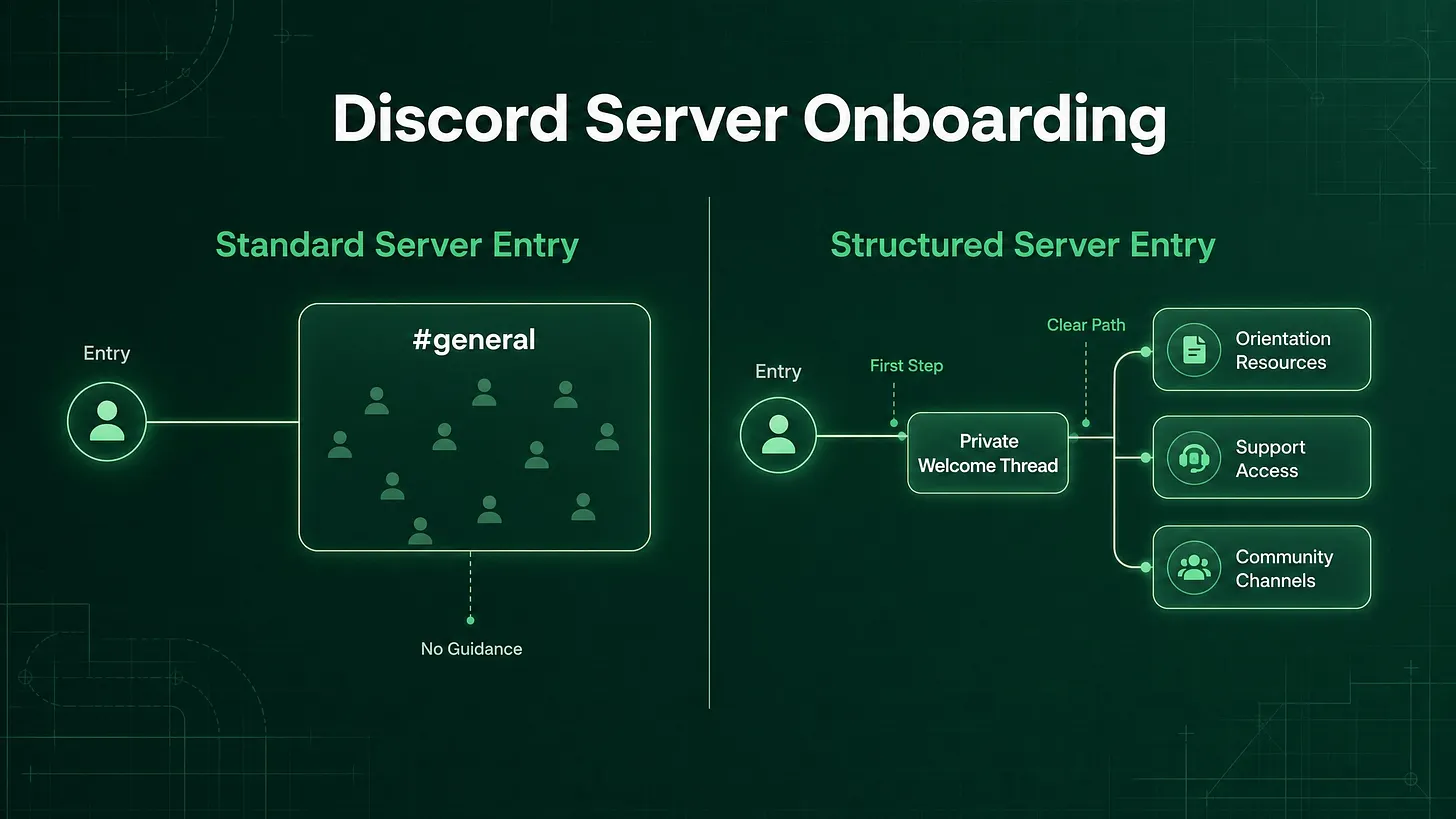
There is a moment inside every Discord community that most server owners never design deliberately. It happens the second a new member completes the join process. The screen loads. The channels appear. And the member begins deciding whether this community is worth their time. Most servers direct that person into #general. The channel is already running. Conversations from hours ago sit unread. Regulars are talking to each other in shorthand the new member does not understand. Nobody has acknowledged the new arrival. The interface offers no clear indication of where to go, what to do, or why any of it matters. The new member reads for a moment. They decide they have nothing relevant to contribute. They close the app. This sequence plays out across thousands of communities every day. Communities that are actively trying to grow. The problem is not that the community is unfriendly. The problem is that the onboarding experience was never designed as a system.
What a Private Welcome Thread Actually Does
A private welcome thread is a channel visible only to the new member and a designated team member. It opens automatically when someone joins, triggered by a bot. Within minutes, a real person introduces themselves, acknowledges the arrival, and asks a simple question. The question matters less than the act of asking it. When a new member receives a direct message from a real team member within their first fifteen minutes, they form an immediate impression: this community is paying attention. Someone here noticed I arrived. That impression is difficult to replicate through any other mechanism. Most server owners underestimate how powerful that early contact is. They assume members will warm up over time. They assume a good channel structure is sufficient to orient people. They assume that once someone joins, the hard work is done. The retention pattern tells a different story. Communities that implement private welcome threads consistently retain more members through the first critical window of thirty to forty-eight hours. Members who receive direct contact in that window are more likely to post, more likely to return, and more likely to become long-term contributors. This is not because the welcome thread is a magic fix. It is because the welcome thread forces a set of operational behaviors that most communities skip entirely.
The Infrastructure Behind the Thread
Running private welcome threads at any meaningful scale requires infrastructure. Not complicated infrastructure. But infrastructure. You need a bot that creates the thread the moment someone joins. The bot needs to pull the new member into the thread automatically and tag the appropriate team member. It needs to do this reliably at any hour, including late at night and on weekends. You need a protocol that defines the team member's expected response window. If the thread opens and sits unresponded for four hours, it defeats the purpose. The response window should be tight. Fifteen to thirty minutes is achievable for communities with active moderation. An hour is acceptable. Beyond that, the moment has passed. You need a documented introduction format. Not a corporate greeting. Not a wall of text. A short, direct message that introduces the team member by name, acknowledges the new arrival, and asks one question that opens a conversation. The question can be simple. "What brought you here?" works well. The goal is to invite a response, not to deliver a briefing. And you need someone assigned to monitor those threads. This is the operational commitment most server owners are not prepared to make. It is also the reason private welcome threads remain rare. They require a person with time, intention, and a clear mandate. When these elements exist together, the welcome thread becomes something meaningful. It becomes the first visible proof that the community is managed by people who care whether members stick around.
Why General Chat Fails as a First Experience
The instinct to send new members into #general is understandable. It is where the activity is. It feels welcoming in theory because it puts the new member in the center of things. In practice, it puts them at the edge of someone else's conversation. #general in an active community is designed for people who already know the culture, the regular contributors, and the unspoken norms. For a new member, reading it is like walking into a room mid-conversation and trying to figure out whether they belong. The cognitive load of that experience is significant. The new member has to read enough history to understand the current conversation, evaluate whether their contribution would be welcome, and decide whether they feel safe posting. Most of them decide the answer is no. They leave without posting anything. This is not a personality issue. It is a design issue. The server was not designed to receive them. It was designed for people who are already there. Private welcome threads solve this by removing the public pressure from the first interaction. The new member does not have to prove themselves in front of the entire community in their first moments. They get a private conversation with someone who already knows why they joined and is there specifically to help them orient. That is a fundamentally different experience.
The Scale Question
Server owners frequently ask whether private welcome threads are realistic at scale. If hundreds of members are joining every week, can you actually staff individual welcome conversations for each person? The answer is that it depends on what you build. In smaller communities below a few hundred members, one or two team members can manage welcome threads with minimal friction. The volume is low enough that responses feel personal and timely without requiring dedicated infrastructure. As communities grow into the thousands, the welcome thread system needs to evolve. You need more team members assigned to intake. You need clearer role assignments so threads do not go unresponded because everyone assumed someone else would handle them. You may need to automate more of the initial greeting while reserving the human response for follow-up messages. Communities operating at tens of thousands of members often segment their welcome process by member type. High-value members or members who meet specific criteria receive more intensive onboarding. Others receive a streamlined version that still includes direct contact but at a faster cadence. The principle scales. The specific implementation changes as the community grows.
What This Reveals About Community Management as a Discipline
The private welcome thread is a small system inside a larger operational framework. Understanding why it matters requires understanding what community management actually is at a professional level. Running a successful Discord community is not a social media job. It is an operations job. The skills involved are closer to customer success, support operations, and systems design than they are to content creation or social posting. The team members managing a community at scale are not just friendly people who like talking online. They are operators running intake workflows, escalation protocols, retention systems, and engagement infrastructure. The welcome thread is the first node in that operational chain. If it is missing, the rest of the system is receiving members who were never properly onboarded.
Building the System Before You Need It
One of the consistent patterns across communities that struggle with retention is that they try to fix onboarding after they have already lost members. By the time the owner decides something needs to change, they have cycled through members who joined, looked around, and left. The smarter approach is to build the welcome system before the community reaches the scale where retention becomes an obvious problem. When you implement private welcome threads early, you are building muscle memory for the team. You are establishing the protocol. You are learning what members respond to, what questions generate good conversations, what introductions feel genuine rather than scripted. By the time you are operating at significant volume, the system is already running. You scale what is already working rather than trying to retrofit infrastructure into a community that has already formed habits around the absence of it. This is the difference between communities built for scale and communities that accidentally grew. The ones built for scale designed the intake experience with the same intentionality they applied to channel structure, moderation, and engagement programming. The private welcome thread is one piece. But it is the first piece. And first pieces matter more than most server owners realize.
Daniel Jeong is a Discord community infrastructure consultant working with SaaS companies, AI startups, and high-growth technology teams. He specializes in transforming Discord servers into structured operational systems. danieljeong.org