The Dread You Feel Opening Discord Is a Missing Escalation Path
Why founder burnout in community management is an operational signal, not a personal failing.

The Feeling Comes Before the Diagnosis
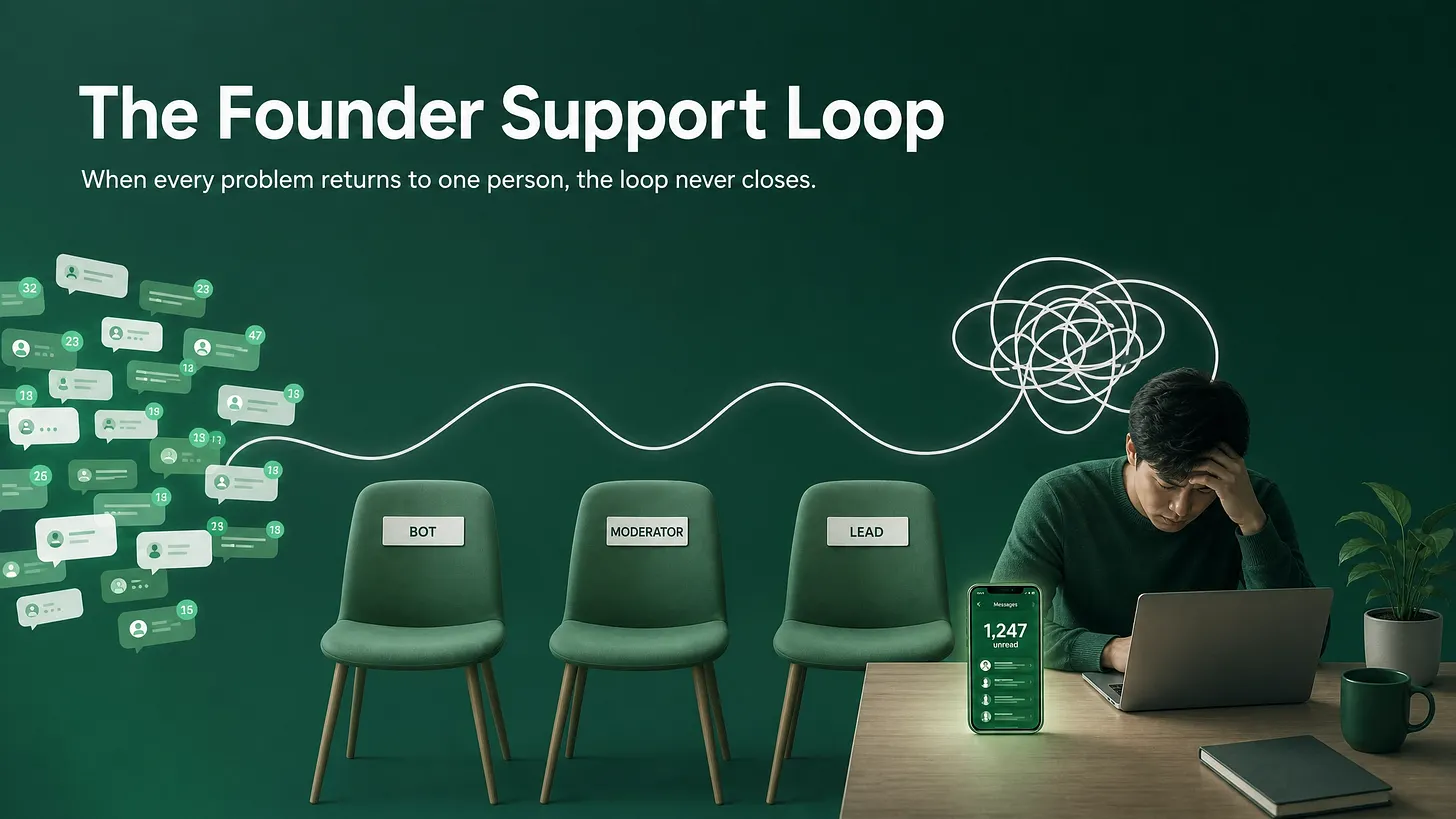
Most founders do not describe their Discord problem in operational language. They describe a feeling. They open the app and something tightens in the chest. A red notification badge sits there with a number that never really reaches zero. Somewhere in a channel, a conversation is heading in a direction they cannot predict, and they are the only person who can steer it. That weight follows them into dinner, into weekends, into the quiet part of the night when they should be asleep. When founders talk to me, the language is surprisingly consistent. They say they dread the app. They say they carry a low grade anxiety they cannot fully explain. Some of them have started to resent the platform itself, as if Discord were a bad decision they made rather than a tool that was never set up correctly. The resentment is real and it is understandable. It is also pointed at the wrong target. The feeling is not the problem. The feeling is the readout. It is telling you something specific about how your community is built, and once you can read it, the fix stops being emotional and becomes structural.
What the Dread Is Actually Measuring
Here is the pattern underneath the anxiety. In most struggling communities, every incoming signal routes to one person. A member asks a question nobody else can answer. A conflict flares and nobody else has the authority to step in. An edge case appears and there is no rule for it, so it waits for a decision that only the founder can make. Multiply that across hundreds or thousands of members and the founder becomes the single point through which everything must pass. That is the definition of an open loop. Your brain cannot close a task that has no owner other than you, so it keeps the loop running in the background at all times. You are never off, because the system was never designed to run without you watching it. The dread is your nervous system reporting an accurate fact. The community has no way to resolve anything unless you are present. This is why hiring one more community manager rarely fixes the feeling. If the new hire has no defined authority and no clear routing, they simply become a second person forwarding everything back to you. The load does not move. It just gains a middle step.
Escalation Is Infrastructure, Not a Personality Trait
The calm you are looking for does not come from working harder or caring less. It comes from building an escalation path. An escalation path is a set of decisions made in advance about where each type of problem goes and who owns the outcome. It is infrastructure in the same way that plumbing is infrastructure. You do not think about it when it works, and you think about nothing else when it fails. A functioning escalation path answers a few blunt questions before a problem ever appears. Which issues should a bot resolve without any human touch. Which issues should a moderator handle on sight. Which issues should a team lead review. And which issues, the genuinely rare ones, actually deserve the founder. When those lanes exist, most of what used to reach you never arrives, because it was resolved two or three layers earlier by the person or the system built to handle it.
Calm communities are not calmer by luck. They decided in advance where each type of problem goes and who owns the outcome.
The word that matters most there is ownership. Routing a problem to a moderator is meaningless if the moderator does not own the outcome. Ownership means the issue closes at that layer and does not bounce back up. Most founders have some loose version of delegation already, but the loop still returns to them because nobody below them was ever given the authority to end the conversation.
Why This Gets Worse as You Grow
The instinct is to believe the dread will fade once the community is larger and more established. The opposite is true. Manual handling that feels manageable at three hundred members becomes impossible at three thousand, and it becomes a genuine liability beyond that. The operational requirements of a community change at every order of magnitude. At a hundred members, personal relationships carry everything. You know people by name and you can hold the whole community in your head. At a thousand members, structured onboarding becomes necessary because you can no longer greet everyone yourself. At ten thousand, documentation becomes critical because the same questions repeat and your team cannot answer each one from scratch. At a hundred thousand and beyond, automation and moderation frameworks are the only thing keeping the community coherent, and a real operations team runs the day to day.
| If you feel more dread as the community grows, that is not a sign you are failing. It is a sign your systems have not scaled at the same rate your membership has. |
|---|
The founders who escape the dread are the ones who treat each growth stage as an operational upgrade rather than a personal endurance test. They add routing before they add members, not after the overload has already arrived.
The Reframe That Changes the Work
When a founder tells me they have Discord trauma, I do not treat it as a mindset issue. I treat it as a diagnosis. The heaviness they feel is data about a missing layer in their operation. That reframe matters because it points to a fix you can actually build instead of a feeling you are supposed to power through. I have built these paths for communities across SaaS, AI, and eCommerce, including servers with more than a million members. The size changes the tooling. It does not change the principle. Every community that runs calmly has decided, on purpose, where problems go. Every community that runs on dread has left that decision unmade, which means the decision defaults to the founder every single time. So if opening Discord feels heavy, treat the heaviness as a signal worth reading rather than a flaw worth hiding. It is telling you the routing was never built. That is a solvable problem, and solving it is the difference between a community that lives in your head and one that runs on its own structure.
How to Map Your Own Escalation Path
You can start diagnosing this without any new software. Spend one week writing down every time a community issue reaches you personally. Not the ones you chose to join, the ones that had nowhere else to go. Next to each entry, write the honest answer to one question. Could this have been resolved by a bot, a moderator, or a lead, or did it genuinely require you. Most founders are surprised by the result. The large majority of what reaches them could have stopped at a lower layer if that layer had existed and had clear authority. A returning member asking where the onboarding channel is does not need a founder. A rule violation that already has a documented consequence does not need a founder. A repeated product question does not need a founder if the answer lives in a documented, searchable place. Once you see the list, the missing layers become obvious. The next step is to assign owners and write the rule down. An escalation path that lives only in your head is not infrastructure, it is a hope. It has to exist as documentation that your moderators and leads can read, follow, and act on without checking with you first. The moment the rule is written and the authority is real, the loop starts closing below you.
The Question Nobody Asks Until It Is Too Late
There is a second cost hiding inside the dread, and it has nothing to do with your mood. When every decision routes through one person, that person becomes a single point of failure for the entire community. If the founder steps away for a week, the loops do not pause, they pile up. If the founder ever leaves, the community has no memory of how anything was decided, because none of it was ever written down. A community that depends entirely on one person is fragile in a way that does not show up until the day that person is unavailable. Building escalation paths solves the daily dread and the long term fragility at the same time. Documented routing means the community can survive a vacation, a sick week, or a change in staff without losing its structure. The same infrastructure that gives you quiet evenings also gives the community a spine that does not depend on any single human being.
What Changes When the Loop Closes Somewhere Else
The change founders notice first is not a metric. It is the quiet. The badge count stops feeling like a threat because most of what it represents is being handled by the layer built for it. You start to trust that a conflict at midnight will be managed by a moderator who has the authority to manage it, which means you can actually close the app. The second change shows up in the numbers that matter. Communities that run on clear systems retain members better, because new arrivals get fast answers from a system that was designed to answer them rather than waiting for one overloaded person. Engagement rises when responses are quick and consistent. I have seen communities hold engagement rates far above the typical baseline once the operational layer is doing its job, and none of that depends on the founder being permanently online. The deepest change is what it does to the founder. The resentment fades because the platform stops being the thing that takes from you. Discord becomes what it was supposed to be from the start, a retention engine that deepens your relationship with the audience you already earned. The dread was never proof that Discord was a mistake. It was proof that a layer was missing. Build the layer, and the feeling goes with it.
Daniel Jeong builds escalation systems and community infrastructure for SaaS, AI, and eCommerce brands that treat Discord as revenue infrastructure rather than a chat room. If opening your own server feels heavy, the routing can be built. danieljeong.org