The Community Manager Was Not the Problem. The Missing Systems Were.
Why Discord manager turnover is almost always a structural failure, and what to build before you hire again.

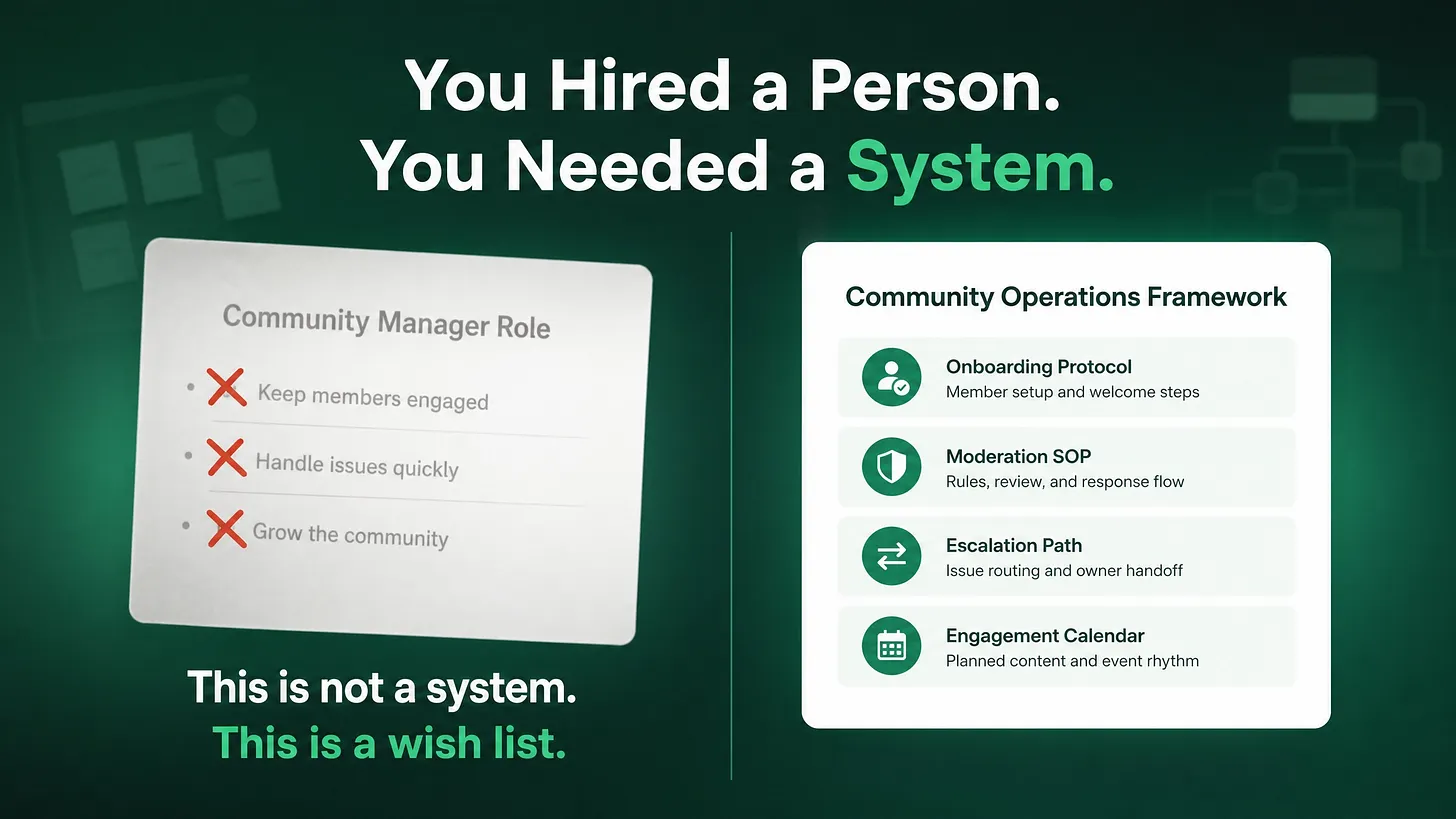
The Hire That Should Have Worked
Founders who have been burned by a Discord community manager tend to describe the experience in similar terms. There was a promising start. The manager seemed capable. The community had potential. Then, over weeks or months, everything quietly fell apart. Questions went unanswered. Moderation decisions felt arbitrary. The energy in the server declined. The manager eventually left, either burned out or let go, and the founder was left with a damaged community and a deep reluctance to try again. This pattern is not random. It is structural. The manager who failed was almost certainly placed into an environment without the operational infrastructure to support them. No onboarding SOP. No documented moderation guidelines. No escalation protocol. No engagement calendar. No clear definition of what success looked like or how to measure it. They were hired to manage a community that had no documented systems, and they were expected to build and operate everything simultaneously while the community watched. Even experienced operators will struggle in that environment. Not because they lack skill, but because there is nothing to execute against. There is only improvisation, and improvisation at scale is not sustainable.
What a Community Manager Is Actually Hired to Do
When you hire a community manager without existing systems, you are not hiring someone to manage a community. You are hiring someone to build and manage one simultaneously, often without acknowledgment that building is part of the scope. Those are two different jobs. They require different skills, different timelines, and different support structures. Conflating them is one of the most common mistakes founders make when staffing Discord communities. A community manager's core function is to operate within a defined framework. They execute onboarding flows, enforce moderation policies, follow escalation protocols, and implement engagement strategies. Their effectiveness is directly tied to the quality of the systems they are working inside. A community architect's function is to design that framework. They audit the server, map member journeys, document operational procedures, and build the infrastructure that a manager will eventually maintain. Most community managers are hired to do both, paid as though they are doing one, and evaluated when the second job goes poorly.
The Four Documents That Change the Outcome
Before hiring or rehiring a community manager, four operational documents need to exist. Not as aspirations or rough notes, but as completed, usable references. Onboarding SOP This document defines what happens between a new member's first entry into the server and their first meaningful interaction with the community. It maps every step: verification gates, welcome messages, role assignment logic, first-channel guidance, and the check-in process within the first 72 hours. Most Discord communities lose a significant portion of new members within the first 48 hours. That attrition is almost never caused by a lack of interest from the member. It is caused by a lack of clarity about where to go and what to do next. A documented onboarding SOP turns a chaotic first experience into a guided one. Moderation Guidelines This document removes the need for judgment calls in most moderation situations. It defines categories of behavior, maps each category to a response, and establishes when escalation is required. Without this document, every moderation decision is a fresh judgment call. Different managers will handle the same situation differently. Members will notice the inconsistency and interpret it as favoritism or lack of leadership. The community's perception of fairness depends on whether the rules are applied consistently, and consistency requires documentation. Escalation Path This document defines the three-tier structure that every operational community needs. Tier one covers situations the community manager handles independently. Tier two covers situations that require review by a senior moderator or team lead. Tier three covers situations that require founder awareness or direct involvement. Without a clear escalation path, two things happen. Either everything escalates to the founder because the manager has no authority to resolve anything independently, or nothing escalates because the manager does not know where the line is. Both outcomes are damaging. The first creates operational dependency. The second allows serious problems to compound in silence. Engagement Calendar This document transforms content and programming from reactive to intentional. It maps what gets posted, when, and why, across a defined time window. It accounts for recurring formats, member-facing events, and community milestones. A community manager without an engagement calendar will default to posting when inspiration strikes or when the server feels quiet. That is not a rhythm. It is a gap-filling strategy, and members can tell the difference.
Why Systems Failures Get Misread as Hiring Failures
Founders who have experienced multiple rounds of community manager turnover often conclude that good community managers are rare or that the role is inherently unreliable. That conclusion is understandable but usually incorrect. The pattern that actually produces turnover is not a talent shortage. It is an onboarding failure at the operational level. When a new manager enters an undocumented server, they spend the first weeks reverse-engineering what the community's norms are supposed to be, what level of moderation is expected, and what the founder actually wants from the community long-term. They are simultaneously learning the environment and being evaluated on their performance within it. That is not a setup for success. It is a setup for gradual failure that both sides will misattribute. The manager will feel unsupported and unclear. The founder will feel that the manager is underperforming. Both assessments are accurate. Neither identifies the root cause. The root cause is the absence of the operational layer that should have existed before the hire.
What to Build Before You Hire Again
The practical sequence for rebuilding a Discord community management operation starts with an audit, not a job posting. Audit the server's current state. Map every channel against its actual usage. Archive channels that have not seen meaningful activity in more than 30 days. Identify where new members are getting lost and where the most recurring support questions are appearing. From that audit, draft the four documents outlined above. The onboarding SOP does not need to be long. It needs to be usable. The moderation guidelines do not need to cover every possible scenario. They need to cover the most common ones clearly. The escalation path needs three tiers and a clear definition of what belongs in each. The engagement calendar needs a 30-day window at minimum. Once those documents exist, you are ready to hire. Not because the systems are perfect, but because there is something for a competent manager to operate within. Their first weeks become execution, not exploration. Their performance becomes measurable against documented expectations rather than intuited ones. The community manager role is not inherently unstable. The version of it where the manager is expected to build and operate simultaneously, without documentation, in a server designed by guesswork, is unstable. That version can be resolved before the next hire happens.
The Long View
Communities that have maintained consistent quality over years share one characteristic that is less glamorous than the engagement metrics or the member counts: they have operational documentation that predates the current management team. That documentation does not make the community manager irrelevant. It makes them effective. It gives them context, authority, and a framework for decision-making that does not require constant founder involvement. If your Discord has experienced manager turnover more than once, review the operational documentation that was in place before each departure. In most cases, the documentation either did not exist or existed only as informal understanding held by a single person. When that person left, the understanding left with them. The community is not the problem. The platform is not the problem. The structural absence of documented systems is the problem, and that is entirely within your control to fix before the next hire.
If you are rebuilding a Discord community after a management failure and want to approach it as an infrastructure project rather than a staffing one, danieljeong.org is where to start.