The Badge on a Member's Profile Does More Retention Work Than Your Welcome Message
How status systems inside Discord communities function as long-term retention infrastructure

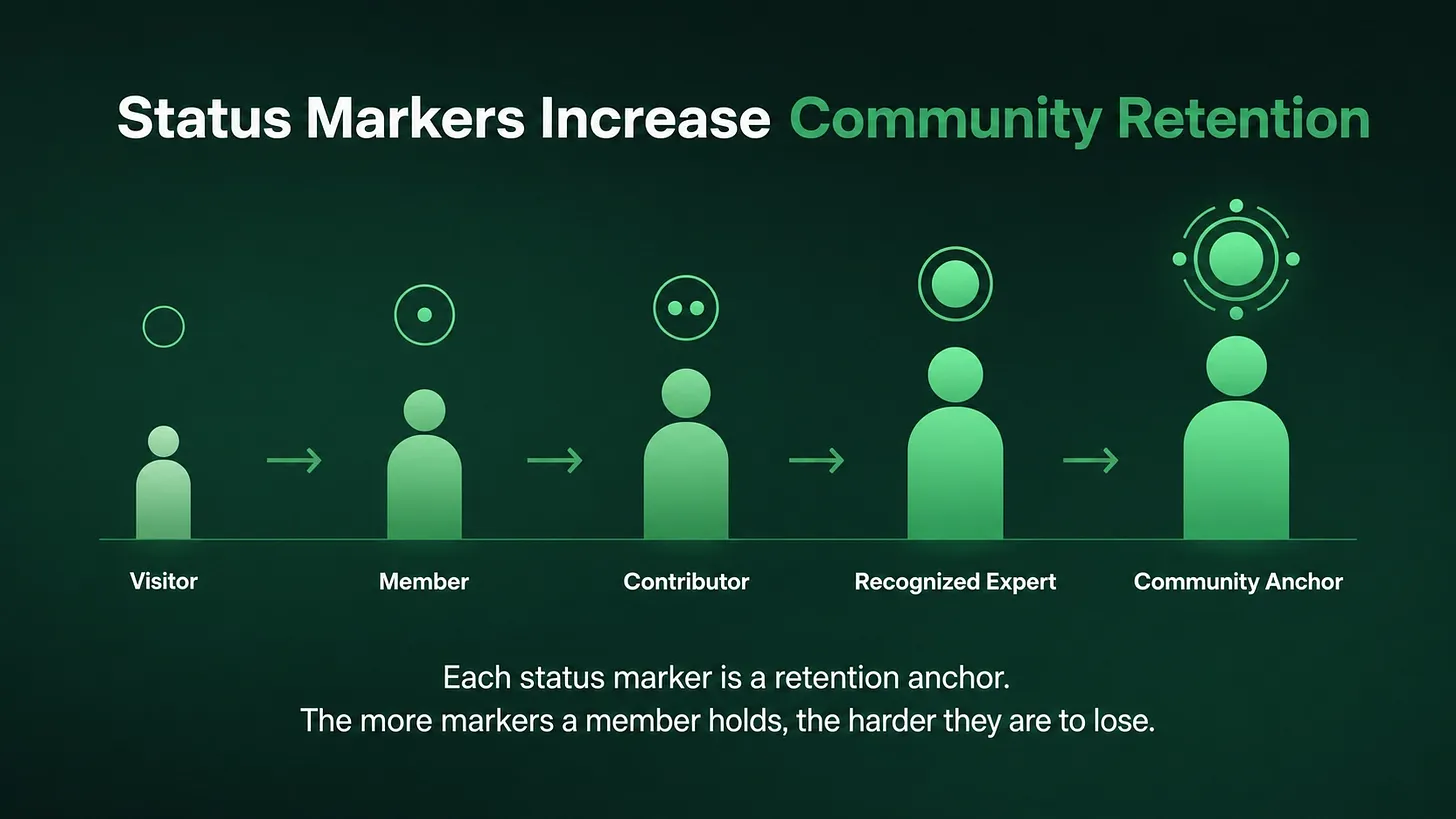
Status Systems Are Operational Infrastructure, Not a Design Afterthought
Most server owners think about badges and roles as organizational tools. A way to sort members. A way to mark who has paid for which tier. A way to distinguish moderators from regular members. They are all of that. But they are also something more specific: retention infrastructure. A member who has earned visible status inside a community has something in that community that is uniquely theirs. A marker that reflects their history in the space, their contributions, their verified expertise, or their sustained participation. That marker does not transfer to another server. It does not follow them to a competitor's community. It exists specifically in this context, and leaving means losing it. This is not a minor psychological observation. It is the operational foundation of some of the most durable retention strategies in Discord community management.
How Badge Systems Create Behavioral Anchors
The mechanism behind status systems as retention tools is straightforward when you examine it directly. When a member receives recognition inside a community, a few things happen. First, their relationship to the community shifts from passive to participatory. They are no longer just someone who joined. They are someone the community has acknowledged. That acknowledgment creates a sense of belonging that passive membership does not. Second, the status marker becomes a social signal within the community. Other members can see it. The recognized member's contributions are now more visible. Their standing in the community is legible at a glance. This social legibility creates an incentive to maintain and protect that standing. Third, and most importantly from a retention perspective, the member now has something to lose by leaving. Not a membership fee or access to content, but a status identity that they built inside this specific community. That is a fundamentally different type of attachment than the one created by a subscription.
The Anatomy of a Well-Designed Status System
Badge and status systems in Discord communities can be structured in multiple ways, each serving different retention functions. Contribution-based status markers reward active participation. Members earn recognition for posting a certain number of times, being present for a defined period, helping other members answer questions, or participating in community events. This approach incentivizes the behaviors that make a community active and valuable for everyone. Members working toward the next contribution milestone are, by definition, contributing to the community while pursuing their own recognition goal. Expertise-based status markers identify members who have demonstrated knowledge or skill in a specific area. A server focused on a technical subject might have verified expert badges for members who have consistently provided accurate and helpful guidance. A trading community might mark members who have documented verified results. These markers serve the community by helping other members identify who to trust, and they serve the recognized member by publicly affirming their expertise in a relevant context. Tier-based status markers tied to paid membership levels create a visibility component to the value proposition of upgrading. A member at a lower tier can see the badges held by members at higher tiers. The badge becomes part of what they are purchasing when they upgrade, not just the content or channel access. Event and milestone markers recognize participation in specific community moments: a founding member badge, a badge for attending a particular live session, or recognition for completing a challenge or program. These markers are time-bounded, which creates a scarcity dimension. Members who were present for a specific event hold something that later arrivals cannot obtain.
What Ruins a Badge System
A poorly implemented status system does more damage than no system at all. The most common failure is eroding the standards for earning status. When a community starts handing out badges arbitrarily, or when the criteria drift over time and become inconsistently applied, the badge stops functioning as a meaningful signal. Members who earned their status through genuine effort watch the marker they worked for lose its meaning. The community stops treating badges as indicators of anything real. The retention mechanism dissolves. The second common failure is delays in granting status. If a member qualifies for a badge and waits weeks or months to receive it, the moment of recognition is disconnected from the achievement. The operational discipline required to run a badge system includes timely, reliable fulfillment. Status should be granted within a defined window after the qualifying criterion is met, not whenever someone on the team remembers to check. The third failure is invisibility. A badge that no other member can see, or a role that does not change how the member appears in the community, loses most of its retention value. Status systems function partly because of the social legibility they create. If the marker does not change anything visible about how the member appears to others, the behavioral anchoring effect is significantly reduced.
Running Status Systems as an Ongoing Operational Function
Badge and status systems are not built once and left to operate. They require ongoing management. The criteria for each status level need to be reviewed periodically. As the community grows and the member composition changes, the thresholds that made sense at a smaller scale may need adjustment. Status that was genuinely rare at a few hundred members may become common at a few thousand. The system needs to evolve to maintain the distinction between levels. New status categories can be added over time as the community develops new activities, programs, or content areas. A community that launches a mentorship program might add a mentor badge. A community that starts hosting live events might add an event participation marker. These additions give existing members new ways to earn recognition and new reasons to remain engaged. The team member responsible for managing the status system needs a clear protocol: what the criteria are, how to verify that a member has met them, when and how to grant the status, and how to handle edge cases. Without that protocol, the system drifts.
What Status Architecture Looks Like in Practice
In communities where badge and status systems are running well, you can observe the behavioral effects directly. Members in the tier below a recognition threshold are actively working toward it. They are posting more, helping more, attending events, participating in programs — whatever the criteria require. The status system has aligned member behavior with the community's health. New members ask about the badge system early. They want to understand how it works, what they need to do to earn recognition, and what each level represents. This means the system is visible enough to be noticed and compelling enough to be worth pursuing. Long-term members with multiple status markers are among the community's most stable participants. They are not passive. They are invested. Their history in the community is visible in their profile. That history is one of the most durable anchors a community can create.
Daniel Jeong builds Discord community infrastructure for technology companies, creator platforms, and high-growth organizations that need community retention to function as a business system. danieljeong.org