The Accountability Layer Is the Part of Your Community People Actually Pay For
Members do not need more material. They need a room that notices when they stop and does something about it without waiting for a human to remember.

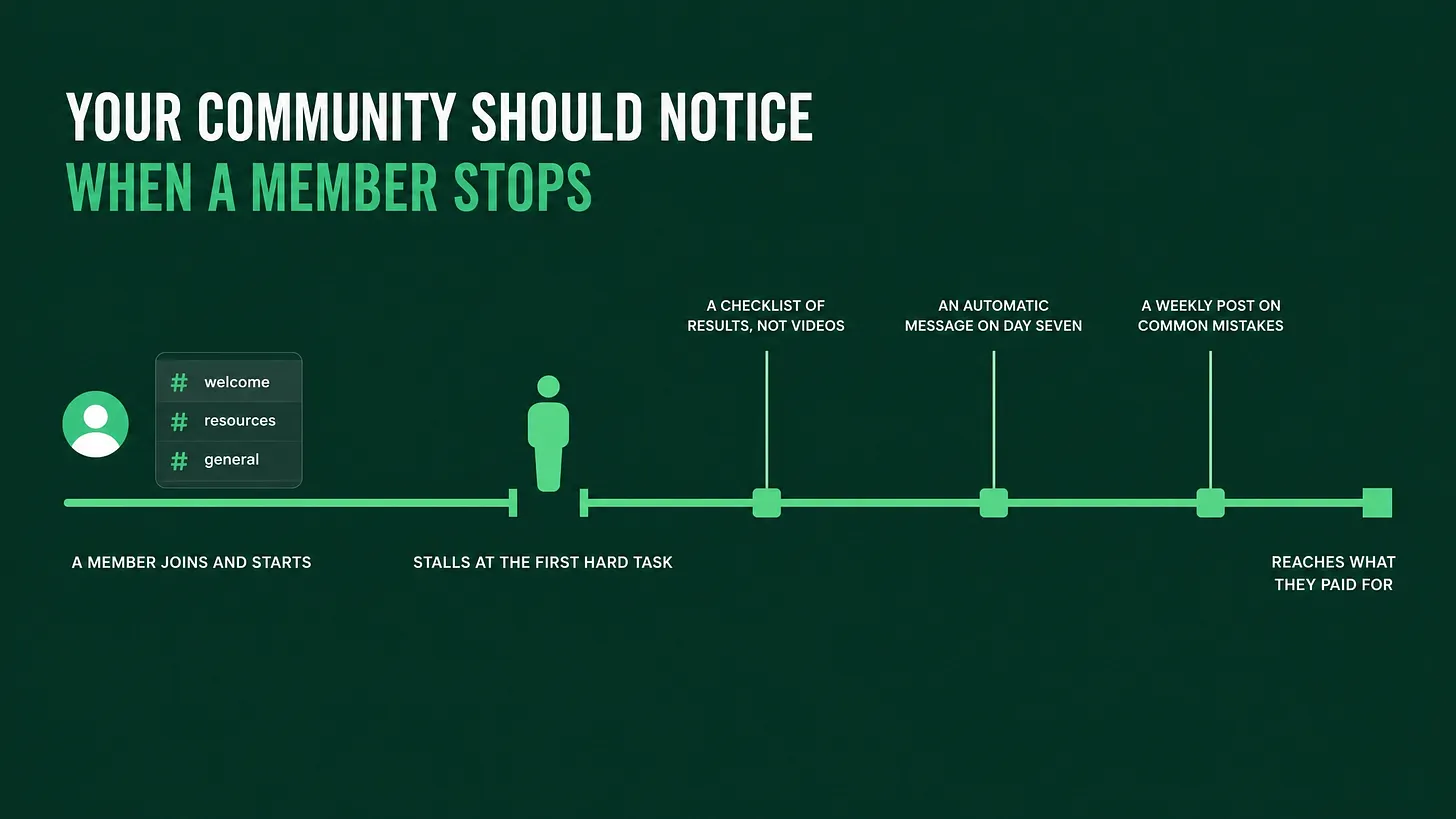
Members stall at the first task that requires a real decision, and most communities never notice. An accountability layer fixes it with three automatic parts: a checklist tied to the outcome, a timed check in after week one, and a recurring digest of common errors. Completion drives testimonials, upgrades and renewals.
Every paid community has a number that nobody puts on a slide. It is the percentage of buyers who never reach the outcome they paid for. Not because they were sold badly, and not because the material was weak, but because at some point they stopped and nothing in the room reacted. That number is the real product review. Everything else is marketing.
The stall has a predictable shape
The sequence repeats with unnerving consistency across programs, industries and price points.
- Purchase. Motivation is at its peak. The member joins, introduces themselves, and reads more than they will ever read again.
- Sprint. The first block of material goes down fast because it is conceptual and requires nothing of them.
- Stall. They arrive at the first task that requires a real decision about their own situation. They pause to think about it. The pause becomes a week.
- Restart and quit. They return, cannot remember where they were, decide to start over, and quit somewhere during the second attempt. Step three is where the community either intervenes or does not. Almost every intervention that works happens inside a seven day window, and almost no community is instrumented to act inside it.
The material was never the constraint. Attention was, and attention is not something a member can be blamed for losing.
Three parts, all of them operational
What interrupts the stall is not more content. It is a small set of mechanisms that run on their own.
The checklist is tied to the outcome
Most progress tracking mirrors the table of contents. Lessons watched, modules completed, videos ticked off. That measures consumption rather than progress, and members know the difference even when the dashboard does not. Build the checklist around what the person is trying to achieve. If they bought a working system, the checklist items should be states of that system existing, not lessons about it. The difference in behaviour is immediate, because a member can see whether they are actually closer to the thing they bought.
The check in fires without a human
Seven days after joining, an automated message should arrive asking one specific question. Not a broad greeting, and not an offer of help in the abstract. Something closer to asking which step they are on and what is currently blocking it.
⏱️ Specificity is what makes this work. A general message invites a polite non answer. A question naming a particular step gives a stalled member permission to admit exactly where they stopped, which is the hardest thing for them to volunteer unprompted.
The digest tells them what everyone else is getting wrong
Whoever spends the most time in the support queue knows things nobody else in the company knows. That knowledge should leave the queue on a schedule. A short recurring post covering the errors currently costing members the most does two jobs at once. It prevents repeat problems, and it quietly signals that somebody is paying attention to how people are actually doing rather than how many people joined.
Why this belongs in an operations budget
| Mechanism | Trigger | Owner | Business outcome it protects |
|---|---|---|---|
| Outcome checklist | On join | Program lead | Perceived progress and completion |
| Week one check in | Automated, day seven | Community lead | Early stall recovery |
| Common errors digest | Recurring schedule | Support | Repeat ticket reduction |
None of these depend on anyone remembering. That is the entire point. Systems that rely on a person deciding to do something on a Tuesday decay within a quarter, and the decay is invisible until someone audits it.
The commercial case, stated plainly
Completion is not a customer success metric that lives in a corner of the business. It sits upstream of almost everything a revenue team cares about.
- Members who finish produce testimonials, and testimonials are the single most effective asset a knowledge business can put in front of a cold buyer
- Members who finish buy the next thing, because they have proof the first thing worked
- Members who stall request refunds, and their description of the experience is accurate, which makes it very hard to argue with
- Members who stall tell other people, and that message travels further than any campaign The accountability layer is the cheapest revenue infrastructure most companies are not building. It requires no new content, no new hires, and no platform migration.
What you are actually competing with
A community does not compete with other communities. It competes with a member's inbox, their own clients, their family, and every other thing that has a deadline attached to it while your program does not. That is the design brief. Give the work a shape, give it a rhythm, and make sure something in the room notices when a person disappears. Those three moves change the completion number more than any improvement to the material ever will. Build the layer once and it works on every member who joins afterward, quietly, without asking anyone to remember it.
The rooms that produce results are the ones that keep track of who is falling behind. Design that in from the start. More on community systems at danieljeong.org.