Studying a Competitor's Server Tells You the Floor, Not the Ceiling
Why benchmarking an established community sets your table stakes, and where the actual advantage gets designed.

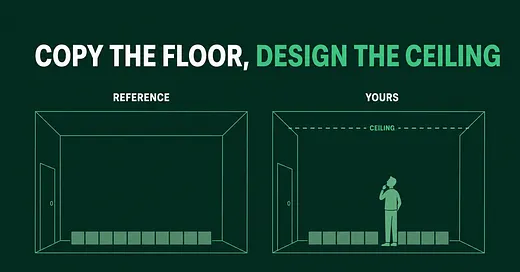
Benchmarking an established community shows you its structure and hides its reasoning, so copying it reproduces the compromises along with the wins. Treat the benchmark as a floor of table stakes. Design the ceiling from your member's first ten minutes, your team's real staffing capacity, and the requests your category keeps ignoring.
The reference server problem
Almost every serious community build begins with a comparison. There is an established server in the same category, running for years, full of members, and it becomes the standard. Match this. Then beat it.
The instinct is sound. Someone else already paid for the mistakes, and studying working systems beats inventing from nothing. The problem is what a tour actually gives you access to. You get the finished surface of a community and none of the thinking that produced it.
A server is an artifact. What you see when you join is the residue of hundreds of decisions, most of them invisible, some of them regretted, a few of them accidents that nobody got around to reversing. #introductions might be there because it works. It might be there because it came with a template two years ago and deleting it felt risky.
What a tour shows you and what it hides
Walk into a mature community and you can inventory the visible layer in an hour. Channel names and their order. Category grouping. Role names. Which bots respond to what. The wording of the welcome. Whether the rules sit in a channel or a modal. Every one of those is an output. The inputs stay behind the wall.
You can read the layout of a community in an hour. You cannot read the reasoning in a year.
Here is the specific hidden layer, item by item.
| Visible on a tour | Invisible on a tour |
|---|---|
| The channel list | Which channels they regret and cannot kill |
| The welcome flow | How many members abandon it partway |
| The support channel | How long a question actually waits |
| The bot stack | What each bot was brought in to patch |
| The role hierarchy | Who manually maintains it every week |
| The event schedule | Which events quietly stopped happening |
Copy the left column and you also import the right column, without knowing you did. That is the whole risk. You have taken on their unresolved problems and labeled them best practice.
Structure copies cleanly, judgment does not
There is a reason this mistake is so easy to make. Structure is the most copyable thing in community work and the least valuable. A channel tree is a list. Anyone can rebuild a list. Ten minutes with a reference server and a decent naming convention gets you something that looks legitimate. It photographs well. It demos well. It survives a stakeholder review, because the stakeholder is comparing it against the same reference you were. What does not copy is the judgment about why each piece exists and what it costs to keep alive. That judgment is the entire job. A room full of well named channels with nobody answering in them is worse than a small server with three channels and a fast reply, because the large empty server has advertised a level of service it cannot deliver.
The unanswered question, the most common inherited defect
Of everything hiding in that right hand column, one defect shows up more than any other. Members ask questions in the open and get no reply. It is almost never indifference. Teams do not sit and watch a question go stale on purpose. The cause is structural, and it is usually one of three things. The team is buried in fulfillment work happening somewhere outside the server, so the server is the last tab they open. The question landed in a channel nobody owns, so every person who saw it assumed another person had it. Or the answer requires information the responder does not have, and there is no path to escalate, so it stalls politely and forever. A visitor sees none of this. A visitor sees a busy, healthy looking community. Members see a place where asking has a coin flip attached.
⚠️ If you copy a structure without copying an ownership model and a response commitment, you have copied the shape of a community and skipped the part that makes it feel alive.
Where the ceiling actually comes from
So the benchmark gives you a floor. Useful, quickly satisfied, not a strategy. Three inputs produce the ceiling, and none of them are visible from inside somebody else's server.
The first ten minutes. A new member arriving in your community has a short window in which they decide whether this place is legible. They need to understand what the community is for, what they specifically get from it, what to do first, and who is a human they can talk to. That sequence depends on who your members are and what they arrived hoping to solve. Nobody else's welcome copy can answer it for you.
Your real staffing capacity. Every open surface is a standing promise. A voice channel implies someone might be in it. A support channel implies a reply. A feedback channel implies someone reads it. Design against the team you actually have on the days they are busy, not the team you imagine on a good week. Capacity is a design constraint, and treating it as one is what separates operators from decorators.
The unmet request list. In every category there is a short list of things members ask for repeatedly and never receive. Faster answers. A clear path to a real person. Recognition that survives past a launch week. Somewhere to talk that is not the firehose. These are known, boring, and largely unaddressed, which is exactly why they are available. This list is where advantage lives.
How to run a benchmark properly
The reference server still has value. Use it differently.
- Inventory it once, then close it. Capture the table stakes: the things members in this category expect to find on arrival. Match those quickly and stop treating the reference as a target.
- Join as a member, not an auditor. Ask a question and time the reply. Follow the welcome path all the way through and note the exact point where you lose interest. This surfaces the hidden layer better than any structural review.
- Look for what is missing, not what is present. Read the questions in their public channels and mark the ones without answers. That pattern is your specification.
- Design your own opening ten minutes from scratch. Nothing about your welcome path should be inherited. It is the one thing entirely specific to your audience.
- Cut every surface you cannot staff. Then commit publicly to the response standard on the ones that remain.
Table stakes are not a strategy
There is a clean way to hold all of this. The benchmark defines the price of entry. It does not define the win. Matching an established competitor gets you to the point where a new member does not immediately notice something is missing. That is worth having and it takes a fraction of the effort people spend on it. The remaining effort belongs above the floor, in the parts that are specific to your members, your team, and the requests your category has been ignoring for years. The community worth building is not the one that looks like the leader. It is the one the leader could not operate.
The visible layer of any community is the cheapest part to copy and the least of what makes it work. Spend your effort on the part nobody can tour. danieljeong.org