Standing Out From Similar Discord Servers Takes a Belief Members Can Repeat
Write one sentence your field could argue with, test it, and repeat it everywhere members already look, from the start-here channel to moderator replies.

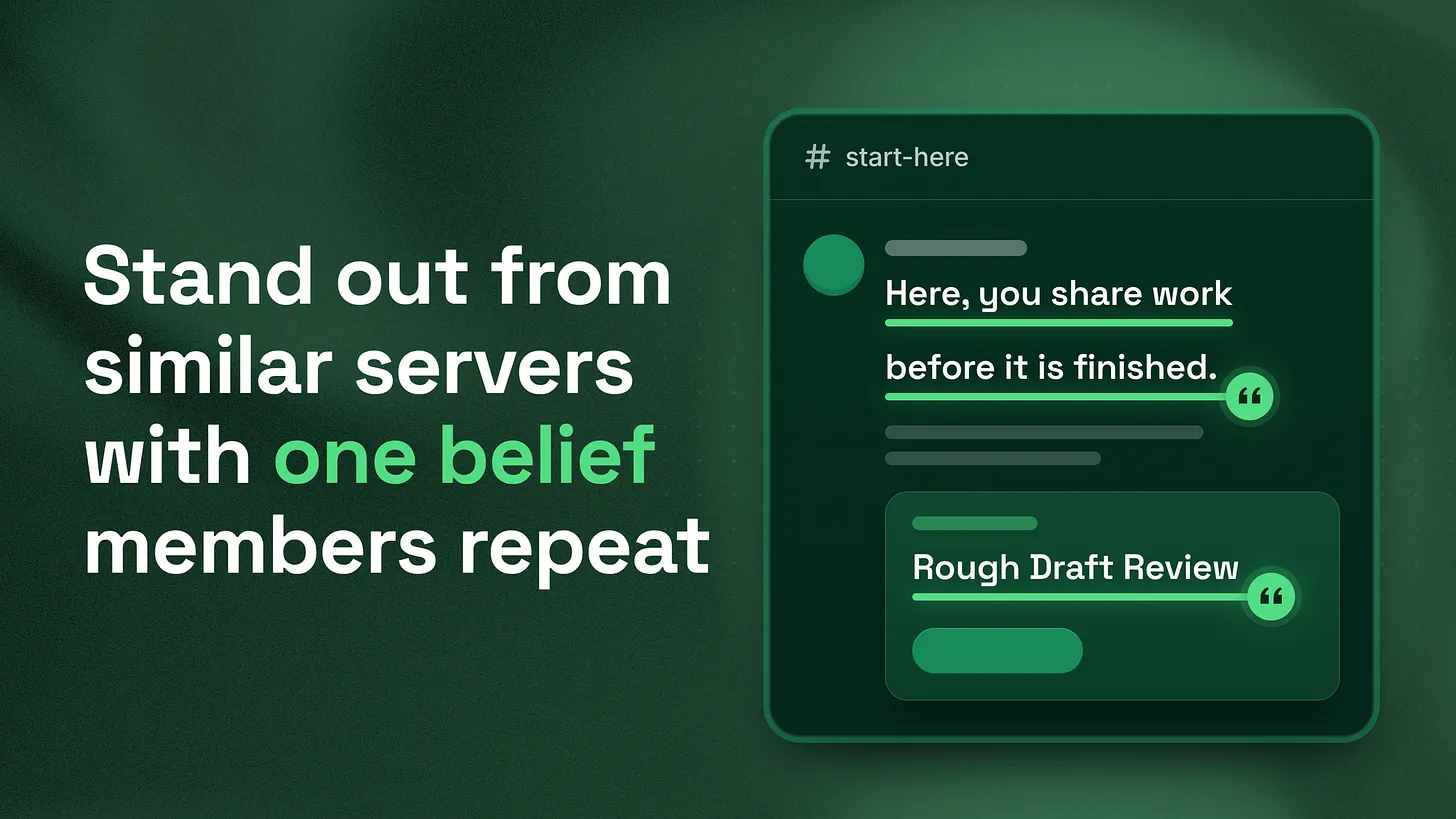
Similar servers in one field blur together because none says what it believes. The question of how to make a Discord community stand out from similar servers comes down to one belief some people in your field would dispute. Check that it helps members act and that moderators can use it, then repeat it in start-here, the welcome flow, event names, moderator replies and channel topics.
Lookalike servers are missing one sentence
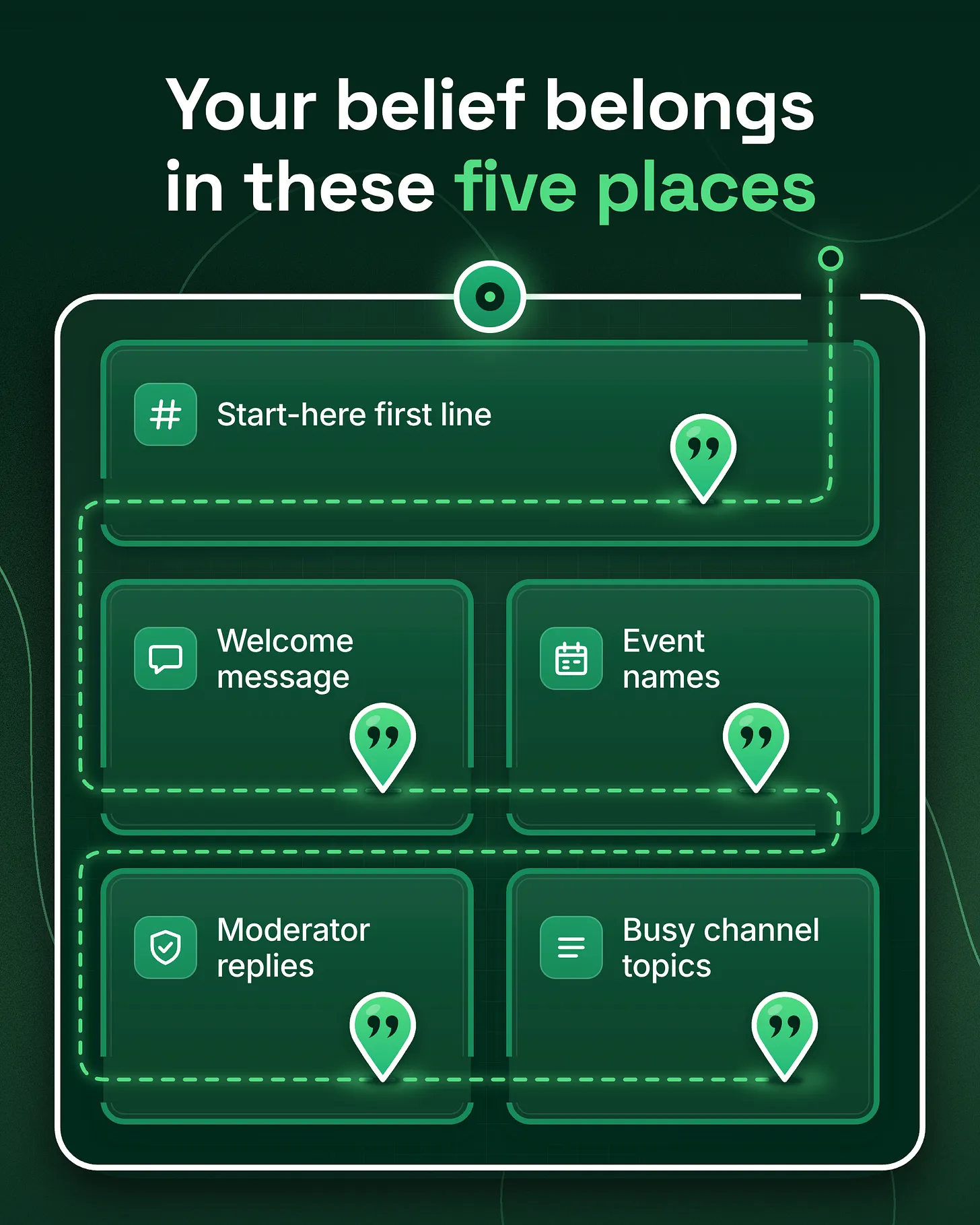
You open a competitor's Discord, and their start-here post reads like yours with the logo swapped. That happens when no server in a category says what it believes, and the fix is one sentence. Write down a belief about your field that some people in it would argue with, check that it helps your members do something, then repeat it in every place a member looks: the first line of your start-here channel, the welcome message, the names of your events, the way your moderators answer, and the topics of your busiest channels.
 A server with a stated point of view gives members a way to describe it in one sentence, and a sentence members can repeat is what makes a server memorable. A server without one gets described by its product name and the word "Discord," which is also how its three closest neighbours get described.
I have seen the same pattern in a few servers. Two servers in the same field can have the same channels, the same bots and the same event calendar. The one people remember is the one that holds a view about how the work should be done, and keeps saying it.
A start-here post that would still read true under a competitor's name gives a new member no reason to pick your server.
Six symptoms of a server with no point of view
You can diagnose this in an afternoon. Each symptom below is something you can check yourself, today, without any tools.
- It fails the swap test. Open your start-here channel and replace your brand name with a competitor's. If every sentence still reads true, the channel says nothing that belongs to you.
- The welcome message is only a map. It lists channels and rules. It tells a new member where things are and never tells them what this place thinks.
- Event names describe a format.
Community Call,Weekly AMA,Office Hours,Showcase Friday. These say what shape the event takes. None of them says why your community runs it. - Moderators answer the same borderline case three different ways. When there is nothing shared to point at, every judgment call comes from personal taste, and members notice the inconsistency before staff do.
- Members describe the server by the product. Ask five regular members how they would describe the server to a friend in one sentence. If every answer is some version of "it is the Discord for the product," the server has no identity of its own.
- The channel list mirrors a template or a feature list. Channels named after product features, or copied from a setup guide, tell members what the server contains and nothing about how it works. Here is the swap test written out, so you can run it on your own copy:
1. Copy the first three sentences of your #start-here post.
2. Replace your brand name with the name of a competitor's community.
3. Read it aloud.
4. Every sentence still true? The server has no point of view.
   At least one sentence now false? You have the start of one.
Two or more of these symptoms usually travel together. A server that fails the swap test tends to have format-only event names too, because both come from the same place: copy written to fill a slot, not to say something.
Why good teams end up here
If you run product marketing, you already do this work for the product. You write a positioning statement, you decide which competitor claims you will contest, and you make sure the launch page, the sales deck and the onboarding emails all carry the same message. Nobody would ship a launch where every surface said something different. The community is often the one customer-facing surface that never got that treatment. It was set up quickly, from a template, by whoever was available. The start-here post was written by one person, the welcome bot by another, the event names by a third, and moderators improvise their replies. Each piece is reasonable on its own. Together they say nothing, because nobody decided what they should say. There is also a quieter reason. Stating a belief feels risky. Someone might disagree. So teams default to copy that nobody could object to: friendly, welcoming, helpful. That copy is safe, and it is exactly why the server blends into the others. A belief that no one in your field would argue with is a description of the field, and every server in that field already has it.
Draft three or four candidate beliefs
Start with what your community actually does differently, or wants members to do differently, compared with the common practice in your field. Use this template as scaffolding, then cut it down:
In [your field], most people [common practice].
In this server, members [what they do instead], because [the reason].

Short form, for every surface:
"Here, [what members do instead]."
Some examples across different kinds of communities, to show the shape rather than to copy:
| Kind of community | A belief some people in the field would argue with | What it changes for members |
|---|---|---|
| Design tool | Share work before it is finished. | Members post drafts, and feedback arrives while it can still change the work |
| AI product | Test it on your own data before you trust any benchmark. | Members bring real examples and compare results instead of quoting leaderboards |
| Developer platform | A small working example beats a long explanation. | Questions arrive with code that runs, so answers come faster |
| Game | Feedback from new players counts as much as feedback from veterans. | New players speak up early instead of lurking |
| Trading education | Write your exit before you write your entry. | Members share plans before results, and discussion shifts to process |
Notice that each belief is about how members work, not about how good the product is. That distinction matters for the tests in the next step. Write three or four candidates. Do not pick yet.
Three tests for every candidate
Put every candidate through three questions. A belief that fails any one of them goes back for rewriting. Would anyone in your field disagree? This is the hardest of the three tests to pass. "Learning together makes everyone better" passes no test, because nobody argues against it. "Share work before it is finished" passes, because plenty of people in design believe you should only show polished work. You are looking for a sentence a thoughtful person could reasonably push back on. Avoid beliefs that are only provocative. The disagreement should be a real difference in how people work, not an attack on anyone. Does it serve members? The belief has to change what a member does or gets. "The fastest tool on the market" is a product claim. It belongs on the website, and it does nothing for a member in the middle of a project. "Share work before it is finished" tells a member what to do next and why it helps them. If you cannot point to a member behaviour the belief encourages, it is an ad in disguise. Can a moderator use it to make a call? Imagine a borderline post: someone shares a half-built design and apologises for how rough it is. A moderator who knows the belief has an obvious reply. A belief that cannot settle a single real situation is too vague to carry the server.
| Candidate | Anyone disagree? | Serves members? | Moderator can use it? |
|---|---|---|---|
| "A friendly place for everyone" | No | No | No |
| "The best tool for creators" | Some | No | No |
| "Share work before it is finished" | Yes | Yes | Yes |
When one candidate passes all three, check it against your product positioning. The belief should never contradict what the product promises. The strongest ones read as the community version of the positioning: the positioning says what the product does, and the belief says how the people around it work.
Placing it where members look
A belief written in a planning doc does nothing. It has to sit where members will see it, at the moments they are paying attention. These five surfaces cover the moments that matter.
The first line of #start-here, and the channel topic
Many start-here posts open with "Welcome to the community!" Replace that line with the belief. The rules, the channel map and the links can follow. Then put the short form in the channel topic, the line that shows at the top of the channel, so it is visible even to members who never scroll.
Here, you share work before it is finished.
Drafts get better feedback than final versions, so post early and ask for one specific thing.
Start in #works-in-progress. Rules and channel map are below.
The welcome message and one onboarding question
Whatever greets a new member, a bot message or a pinned welcome post, should carry the belief in its first two sentences. If your server has Community features turned on, Discord's Community Onboarding (checked October 2026) lets you ask new members questions whose answers assign them roles and add channels to their list. Write one question that puts the belief into action. For the example above: "What are you working on right now?" with answers that route members straight into the channel where drafts get shared.
Event names and descriptions
Event names are seen every week, by members who never reread start-here. Rename format-only events so they carry the belief. Showcase Friday becomes Rough Draft Review. Weekly AMA becomes Bring a Half-Built Thing. Discord's Scheduled Events give each event a name and a description, so use the description line to state the belief in plain words.
The way moderators answer
Moderation voice is the surface teams forget, and it is the one members experience most personally. Give moderators two or three short reply lines that use the belief, for the situations that come up most. Discord's AutoMod FAQ also lets you add a custom message, up to 150 characters, that a member sees when AutoMod blocks their post. Write that message in the same voice.
Member apologises for rough work:
"No apology needed. Rough is exactly what this channel is for. What one thing do you want feedback on?"

Member posts only finished work, asks why it got little response:
"Finished work gets compliments. Drafts get feedback. Try posting the next one earlier."
The topics of your busiest channels
The channel topic line on #general, your main feedback channel and any forum channel's post guidelines is read by members every day without them noticing. One short line in each, written in the voice of the belief, keeps it present in ordinary conversation.
| Surface | When a member sees it | What to write |
|---|---|---|
| #start-here first line and topic | Joining | The belief, in full |
| Welcome message and onboarding question | First minutes | The belief, plus one question that acts on it |
| Event names and descriptions | Every week | A name that carries the belief |
| Moderator replies and AutoMod message | When something goes wrong | The belief, used to explain the call |
| Busy channel topics | Every day | The short form |
Repetition is what makes it stick
A belief stated once gets forgotten. Members read start-here once, if at all. What builds a reputation is the same idea showing up at five different moments, in five different forms, until members start saying it themselves. Three habits keep it alive:
- Read every surface once a month. Open start-here, the welcome flow, the event list, the moderator reply lines and the channel topics in one sitting. Anything that drifted gets rewritten.
- Give it to every new moderator on day one. The belief and the reply lines go into moderator onboarding, before any rules training.
- Name new events through it. Before any new event gets announced, ask whether its name carries the belief. If it only describes the format, rename it. You will know it is working when members start using the belief in their own posts and replies. That is the moment the sentence stops being your copy and becomes what the server is known for.
Mistakes that undo it
- Turning it into a banner slogan. A belief that only appears in a graphic gets scrolled past. It works because it shows up in text people actually read.
- Using it to argue with other servers. The belief is about how your members work. It is never a dig at another community.
- Picking a belief that shuts out your own members. If a large part of your current community would feel unwelcome under it, it is the wrong belief.
- Changing it every quarter. Repetition is the mechanism. A new belief every few months resets the clock to zero.
What the belief does not cover
A stated belief does one job: it sets what newcomers hear about your community in the start-here channel, the welcome flow, your events and the way your moderators talk. Everything else a community runs on sits outside it and needs its own work, including role and channel structure, support routing, engagement rhythm and reporting. The belief keeps those four places saying the same thing, and it does not fix the rest. To be plain about limits: a stated belief will not bring new members in by itself, and it does not guarantee activity. What it does is give the people already in your server a clear sentence to describe it with, and a reason to choose it over the server next door. The first pass is short: run the swap test on your start-here post, write three candidate beliefs, put each through the three tests, and place the winner in the first line of start-here, your welcome message and the name of your next event.
Taking the belief further
Writing the belief and placing it in those five spots is work you can finish on your own. Each place it lands, from the start-here channel and the welcome flow to your events and your moderation voice, has more to it than one sentence, and my articles at danieljeong.org/articles go further into onboarding, events and moderation. If you want a second look at your own server, request the free community analysis at danieljeong.org/free-analysis and I'll tell you what's working, what isn't, and what to fix first. Should you want the welcome flow, engagement and moderation looked after for you, my service is at communitymanagementpro.com. *Servers in your field all have channels, bots and a calendar. Fewer have a sentence. Write yours this week and give your members something to repeat. *danieljeong.org