Retention Content Looks Nothing Like Acquisition Content
The work that fills a community and the work that holds one obey opposite rules, and running both from a single calendar guarantees the second one never gets made.

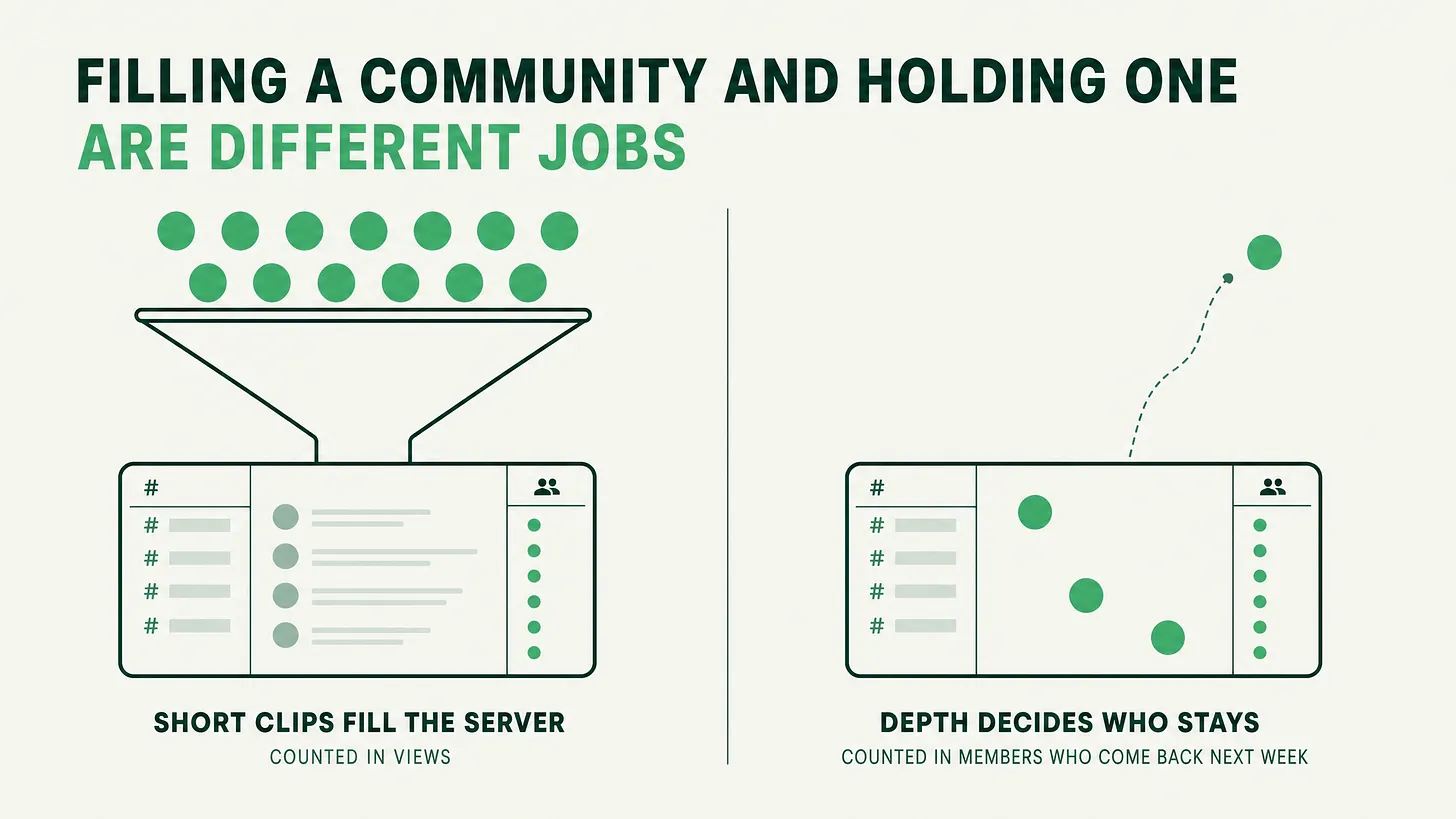
Acquisition content is engineered for strangers in a hostile feed. Retention content is long, specific and unhurried because the viewer already opted in. Judging the second by the metrics of the first kills it. Run a separate calendar, staff it with whoever does the actual work, and measure returning members rather than views.
A company builds an audience with short video, opens a community, and watches it go quiet within two months. The obvious diagnosis is that the community was set up wrong. Sometimes that is true. More often the content strategy that filled the room is the same strategy still running inside it, and it is the wrong tool for the job. Filling a room and holding a room are separate disciplines. They share a department, a budget line, and usually a single production calendar, which is how one of them ends up never getting made.
What acquisition content has to survive
A piece of content aimed at strangers operates in genuinely hostile conditions. The viewer did not ask for it, has no relationship with the person on screen, and is one thumb movement away from something else. Everything about the format follows from that. The hook exists because attention has to be captured before it is earned. Context gets stripped because context costs seconds. Length collapses because completion rate is the currency. None of this is a compromise, it is a correct response to the environment.
Acquisition content is designed to win an argument with someone who never agreed to have it.
That work belongs in the marketing budget and should be judged on reach, completion and conversion into the room. The mistake is assuming the same craft carries over once someone is inside.
What retention content has to do instead
A member watching your content has already made a decision about you. The hostility is gone. The scarce resource is no longer attention, it is trust, and trust is built by specificity rather than by compression. The formats that work here look almost careless by acquisition standards:
- The build that broke. A project shown in full, including the part that failed, what it cost to discover, and what got rebuilt afterward.
- The decision, with the rejected option attached. Most content shows what was chosen. Almost none shows what was seriously considered and dismissed, which is where the actual expertise lives.
- The unhurried walkthrough. Someone with their hands on the work talking through it at normal speed, without editing out the pauses where they think.
- Members on camera. Not testimonials. Members describing their own problem in their own words, which teaches everyone else in the room what good questions look like. Ten minutes and up is normal. One idea per piece. No hook engineering, because manufactured urgency reads as condescension to someone who already opted in.
The strongest signal that a piece of retention content worked is not that it was watched. It is that a question in the support channel two weeks later references it.
The measurement trap
This is where most programs die. Retention content gets published, gets a fraction of the views the clips get, and gets cancelled at the next quarterly review by someone comparing two numbers that were never comparable.
| Question | Acquisition content | Retention content |
|---|---|---|
| Who is it for | People who have never heard of you | People who already paid or joined |
| What is scarce | Attention | Trust |
| Correct length | As short as the idea allows | As long as the idea requires |
| Primary metric | Reach and joins | Returning members and tenure |
| Who should make it | Content and social team | Whoever does the actual work |
Views are the wrong instrument for measuring something made for people you can already count. Track how many members return week over week, how long subscriptions last, and whether the sophistication of questions in support increases over time. That last one is soft, unfashionable, and the most honest indicator on the list.
The ownership argument
There is a structural reason this matters beyond engagement. Reach on any platform is rented. The terms are set by someone else, revised without notice, and repriced continuously. A strategy built entirely on it is a strategy where the most important variable belongs to a third party. A member who watched forty minutes of your work, joined your room, and is still there next quarter is a relationship you own. It survives algorithm changes. It compounds. It can be contacted directly. The short form work is how people find you and it should keep running. The long form work is how the relationship becomes durable, and it is the half most companies underfund because its returns arrive slowly and land in a different column.
Running the second calendar
Keep it small and keep it owned by the right person. One substantial piece a month from whoever is closest to the work will outperform four pieces a week from someone summarising it secondhand. The production standard is different too. Retention content tolerates rough edges, because the authority comes from the content of the decision rather than the polish of the delivery. What it does not tolerate is vagueness. A member can tell within thirty seconds whether the person speaking has actually done the thing. Build the second calendar, give it its own metrics, and protect it from being judged by the first one. That protection is most of the job.
The content that fills a room and the content that holds it are different crafts. Fund both, and stop scoring one with the other's scoreboard. More on community strategy at danieljeong.org.