One Discord Server or Multiple for Different Brands: Start With One and Split on Five Triggers
What breaks as you add brands and servers, the five conditions that justify a second server, and the ownership checklist every server needs before it opens.

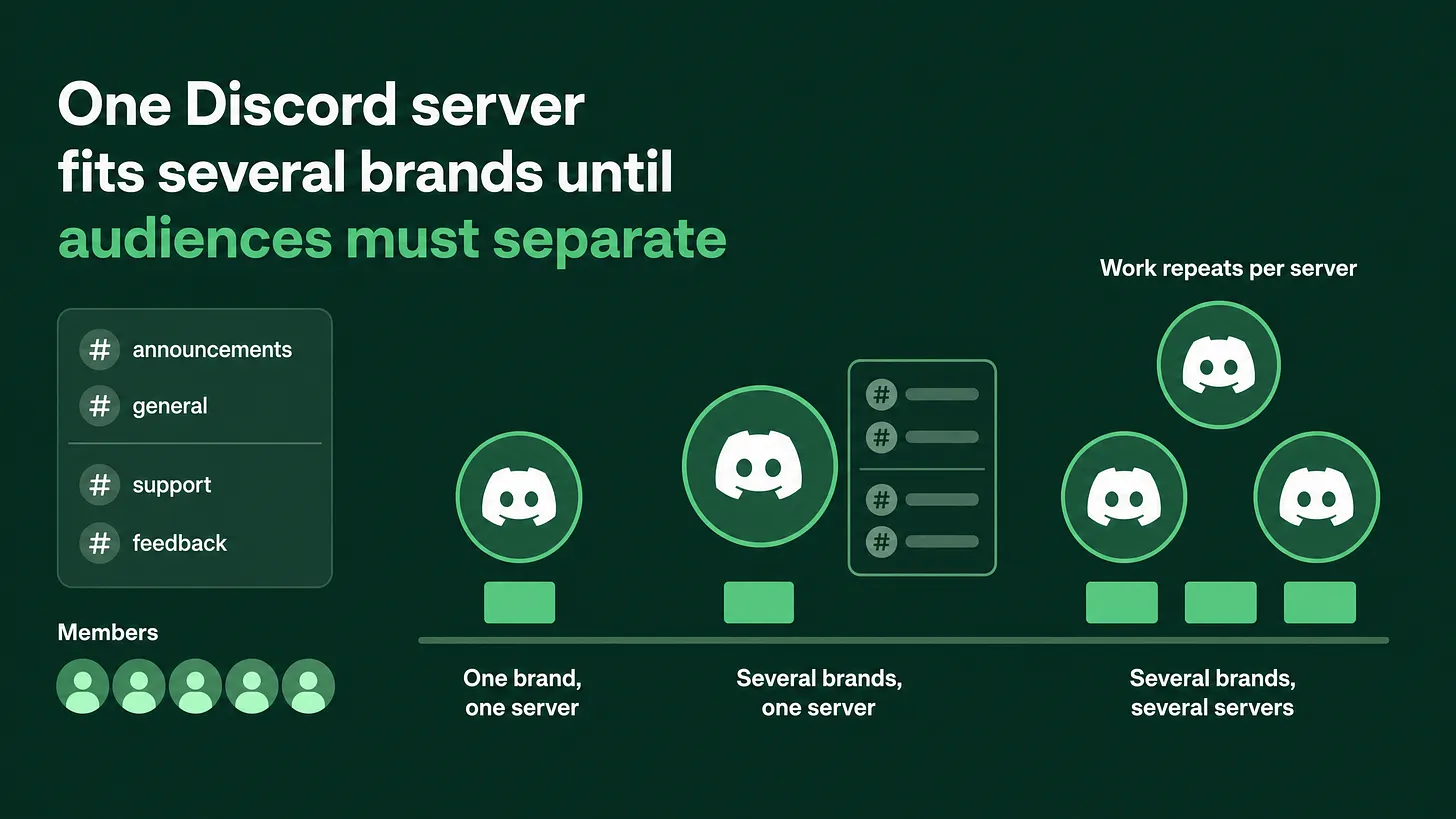
If you are deciding one Discord server or multiple for different brands, start with one. Ask every new member which brand brought them in, give them a brand role, and let the role open that brand's channels. Open a second server only when a written trigger fires, such as audiences that must not see each other or a brand being sold.
Two empty servers and a team with no spare hours
A company runs several brands. Leads arrive from ads, landing pages, newsletters and messaging channels. Somebody has already created a Discord server for two of the brands, both still empty, and the team that would have to run them is already busy. The open question is whether to build both servers or start with one. Start with one. Put every brand inside it, ask each new member which brand brought them in, and let that answer decide which channels they see. Keep a short written list of the conditions that would justify a second server, and open one only when a condition on that list is true. A few Discord features carry this model, and each is simpler than it sounds:
- Onboarding is Discord's built in join flow for Community servers. It shows new members a few questions when they arrive, and each answer can give them a role and a set of channels.
- Roles are labels on a member's account. They decide which channels a member can see and which announcements reach them.
- Categories are the folders in the channel sidebar. One category per brand keeps each brand's channels together.
- AutoMod is Discord's built in filter. It blocks messages that match rules you write. The reason to start with one is cost. Almost everything that makes a server safe and useful is paid once per server, regardless of how many people are inside it. Each server carries its own moderation rota, its own AutoMod rules, its own bots, its own announcement channel, its own onboarding flow and its own admin list. A second server doubles that fixed work even while it holds a handful of people.
A small server costs the team almost the same weekly work as a large one, so the number of servers is the number to keep low.
Stage one: one brand, one server
With one brand in one server, the structure is simple and very little breaks in the channels. The thing that breaks is ownership. Servers are usually created by whoever had a spare ten minutes. The server is then owned by that person's personal account. Nobody knows whether two factor authentication (a second login step, usually a code from a phone app) is switched on for that account. Admin rights get handed out in direct messages as people ask for them, and nobody writes down who has what. None of this shows while the server is small. It shows when that person leaves the company, or when their account is compromised and somebody else now controls the server your ad spend is sending people to. Fixing it takes minutes while the server is empty and days once it is busy. Run the ownership checklist further down before the first member arrives. Every server you add later will copy whatever habits this first one set, so this is the cheapest point to get them right.
Stage two: two or three brands in one server
Adding a second and third brand to the same server is where most teams either get the structure right or start drifting toward a second server without deciding to. Four things break if the server is left as it was built for one brand.
- Members land in the wrong room. Somebody who arrived through the second brand's funnel sees a channel list written for the first brand, cannot tell whether they are in the right place, and leaves.
- Announcements reach the wrong people. A launch for one brand pings every member. Members of the other brands learn to mute the whole server, and then they miss their own brand's news as well.
- Moderators guess. Nobody has said which rules apply in which channels, so each moderator enforces their own reading.
- Reporting blurs. You can see the server's total joins, but you cannot tell which brand's funnel is producing members who stay.
The fix is the one server model, and it has four parts.
An onboarding question for brand interest. Make it required and allow more than one answer. Word it plainly:
Which of our brands are you here for?Each answer grants that brand's role. Members who follow more than one brand pick more than one. Members can revisit their answers later from the server's Channels and Roles page, which is how a member of one brand becomes a member of two without ever leaving the server. Brand roles. One role per brand, named after the brand, for example@Brand A. These roles grant visibility and nothing else. Keep them separate from staff roles so that giving someone a brand never gives them permissions. Brand categories. Each brand gets one category that only its role can see, holding a news channel and a discussion channel to start. Add a help channel or anything else only when members ask for it. Shared spaces. The welcome and rules, a general channel, introductions and the help desk stay visible to everyone. These shared spaces are where members notice the other brands exist, and that is how a member of one brand ends up following a second. A layout that follows those four parts looks like this:
WELCOME            visible to everyone
  #start-here
  #rules
SHARED             visible to everyone
  #general
  #introductions
  #help-desk
BRAND A            visible to @Brand A
  #brand-a-news
  #brand-a-chat
BRAND B            visible to @Brand B
  #brand-b-news
  #brand-b-chat
STAFF              visible to @Staff
  #mod-log
  #staff-room

Onboarding question (required, multiple answers allowed)
  "Which of our brands are you here for?"
    Brand A  ->  grants @Brand A
    Brand B  ->  grants @Brand B
The harder decision inside one server is what to share and what to keep per brand. This is the split I use:
| Area | Shared across every brand | Kept per brand |
|---|---|---|
| Moderation | One moderator roster and one coverage rota for the whole server | A brand lead who can manage messages inside that brand's category |
| AutoMod rules | One base rule set for spam, scam links, invite links and slurs | Brand specific keyword rules, limited to that brand's channels by exempting the rest |
| Bots | One moderation bot and one logging bot, configured once | A content feed only for a brand that genuinely needs one |
| Staff roles | One staff role with moderation permissions | A brand lead role with no server wide permissions |
| Announcements | A server notice only for things that affect every member | One news channel per brand that pings the brand role, never everyone |
| Reporting | Total joins and how many members return after their first week | Members holding each brand role and activity in each brand category |
Reporting per brand comes almost free in this model. The role list shows how many members hold each brand role, so you can compare which funnel brings in members who stay without building anything. This model has a ceiling, and it arrives with one of the five triggers below, whatever the member count.
Stage three: several brands in several servers
When a company splits brands across servers, a different set of things breaks, and most of them are costs that were invisible while there was one server. Every fixed cost is paid again. Each server needs moderators covering the hours its members are active. AutoMod rules are written per server, so a scam pattern you block in one server keeps working in the other until someone copies the rule across. Bots are invited and configured per server. Staff get permissions in each server separately, which means each server has its own admin list to keep current. Onboarding is written and maintained per server. Moving between brands now costs a join. A member of one brand who would like to follow another has to find an invite, join a new server, sit through its onboarding and accept its rules. Each step loses people. Inside one server the same move is one changed answer. Security has more doors. Each server has its own owner account and its own list of people with admin rights. An old contractor who was removed from one server can still hold rights in another, because nobody checks both. Activity thins out. A server where few people are talking feels empty, and people leave rooms that feel empty. Splitting an audience across servers divides the conversation that makes each one feel alive. If a company is genuinely at this stage because a trigger forced it, the fix is a shared operations layer across the servers:
- One staff roster covering every server, so coverage is planned in one place.
- One base AutoMod rule set, copied to every server whenever it changes.
- The same bot setup in each server, owned by one named person.
- Announcement following for company wide news. In Community servers, an announcement channel can be followed from another server, so a notice written once appears in each server that follows it.
- One written process for banning someone across all servers when the reason applies to all of them.
- The ownership checklist applied to every server on the same schedule.
The decision table
Start with one server. Open a separate server only when one of these is true.
| Trigger | What you would actually see | If it is not true |
|---|---|---|
| The audiences conflict or must not see each other | One brand serves a group that would be put off or put at risk by seeing the other brand's members or conversation | Separate them by role and category inside one server |
| Compliance or moderation rules differ materially | One brand operates under rules about what members or staff may say that would make the other brand's normal conversation a risk | Add brand specific AutoMod rules scoped to that brand's channels |
| One brand's volume drowns the others | The shared channels and the moderation queue are dominated by one brand, and members of the others say they cannot find their own conversation | Tighten the shared spaces and give the quieter brands a fixed weekly moment of attention |
| A brand needs a different owner or team with its own admin rights | A separate team or partner needs full admin control that you would never give them over the other brands | Give that team a brand lead role limited to its own category |
| A brand is being sold or spun out | The brand will leave the company, and a server transfers to a new owner as a whole | Keep it in the shared server |
If none of the five is true, route with onboarding and roles. A brand's distinct look and voice fit comfortably inside its own category and its own role.
The staffing question for every extra server
Before a second server opens, answer these in writing, with a person's name beside each line:
- Who moderates it during the hours its members are active, and who covers when that person is away?
- Who maintains its AutoMod rules, and who copies changes across from the other servers?
- Who owns its bots, and who hears about it when a bot stops posting?
- Who writes its announcements, and how often?
- Who answers questions in it within the response time you promise everywhere else?
- Who reviews its admin list, and on what date? Then total the weekly hours those answers imply and set them against the hours those people actually have free. If any line has no name beside it, or the total is larger than the free hours, the server is not ready to open. A team that is already too busy to run one server will not find the hours for two, and a server that nobody runs teaches its first members that nobody is listening.
The ownership and security checklist for every server
Run this before the first member arrives, and again every quarter.
- The owner is a company controlled account, with its login and backup codes stored in the company password manager, never one employee's personal account.
- Two factor authentication is on for the owner account.
- The server's safety setting that requires two factor authentication for moderator actions is switched on. The owner account needs two factor authentication enabled before this setting can be turned on.
- The Administrator permission is held by as few people as possible. Moderators get the specific permissions they need instead.
- A written admin list exists outside Discord: each person's name, their role, the date access was granted, who approved it and why.
- Admin access is requested and granted in writing, by email or ticket, so there is a record of every change.
- Every bot is reviewed: which ones hold Administrator, who invited them, and whether they are still needed.
- The owner account's recovery email is a company address that survives any one person leaving.
How to split later without losing members
If a trigger does fire, a brand can move out of the shared server cleanly.
- Build the new server first and run the ownership checklist on it. A Discord server template copies channels and roles along with their permission settings, though never messages or members, so the brand's category can be rebuilt quickly.
- Announce the move in the brand's news channel, pinging the brand role, with a date and a permanent invite link.
- On that date, set the brand's old category to read only and pin the invite at the top of each of its channels. Leave it visible for a month.
- Remove that brand's answer from the onboarding question and add the new invite to the welcome channel, so new arrivals still find it.
- Follow the shared server's announcement channel from the new server, so company wide news keeps reaching those members.
- After the month, archive the old category.
Where this sits in the bigger picture
The one versus many decision is one part of role and channel architecture across a brand portfolio. That system has other layers: entry routing from each funnel into the right place, role architecture, moderation coverage, ownership and security, and reporting per brand. This piece covers the server decision and the one server model completely enough to set up without help. The layers around it are separate builds, and the most common gap is entry routing, where every funnel sends people to the same invite and nobody has checked what they see when they land. The number of servers a company runs is a staffing decision made in advance, whether or not anyone treats it as one. Deciding it on paper, before the second server exists, is far cheaper than discovering it a quarter later. More at danieljeong.org.