Onboarding Is Not a Welcome Message, It Is a Three Week Sequence
A new member can hold one instruction. Design the first fourteen days as three beats instead of one wall of text.

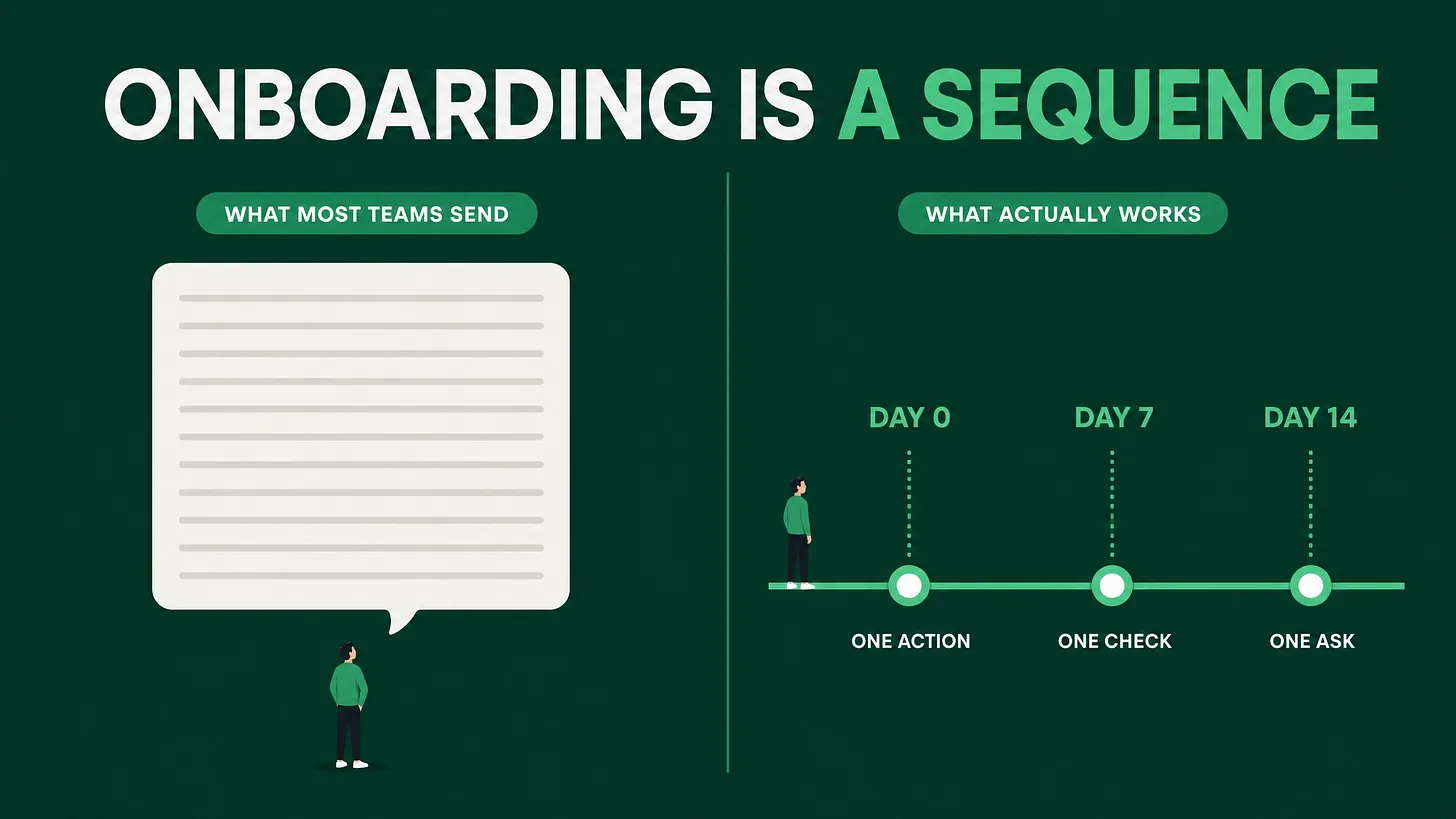
Onboarding fails because it is delivered as one long message at the moment a member has the least context. A person arriving somewhere new can hold one instruction. Build three beats instead: day zero gives one action and a named human, day seven checks whether it happened, day fourteen asks for a contribution. Deliver all three in a private thread so replying is the easiest thing to do.
The wall nobody reads
The standard community welcome is a wall. Here are the channels. Here is what each one is for. Here are the rules. Here are the roles and how to get them. Here is the schedule. Welcome aboard. It is written with care, it is accurate, and it does almost nothing, because it arrives at the exact moment a member has the least capacity to absorb it. They have been in the room for four seconds. They do not yet know why most of that information would matter. Then the team reviews activity in week two, sees a cohort that never posted, and concludes the members were low intent. Usually they were normal.
One instruction is the limit
Here is the constraint that should shape the whole design. Someone arriving in an unfamiliar space can hold one instruction. Not twelve. Not a numbered list of five. One.
Every instruction after the first is decoration. It gets skimmed, and skimming teaches a member that reading here is optional.
This is not a comment about attention spans. It is about sequence. A person cannot act on step four before step one has produced a result, so presenting all twelve steps at once converts a simple path into a research task. When onboarding requires a decision about where to start, most people resolve it by doing nothing.
Three beats over fourteen days
So the alternative is not a shorter welcome message. It is a sequence with a small number of beats, each asking for exactly one thing.
| Beat | What it asks for | What it is really doing |
|---|---|---|
| Day 0 | One action | Producing a first post and a human contact |
| Day 7 | One check | Catching the silent drop before it becomes churn |
| Day 14 | One contribution | Converting a visitor into a participant |
Day zero: one thing to do
The first beat has two jobs and neither of them is education. A named human introduces themselves and explains, briefly, who handles what. Then the member is asked to do exactly one thing. Post in a specific channel. Answer one question. Choose one role. Which action matters far less than the fact that there is only one. The first post is the whole point. A member who has written something in your community behaves differently from one who has only read, because the cost of the second message is a fraction of the cost of the first.
Most communities hand a new member a channel to read. Handing them a person to reply to is a different product entirely.
Day seven: check what happened
The second beat is the one almost nobody builds, and it is where the losses are. A week in, every member is in one of two states. They took the first action, or they did not. Those two states need different messages, and sending the same broadcast to both wastes the beat. Someone who acted gets pointed at the next layer. The room where the real conversation happens, the recurring thing worth attending, the deeper resource. They have proved the path works, so extend it. Someone who did not act gets a direct question instead of another announcement. Something narrow enough to answer in one line, aimed at what they said they came for. Not a nudge to read the rules again. This matters because the silent drop leaves no trace. A member who never posted generates nothing to investigate, so the loss never appears as a problem. It appears as a number that was always a little lower than expected.
Day fourteen: ask for something
The third beat inverts the direction. For two weeks the community has been giving. Now it asks. A piece of feedback. A description of what they are working on. An opinion on something the team is deciding. A question they have not asked yet. Contribution is the mechanism that turns attendance into membership. People stay in rooms where they have put something of their own, and almost nobody is willing to contribute in the first hour. Two weeks in, with one post already behind them and a human they have spoken to, the ask is reasonable.
The format does most of the work
The sequence only functions if it is delivered somewhere a reply is natural. Three properties matter.
- A private thread, not a channel. An announcement in a public channel is a broadcast, and a broadcast implies no reply is expected. A thread opened for one person implies the opposite.
- A named human, not the server. A message signed by a person can be answered. A message from the community as an institution cannot.
- One ask per beat. This is the constraint that keeps the whole thing honest. The moment a beat contains three requests, it becomes a wall again, only shorter. The day fourteen mark is not sacred. Two weeks is a reasonable default because it is long enough for a member to have formed an impression and short enough that they still remember arriving. Adjust it to your rhythm and keep the structure.
Where the information goes
A fair objection: the channel guide, the rules, and the role explanations all still need to exist somewhere. They do, and the answer is that reference material belongs in a reference place. Pinned, searchable, findable when a specific question comes up. What it should not be is the first thing a member is asked to process, because reference material answers questions people have not thought of yet.
Documentation exists to be found. Onboarding exists to produce a first action. Combining them produces a document that fails at both.
What this changes
The effects are unglamorous and they compound. First posts happen sooner, which means members become visible while there is still time to help them. Silent drops get caught at day seven instead of being discovered in a quarterly review. Questions land in the open more often, because every member has already spoken to a person. And the members who reach day fourteen have contributed something, which is the closest thing to a retention guarantee that community work offers. None of it requires new tooling. It requires deciding that onboarding is a sequence somebody owns rather than a document somebody wrote. Onboarding is not the information you hand a new member. It is the first two weeks of their relationship with your community, and most teams leave those two weeks entirely to chance.
Nobody joins a community and reads the manual. They answer the person who spoke to them first. danieljeong.org