Nobody Wakes Up Wanting a Community Manager. They Hit a Wall First.
The decision to fix a community rarely sounds like a hiring decision. It sounds like a problem the business can no longer afford to ignore.

The Decision Never Sounds Like a Decision
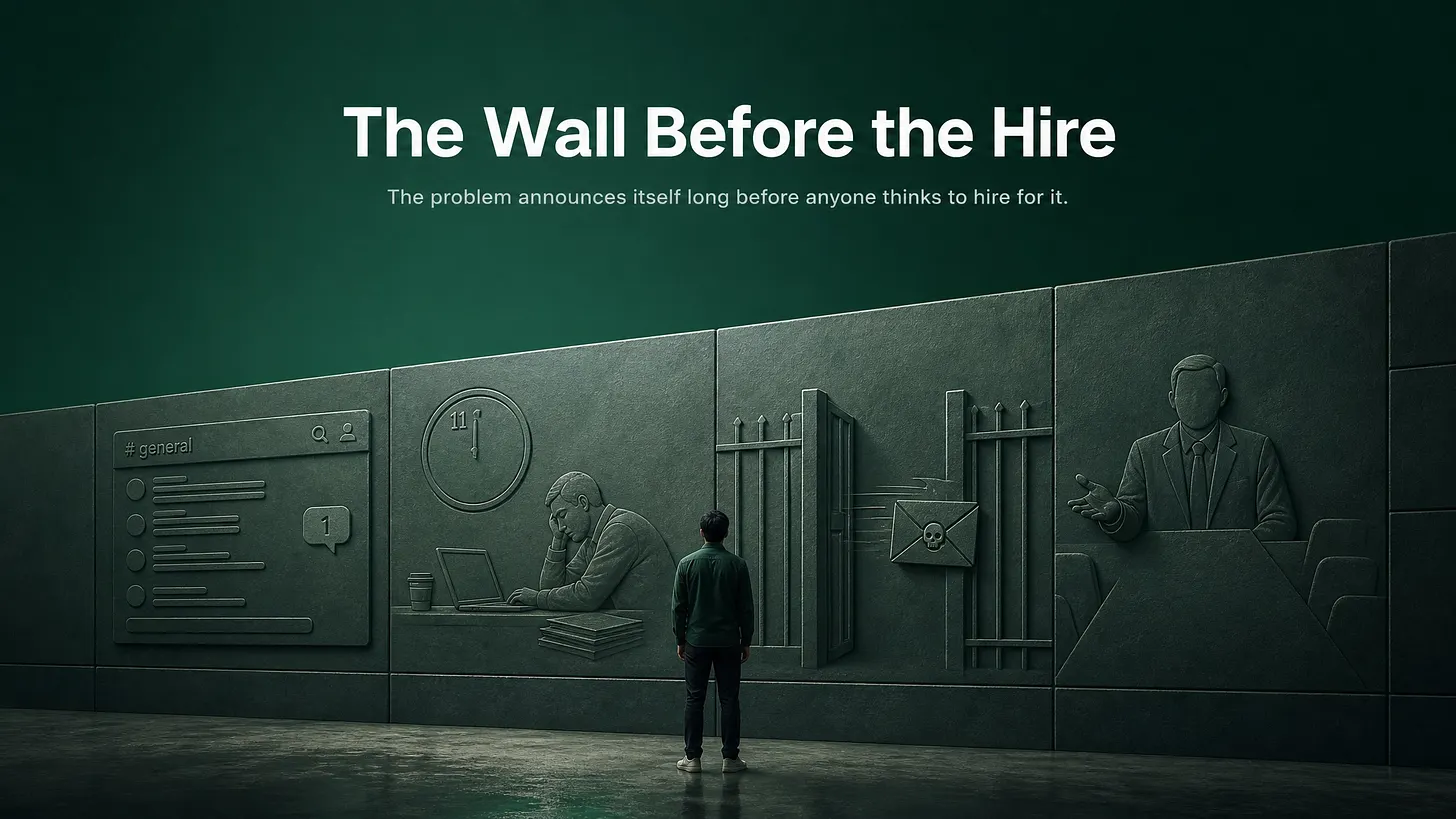
Founders and marketing leads rarely arrive at the thought that they need a community manager. They arrive at a problem they can no longer walk past. The realization does not announce itself in the language of hiring or org charts. It shows up as a specific, uncomfortable moment in an ordinary week, and the moment is usually one they have been quietly aware of for a while before it finally forces a response. That gap matters, because it explains why so many communities sit in trouble for months before anyone acts. Nobody scheduled a review of the server. Nobody put community health on the roadmap. The problem simply kept growing in the background until it collided with something the business actually cared about, and only then did it become real. If you want to understand when a community becomes a priority, stop looking for the hiring decision and start looking for the wall.
The Dead Server a Prospect Sees
One of the most common walls is silence. A company launches something, gets a rush of interested people into the server, and then attention drifts. The team gets busy. The messages slow, then stop. What remains is a channel that looks abandoned, and the damage is not that the existing members left. The damage is what every future prospect sees. Someone considering the product clicks the invite link, lands in the community, and finds a dead room with one old message and no signs of life. They do not think the community is quiet. They think the product is quiet. A silent server reads as a company that lost interest in its own thing, and that impression forms in seconds, long before anyone from the team has a chance to counter it. The server was supposed to be social proof. It became the opposite.
The Hours Nobody Budgeted For
Another wall is time, and it usually lands on a marketing manager who never signed up for it. The community was somebody's side responsibility, so now they are the one answering the same three questions at eleven at night, smoothing over small conflicts, and keeping an eye on the server between the campaigns they are actually measured on. None of it is on their job description, and all of it is quietly eating the hours they need for the work that grows the business. This wall is dangerous because it hides. The person absorbing the cost often does not report it, since it feels like something they should be able to handle. So leadership sees campaigns underperform without ever connecting it to the fact that their marketing lead is spending a third of their attention babysitting a chat room. The community is not just failing to help. It is actively pulling effort away from the work that was supposed to matter.
The Risk That Shows Up Before a Big Moment
Sometimes the wall is fear. A scam message slips into the server through a direct message to a member. Spam starts creeping into channels. Someone posts something that should never have been the first thing a visitor sees. Any of these is a problem on a normal day, and it becomes a genuine liability right before a launch, a funding announcement, or any moment when a wave of new attention is about to arrive. An unmoderated server is a reputation surface the company does not control. When thousands of new eyes are about to land on the community because of an announcement, the absence of moderation stops being a background worry and becomes an active threat to the moment the team has been building toward. The realization here is sharp and sudden. A space that felt harmless suddenly feels like something that could embarrass the brand in front of exactly the audience it wanted to impress.
The Question From Leadership
There is a quieter wall that often forces the issue faster than any of the others. A CEO, a board member, or an investor asks a simple question. What is the community actually doing for us. And the person responsible has nothing to say. No metric, no story, no evidence of value, just a vague sense that the server exists and some people are in it. That silence is its own kind of failure. It signals that the community was never set up to produce anything a business could point to, which means it has been running on faith rather than on results. The moment leadership asks and gets no answer, community stops being a nice extra and becomes a problem someone now owns, because the absence of a story in that meeting reflects on the person who was supposed to have one.
When Theirs Looks Better Than Yours
The last common wall is comparison. Someone on the team looks at a competitor's server and sees it running clean and active, with events happening and members talking, and their own community suddenly feels embarrassing by contrast. That comparison does more than sting. It reframes the community from something the team had stopped thinking about into a visible gap between them and the people they are trying to beat. Comparison is powerful because it removes the excuse that this is just how communities are. Seeing another one work proves that the silence and the mess were never inevitable. They were the result of the other team building something and this team not. Once that is clear, the question stops being whether the community matters and becomes why theirs is working and ours is not.
None of These Are Discord Problems
Every one of these walls gets blamed on the platform. The server is dead, so Discord must be the wrong choice. The moderation failed, so the tools must be inadequate. The team cannot show value, so the whole idea of a community must be overrated. None of that holds up. The platform did exactly what a platform does. It hosted whatever was built on top of it, and what was built was a chat room, not an operation. A chat room greets no one, routes nothing, and produces no record of its own value. It sits there and waits for people to figure it out on their own, and most of them do not. When a business asks that chat room to behave like infrastructure, to retain members, protect the brand, and report on its impact, it fails, because it was never given the structure to do any of that. The walls founders hit are not evidence that the platform failed. They are evidence that nothing was ever built.
What Building It Actually Looks Like
The fix is to treat the community as a system with an owner, a structure, and a job to do. A system greets new members on purpose so the first thing a prospect sees is life rather than silence. It routes questions somewhere other than the one overloaded person, so the marketing lead gets their evenings back. It has moderation in place before the big moment arrives, so a wave of attention is an opportunity instead of a risk. And it produces a record of what it is doing, so the answer to the leadership question already exists before anyone asks it. None of this happens by accident, and none of it happens by working harder inside a broken structure. It happens by deciding, on purpose, what the community is for and building the parts that make it do that. So if your server has started to feel like a liability rather than an asset, treat that feeling as information rather than a verdict on the platform. It is telling you the structure was never built for what you now need it to do, and that is a problem you can solve.
Daniel Jeong builds community infrastructure for SaaS, AI, and eCommerce brands that need Discord to work like a system rather than a chat room. If your server has started to feel like a liability, the structure can be built. danieljeong.org