Never Open a Channel You Cannot Staff
Every channel, feature, and open room in your community is a standing promise, and unstaffed promises do more damage than missing features.

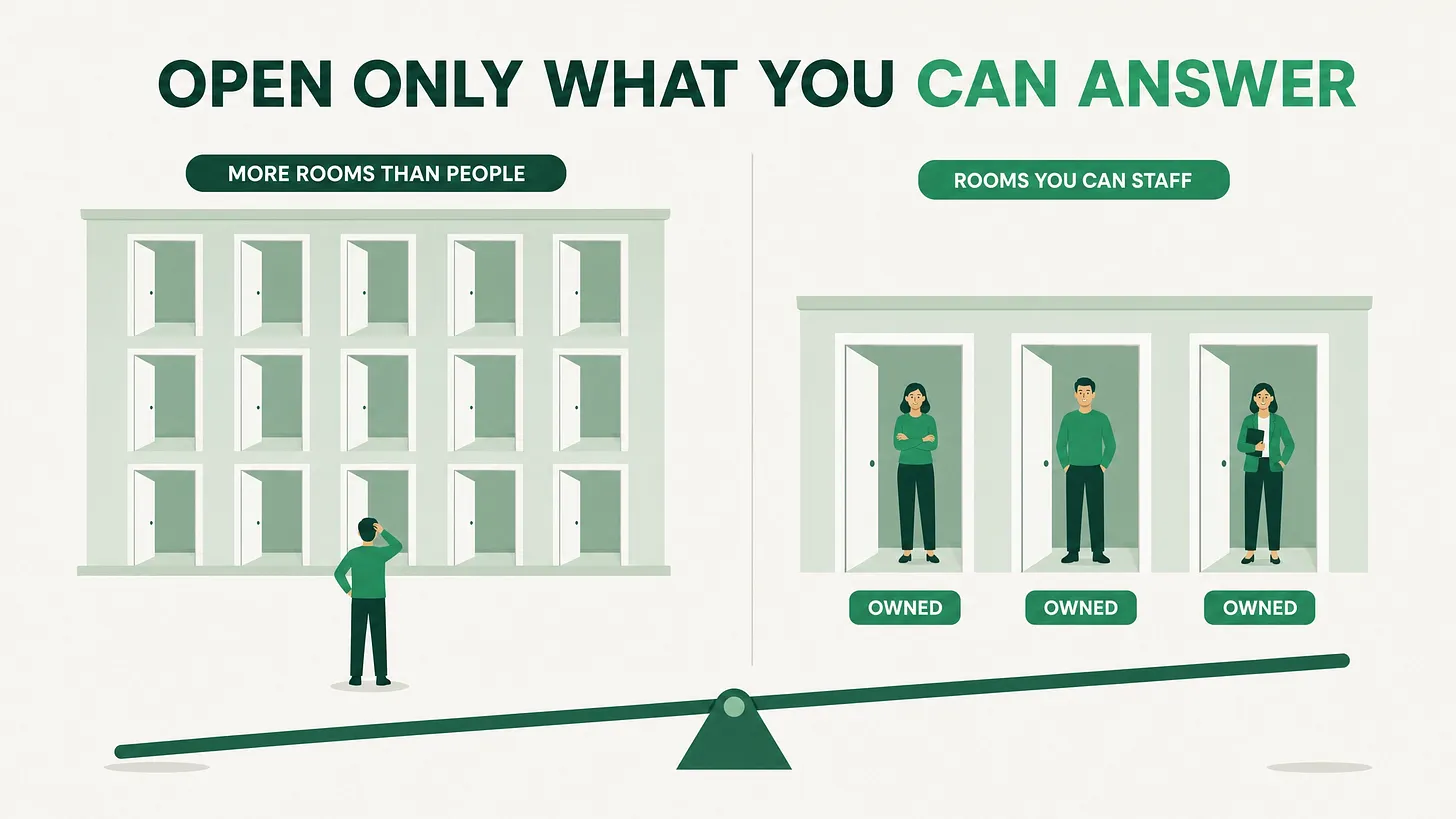
Every channel, feature, and open room in a community is a standing promise that someone has to keep. Unstaffed rooms read as neglect rather than as neutral space, which is why lean communities that answer beat sprawling ones that do not. Before opening anything, name the owner, set a response standard, and plan for the team's worst week.
The wrong diagnosis
When a community feels dead, the instinct is to add. A new channel for the thing people keep asking about. A voice room, since other servers have one. A feedback channel, because gathering input sounds healthy. A ticket system, because support should be organized. The list grows and the room gets quieter. That outcome is not a coincidence, and it is not bad luck. Adding more rooms to an understaffed community makes it feel emptier, because the emptiness now has more places to show. The defect in most struggling communities is rarely a missing feature. It is a pile of channels with nobody behind them.
Every channel is a promise
This is the part that gets skipped. A channel is not a container. It is a commitment, made in public, on behalf of whoever is supposed to be watching it.
| What you opened | The promise it makes |
|---|---|
| Open voice room | Someone might be in here |
| Support channel | A reply is coming |
| Feedback channel | A human reads this |
| Ticket system | Escalation exists and works |
| Introductions channel | You will be welcomed |
| Suggestions box | Decisions get influenced here |
Members never read the promise out loud, and they absolutely register it. Post an introduction into a channel where the last three introductions went unanswered and the lesson lands immediately. This place looks staffed and is not.
Silence is not neutral
Here is the asymmetry that makes this expensive. A channel that does not exist costs you nothing. A channel that exists and stays silent costs you trust.
Empty space in a room that was clearly built for conversation does not read as calm. It reads as abandoned.
Nobody resents a community for lacking a voice channel. Plenty of people quietly downgrade a community for having one that has been empty for six months. An unstaffed channel is worse than a missing one, because it converts a neutral gap into visible evidence of neglect. The same logic runs through everything. A feedback channel with no responses teaches members that their input disappears. A ticket system with slow resolution teaches them that escalation is theatre. Each unkept promise is a small lesson, and the lessons accumulate faster than the channels do.
The capacity check
The fix is a gate, applied before anything gets created. Three questions, and all three need real answers.
- Who owns this specifically. A named person, not a team and not a role. Shared ownership of a channel reliably produces the worst outcome in community work, where everyone who sees a message assumes somebody else has it.
- What is the response standard. Same day. Within an hour during business hours. Weekly summary. The number matters less than its existence, because a standard is what makes a miss visible internally before it becomes visible externally.
- What happens on the worst week. Every team has weeks where delivery work swallows everything. If a channel only functions when things are calm, it does not function. Decide in advance whether it gets covered, paused, or closed.
Anything that cannot clear all three is not ready to exist.
Not yetis a legitimate answer, and it is much cheaper than a broken promise.
Features deserve the same test
This applies well beyond channels, and voice is the clearest case. Voice channels look like community. They are also the fastest way to advertise an absent team, because presence is binary and visible. A member glances at the sidebar, sees nobody in the room, and updates their model of the place. Repeat that daily for a month. For a small team, the right move is to treat voice as event infrastructure rather than ambient infrastructure. Open it for a scheduled session with a person committed to being there, then close it. The emptiness stops being a statement because there is nothing to look at.
Ambient features imply constant presence. Scheduled features imply a commitment you actually keep. When capacity is limited, choose scheduled every time.
Run the same reasoning across leveling systems, points economies, weekly rituals, and anything else that requires ongoing human attention. If the mechanism needs a person to stay alive, its real cost is that person's time, not the setup.
Subtraction as a strategy
When you inherit a sprawling community, the highest leverage work is usually removal. Walk the channel list and sort every room into three buckets. Owned and meeting its standard. Owned and failing. Unowned. The first bucket stays. The second gets a fix or a lowered standard, stated publicly. The third gets archived. Archiving feels like a loss and reads as focus. Members notice tighter, faster rooms much more than they notice a missing channel they never used. A community with five living rooms is a better product than one with twenty five rooms, five of which are alive. There is a second benefit. Concentrating the same traffic into fewer channels raises the visible activity in each one, which makes the community feel busier without a single new member. Density is a design choice.
Small and answered beats large and silent
The underlying principle is not restraint for its own sake. It is a match between what you have built and what you can operate. Infrastructure means something that works when it is used. By that standard, three channels with named owners and a response standard is infrastructure. Twenty five channels maintained by hope is decoration that happens to be interactive. Build for the team you have on their hardest week. Everything left standing after that filter is real.
A room nobody answers in teaches people not to speak. Build fewer rooms and keep every promise attached to them. danieljeong.org