Members Can See the Channels They Can't Use Yet, and That's the Point
Why visible restriction outperforms both open access and a fully hidden structure.

The Two Ways Onboarding Usually Fails
Most Discord communities pick one of two onboarding defaults, and neither one was chosen on purpose. The first default is full openness. Every channel is visible and usable from the moment someone joins, verification happens once, and the entire server sits open in front of a member who has done nothing yet to demonstrate interest. The second default is the opposite. Everything stays hidden behind a role that only a moderator can assign, usually after some manual check that depends on someone being online and paying attention. Both defaults create the same failure from different directions. In the fully open version, there's no momentum, no sense of progression, and no reason for a member to do anything beyond scrolling. In the fully hidden version, the member has no idea what they're working toward, because they can't see it. They just know something exists somewhere, and they're waiting on a person instead of a process. Neither of these is really a system. They're defaults that got left in place because nobody thought to question them, and the cost shows up quietly in onboarding completion numbers that never get evaluated closely enough to notice the gap.
What Changes When the Destination Is Visible
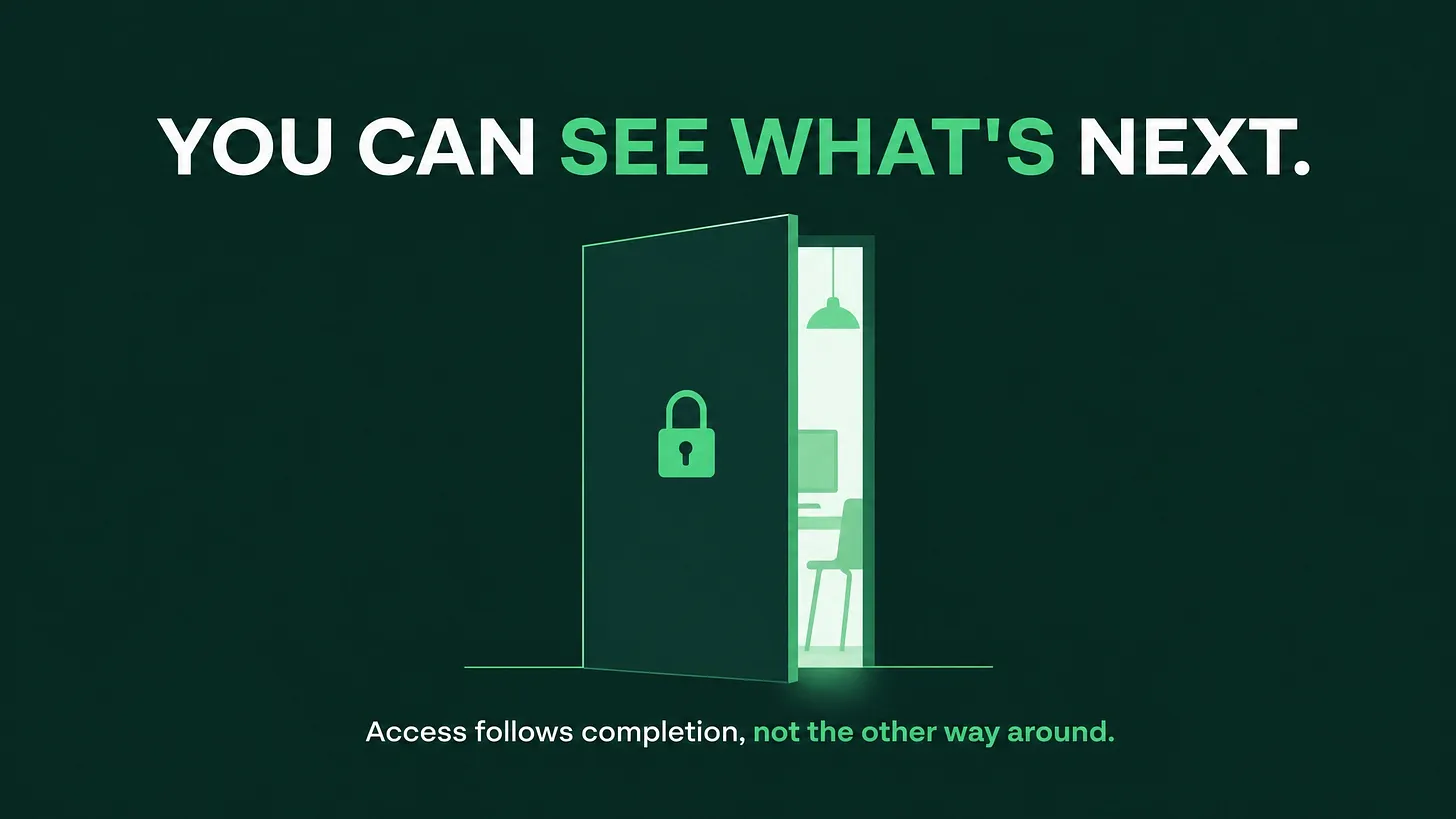
There's a third pattern that shows up in the better run communities I've been inside, and it comes from a small decision that most builders skip. New members can see the entire channel list from the moment they join, including the channels they don't have permission to open yet. The names are visible. The structure is visible. What's missing is access, and access is tied to a short, specific sequence rather than a person's availability. In one build I worked on, new members watch four short instructional modules, then take a short quiz. The moment they pass it, a role gets applied automatically, and every previously locked channel opens at once. Before that happens, they've already scrolled past those channel names. They know they exist. They know roughly what's inside, because the names describe it plainly. The only thing standing between them and that access is a sequence they can complete on their own schedule, without waiting on anyone. This single design choice changes the psychology of onboarding completion. A locked channel that's visible in a list functions as a constant, quiet, self generated reminder. It doesn't require a bot to ping the member. It doesn't require a moderator to notice they stalled out on module two. The structure itself keeps doing the reminding, for as long as the member stays in the server looking at that list.
The Sequence That Makes This Work
The mechanism underneath this is simpler than it looks. Content gets sequenced: watch this, then this, then this, then this. A short quiz checks whether the sequence actually landed, rather than assuming it did. Passing the quiz triggers an automatic role assignment, and that role is what the channel permissions are actually built around. None of this requires a person to sit and manually grant access one member at a time. The entire loop runs without anyone from the team touching it after it's built once. What changes for the member is that the finish line was visible before they started running toward it. What changes for the team is one less manual task competing for attention during a week that's already full of them. The reason this beats a fully hidden structure isn't really about automation, even though the automation matters. It's about what the member sees while they're in the middle of the process. Confidence about what's coming next is worth more than most communities give it credit for, and it's cheap to build once the sequence exists.
Why Reminders Are a Weaker Substitute
A lot of communities try to solve the same problem with reminders. A bot messages members who haven't finished onboarding after a set number of days. A moderator manually checks in on stragglers. Both of these treat the symptom, not the design. They're reactive measures layered on top of a structure that gives members no reason to move quickly on their own. Visibility is proactive in a way reminders can't match, because it doesn't depend on anyone remembering to send a message. It sits in the interface itself, every time the member opens the app. There's no timing decision to make about when a reminder should fire, no tone to calibrate so it doesn't feel naggy, no operational overhead of tracking who's already been reminded and who hasn't. This doesn't mean reminders have no place. It means they should be a backstop for people who genuinely fell off, not the primary mechanism keeping onboarding moving. The primary mechanism should already be built into what members can see the moment they arrive.
What This Requires From Your Infrastructure
None of this works if the channel names themselves are vague. A locked channel with a name like "general two" gives nobody a reason to care that it's locked. A locked channel named for what it actually offers gives members something concrete to want. The visibility only pays off if there's something worth being curious about on the other side of the lock. It also requires that the unlock sequence actually leads somewhere proportional to the wait. If four modules and a quiz unlock a server that turns out to be mostly quiet, the completion earns disappointment instead of trust. Visibility creates an expectation, and the expectation needs to be met on the other side of that door.
The Executive Read
The instinct to make onboarding simpler often points teams toward opening everything immediately, on the theory that friction is always the enemy. Friction isn't always the enemy. The right kind of friction, paired with visibility into what it's protecting, is what makes a member want to move through it quickly instead of ignoring it entirely. If your onboarding funnel isn't converting the way you'd expect, look at what members can actually see before they've done anything. If the answer is nothing, or everything, you've found the gap. The fix isn't more messaging. It's redesigning what's visible before access is earned. A locked channel that a member has already seen is doing work that no reminder message will ever do as reliably, and it costs nothing to keep doing that work once it exists.
Generalized from onboarding builds across multiple client Discord communities. danieljeong.org