Marketing Budget Gets People to Your Discord. It Does Not Keep Them There.
Paid reach fills the top of the funnel. Retention is a separate system, and it is the one most founders forget to build.

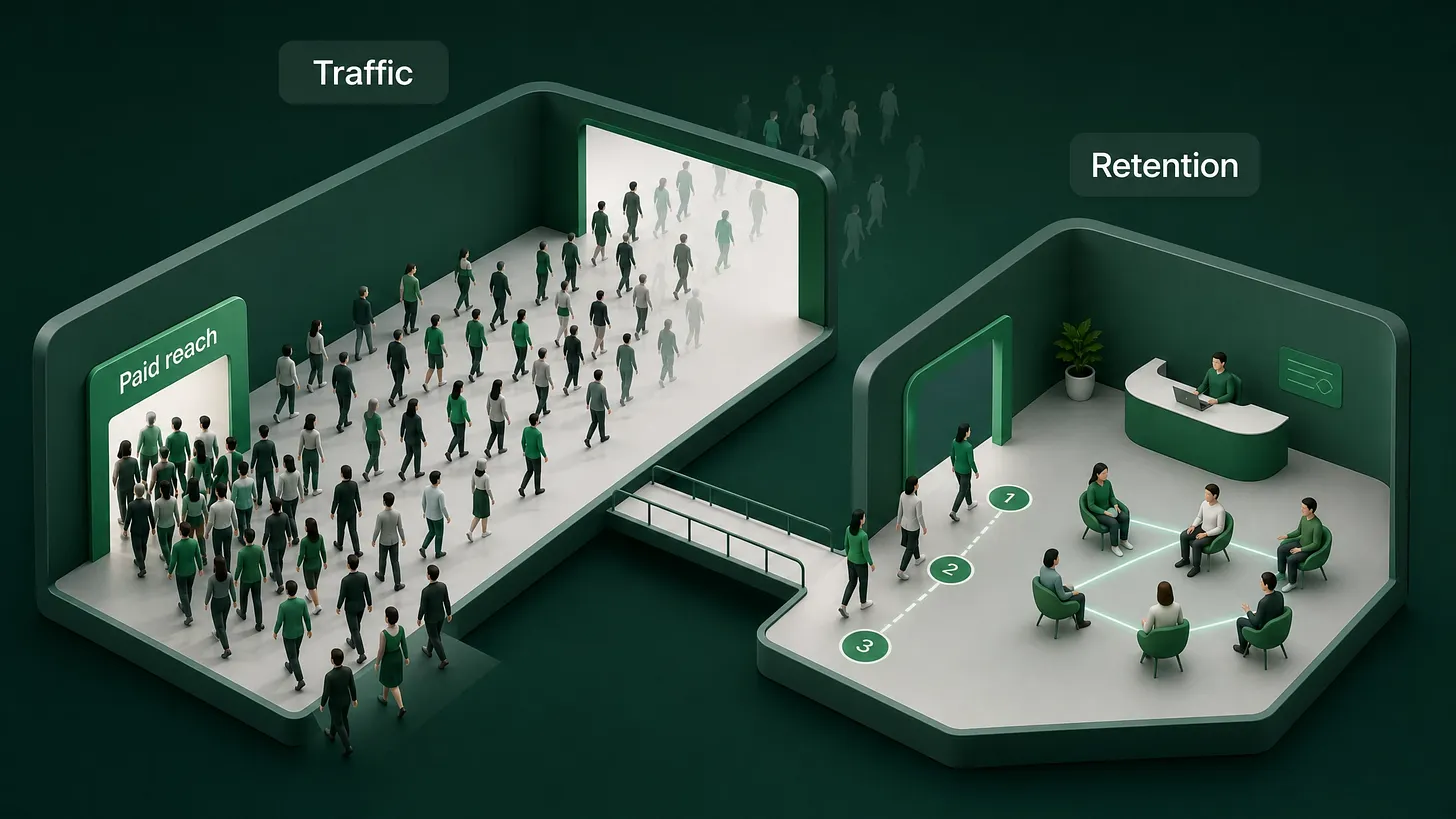
The plan that sounds right
A founder walked me through his launch plan with real conviction. He would fund the marketing himself, get roughly a million eyes on the app inside two months, and then send a fraction of those users into his Discord. In his framing the community was a downstream reward. Prove you can drive attention and the room fills itself. The plan is common because it feels logical. Reach seems like the hard part. It costs money, it takes coordination, and once you have shown you can move a large audience, a busy community looks like the natural next step. The trouble is that attention and belonging are produced by two different systems. Only one of them responds to ad spend.
A crowd is not a community
Point a large audience at an empty server and the outcome is easy to predict. People arrive, look around for a few seconds, and leave. A big number at the top does nothing to change what a single person experiences the moment they land inside. They see a column of channels, a scroll of messages they were never part of, and no clear reason to type. Most of them close the tab. When that happens the money that delivered them is already spent. You did not gain a member. You paid for a visit. Everything that separates a visit from a membership sits on the far side of the click, and that is the part a marketing budget cannot reach.
What a newcomer actually experiences
Watch a real person enter a community for the first time and you can almost hear the questions. Where am I. What am I supposed to do here. Will anyone notice or care if I say something. Those questions get answered in under a minute, and the answer decides whether the person stays. A server with a strong first minute answers all three without being asked. The entry point is obvious. There is one clear action to take before anything else. Some signal, human or automated, acknowledges the person quickly so they feel seen. A server with a weak first minute leaves all three questions hanging, and silence at the threshold reads as rejection even when no one meant it that way. This is why two communities with identical launch numbers can end up in completely different places. The gap is not traffic. It is what the traffic met when it arrived.
Retention is a system, not a mood
Founders often talk about engagement as if it were a feeling that either shows up or does not. In practice it is the output of a handful of deliberate mechanisms working together. A guided entry that gives new members direction. A first action small enough to complete immediately. A response layer that reacts within seconds rather than hours. A reason to return the next day that does not depend on luck. None of that is glamorous, and none of it appears in a launch announcement. It is closer to operations than to marketing. But it is the difference between a room that compounds and a room that leaks. Communities that hold people treat the first session as a designed experience, not an accident that happens after the ads run.
Where the budget should actually go
The order matters more than the amount. Spending heavily on reach before the entry is built means paying full price to fill a bucket with holes in it. Every arrival that leaves is a receipt for money that produced nothing durable. Founders rarely see this clearly because the arrival numbers look healthy, and the churn hides one member at a time. A better sequence puts the first version of the retention system in place before the spend scales. Design the entry. Decide the first action. Build the response layer. Then drive traffic into a room that can actually keep a portion of it. The same budget now buys members instead of visits, and the community starts to hold its own shape between campaigns.