If Members Cannot Find the Support Channel, You Do Not Have Support
Discoverability is an operational decision, and most community teams never test the path a member actually takes to ask for help.

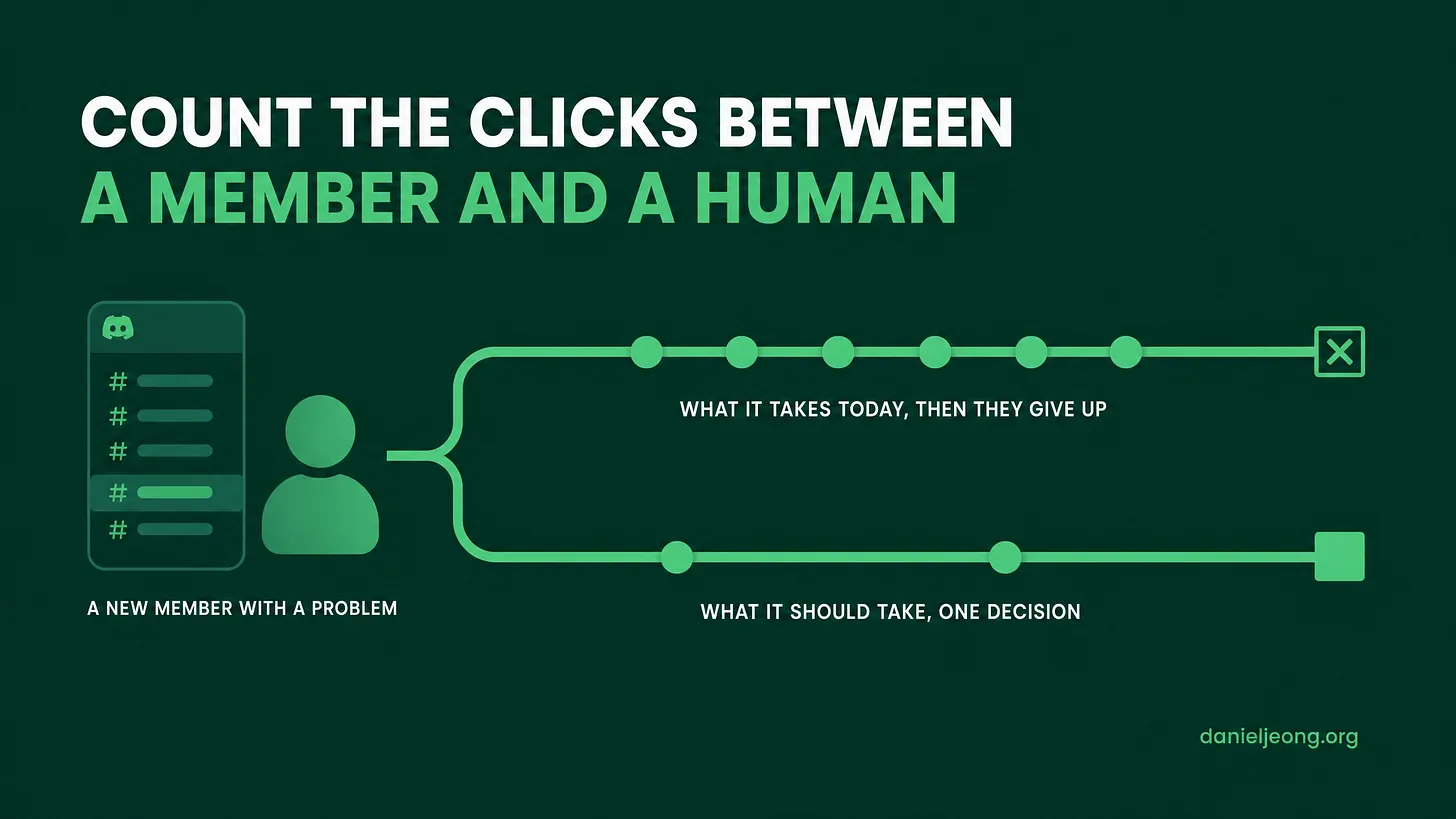
Support that members cannot locate performs exactly like no support at all. Placement, naming and the gap between the owner view and the member view are the usual causes. Move the entry point up, name it for the action, pin one link, and test the path from a roleless account.
One of the most reliable ways to find a broken community is to try to get help in it as a stranger. Not as an owner, not as a moderator with every channel unmuted and every permission granted, but as someone who joined this morning and has a problem right now. Most servers fail that test badly, and the teams running them have no idea, because nobody on the team has ever taken it.
Installed is not the same as reachable
There is a category of community problem that never appears in any report. The ticket tool is configured correctly. The staff role has the right permissions. Response times, when tickets actually arrive, are good. Leadership looks at the setup and concludes support is solved. What is missing is the path. A member with a problem has to convert a feeling into an action, and the community has to make that conversion take as close to zero effort as possible. When it does not, the member does the next easiest thing, which is to post in whatever channel is already open, where the message competes with conversation and loses.
The system was never tested against the state a member is in when they need it, which is impatient, mildly annoyed, and not reading carefully.
Two causes, both structural
Placement follows build history, not member need. Support gets added late in most builds. Late additions land at the bottom of the channel list, and nobody reorders afterward because the order looks fine to the people who already know where everything is. The result is a structure that documents how the server was assembled rather than how it is used. Owners and members are looking at different products. This is the one that catches experienced teams. Your view of the server is filtered by permissions you granted yourself, sorted by unread activity, collapsed into categories you set up months ago, and navigated almost entirely by habit. A new member sees the full list, in order, with no history and no muscle memory. You are effectively evaluating a product you cannot see.
⚠️ The honest test is to hold an account with no roles at all and use it monthly. Not a staff account with roles removed, a genuinely separate account that joins the way anyone else does. Most teams discover something surprising within the first two minutes.
Four fixes, none of them expensive
| Fix | What it looks like | Why it works |
|---|---|---|
| Move it up | Support sits above social channels and directly below the welcome sequence | Members scan from the top and stop scanning quickly |
| Name the action | Channel reads as getting help rather than as a tool name | Nobody in distress goes looking for a ticket |
| Pin one link | A single pinned message in the first channel points straight to it | Removes navigation from the equation entirely |
| Test with no roles | A monthly walkthrough from a roleless account | Catches drift before members do |
None of this requires budget, tooling, or a rebuild. It requires someone to decide that the path to help is a designed object rather than a byproduct of how the server grew.
The measurement problem
Here is why this failure survives for years inside otherwise competent organisations. When support is hard to find, ticket volume goes down. Ticket volume going down looks like success on every dashboard that tracks it. The real signal is elsewhere and much harder to see:
- Problems described in general chat that never became tickets
- Members who went quiet within their first week and never returned
- Repeat questions from people who could not find the answer or the person A falling ticket count in a growing community is a warning, not a win. Pair the two numbers permanently so nobody can read one without the other.
What silence actually costs
A member who cannot find help does not usually complain. They make a small private judgement about how responsive this community is, and that judgement is close to permanent. It rarely gets revisited, because there is no second moment of need that feels different from the first. That is what makes the problem strategic rather than cosmetic. Response speed is one of the strongest drivers of perceived quality in any community, and a member who never asks a question experiences an infinite response time. From the inside, that member simply looks inactive. By the time the pattern surfaces in a retention report, the decisions that produced it were made weeks earlier by people who are already gone.
Run the walkthrough this week
SUPPORT PATH AUDIT

1. Join the server from an account with no roles
2. Start a timer
3. Try to get a human to answer one specific question
4. Record every click and every decision point
5. Stop when you succeed or when you would have given up

PASS CONDITION: one decision, under thirty seconds
Write down the number of decisions. Anything above one means a member arriving with a real problem will make a different choice than the one you designed for. The path to help deserves the same scrutiny a checkout flow gets, for the same reason. Both are moments where someone has already decided to engage with you, and both fail quietly when the route is unclear.
A community is judged on the day something goes wrong, and the judgement happens before anyone on your team is even aware of it. Make the route obvious. More on community infrastructure at danieljeong.org.