How to Show Social Proof in a Discord Community Without Writing a Single Testimonial
Asking members to share their wins produces an empty channel. Capturing what they already posted, with one reaction and no editing, produces a room that sells itself.

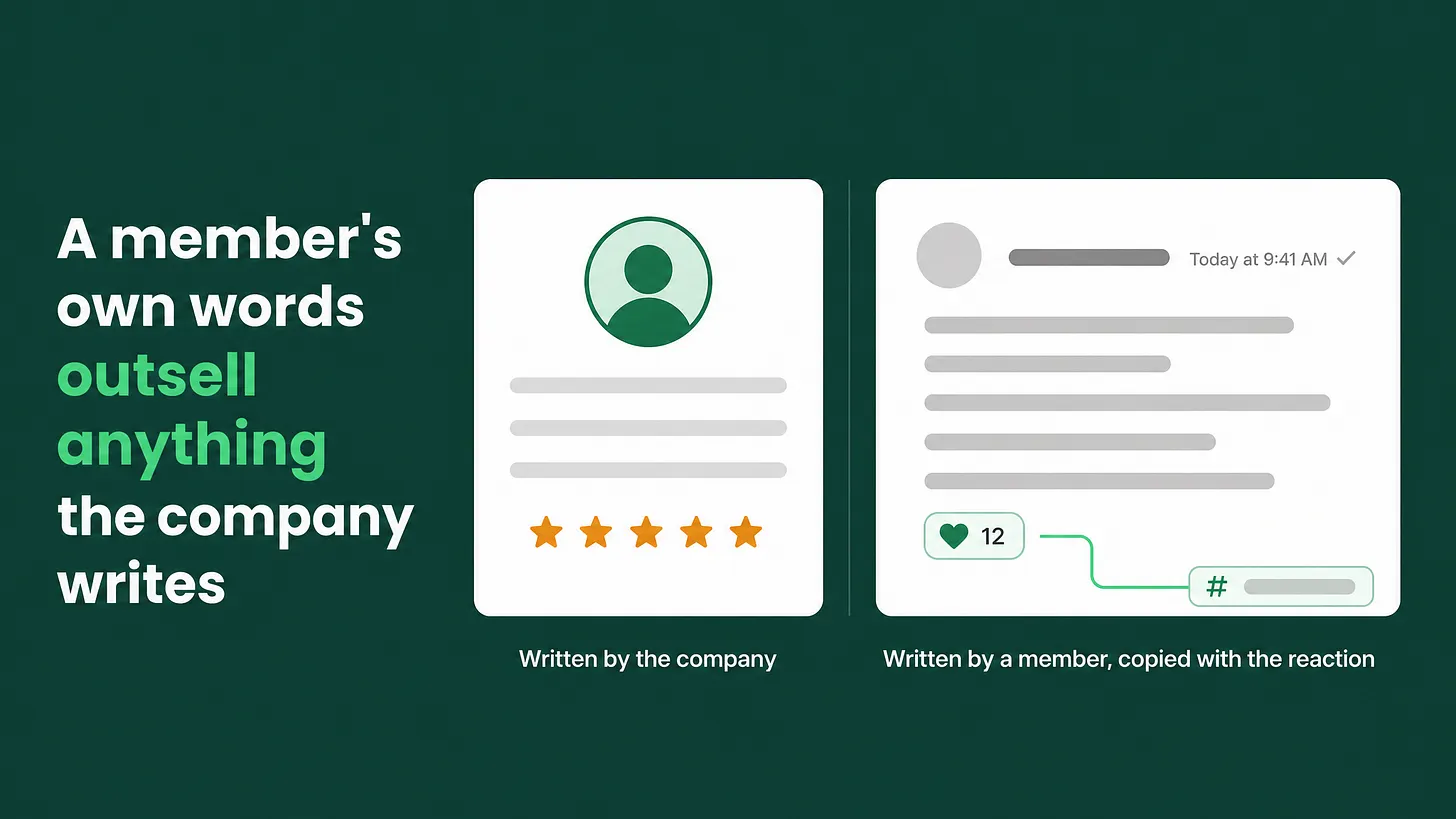
| How to show social proof in a Discord community: stop asking members to write testimonials and start capturing the results they already post. One agreed reaction copies a member's message into a read-only wins channel, word for word, with a link back to the original, and the channel sits near the entrance where new arrivals see it first. |
|---|
The short answer
Do not ask for proof. Capture it. Create a read-only wins channel. Agree on one emoji. Whenever anyone on the team sees a member report a result in any channel, they react with that emoji, and an automation copies the message into the wins channel with a link back to the original. No editing, no rewriting, no request sent to the member. That is the whole mechanism. The rest of this article is why the usual approach fails, the rules that keep the channel credible, and what to do in the first week.
The common practice, and why it produces an empty channel
The standard move is a channel called wins or success stories with a pinned message asking members to share theirs. It stays empty. Not because members are ungrateful, and not because the product does not work. It stays empty because the request asks somebody to sit down and compose a piece of writing whose main beneficiary is the company. There is no moment in a member's day when that becomes the most appealing thing to do. The second standard move is worse. The team writes up results themselves, formats them into tidy cards, and posts them in the server. Members read one line and know exactly what they are looking at, because nobody in a chat room writes in three balanced clauses with a closing benefit statement. The polish is the tell.
A community is the one marketing surface where produced material is a liability. The room is full of real messages, so anything written to persuade stands out immediately.
What is actually happening in your server right now
Members report results constantly, in passing, in the wrong channels, in sentences that were never meant to be marketing. Somebody says the thing finally worked. Somebody thanks another member for an answer that saved them a week. Somebody posts a screenshot of a number going up. Each of those is stronger proof than any case study, and each one is visible for roughly the length of an active conversation before it disappears upward. The asset already exists. The failure is purely one of storage.
The mechanism, in detail
Four components, none of them complicated.
| Component | What it does |
|---|---|
| One agreed reaction | Marks a message as proof, in one click, from any channel |
| A copying automation | Reposts the message into the wins channel with a link back |
| A read-only wins channel | Holds the collection where anyone can scroll it |
| A one-time permission line | Settles consent without interrupting anybody weekly |
The reaction is the important part. It costs the person capturing the proof one second and costs the member nothing at all, which is why the system keeps running after the enthusiasm of the first month wears off. Give the reaction to a small group: the team, the moderators, and eventually your most trusted regulars. Leaving it open to everybody turns the channel into a general highlights feed, which is a different and much weaker thing.
The rules that keep it credible
Never rewrite the message. Copy it exactly, including the abbreviations, the missing capital letters and the typo. Every edit moves the sentence closer to brand voice, and brand voice is what the reader is discounting. Always link back to the original. A quote that can be clicked back to a real message in a real channel is verifiable. A quote that cannot be is a claim. This one detail is what separates the channel from a testimonial page. Ask for permission once. A single line in the join flow covering the fact that messages may be highlighted inside the community, plus the option for a member to ask for a removal, is enough for internal use. If a quote is going outside the server onto a website or an ad, that is a separate conversation with that specific member, every time. Capture the ordinary ones too. A collection of only spectacular outcomes reads as selection, which it is. Small, plain results are more persuasive to a new member deciding whether this place is worth their time, because they look achievable. Never fabricate and never inflate. Any invented quote in a room full of real members will eventually be noticed by somebody who was there when it was not said.
Where the channel goes
High in the channel list, near the entrance, above the general chat rooms. A new member's first minute is spent scanning names. If they reach a channel showing thirty other members reporting real outcomes before they reach anything the company wrote about itself, the entire tone of their arrival changes. They now believe the place works because other people said so, which is the only version of that claim anybody trusts. It also does quiet work for the sales conversation. A prospect invited into the server does not need a case study sent to them, because they can scroll one.
The first week
Wins channel, first week
| Day | Task |
|---|---|
| Day 1 | Create the channel, read only, placed second or third in the list. Pick the single reaction emoji. |
| Day 2 | Add the permission line to the join flow. |
| Day 3 | Wire the automation: reaction copies the message plus a link back into the channel. |
| Day 4 | Backfill by hand. Search the last three months for result language and star fifteen real messages. |
| Day 5 | Tell the team and the moderators what the emoji means and who is allowed to use it. |
The backfill matters more than the automation. A channel that opens with fifteen genuine entries reads as an established record. A channel that opens empty reads as another initiative, and members treat it accordingly.
What to do when the wins are all from the same five members?
That is a finding, not a formatting problem. It usually means the value of the community is concentrated in a small group and the rest of the room is watching. The fix sits outside this channel: ask what those five did differently in their first month, and build that path deliberately for everybody else. The wins channel simply made an existing imbalance visible, which is one of the more useful things it does.
Where this sits in the larger system
Captured proof is one layer of the engagement rhythm, and it is the cheapest one to run. Around it sit recognition that names contributors publicly on a schedule, member spotlights that go deeper than a single message, event recaps that give the room a memory, an introductions loop that turns arrivals into participants, and a reporting habit that tells leadership what the community produced this quarter. Build the wins channel alone and the room gets more persuasive within a week. Build the rest without it and every layer is describing a community whose results nobody can see. Pick the emoji today. The proof is already written.
The most convincing sentence about a company is always the one a customer wrote for a different reason. More at danieljeong.org.