How to Reward Community Ambassadors Without Paying Them: A Reward Ladder Built on Access
Small cash rewards put a low price on your most committed members' work. Access to your team, access to each other, named credit and personal attention cost less and last longer, as long as you run them as a system.

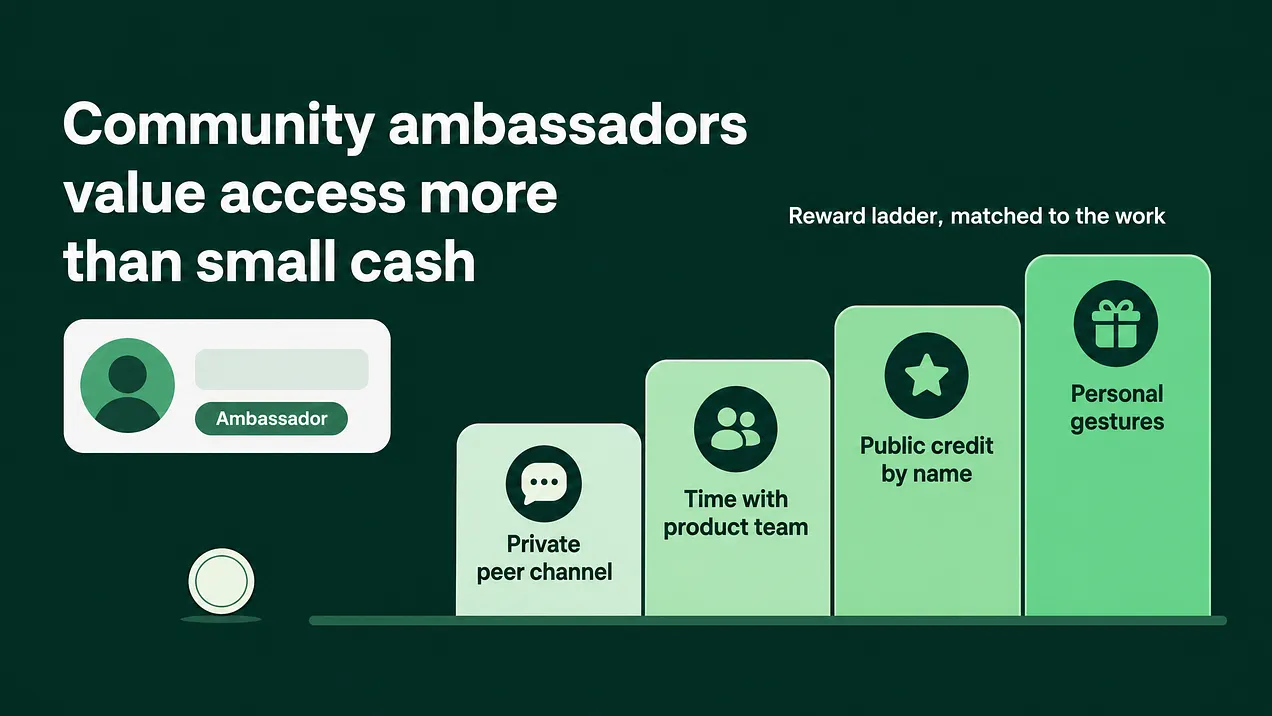
The answer to how to reward community ambassadors without paying them is access: time with your product team, a private space with their peers, named credit when their feedback ships, and gestures that show you know them. Match each reward to the work and track it in a short profile. Keep cash for one-off tasks from outsiders.
Why teams pay ambassadors in small amounts, and what to do instead
An ambassador program is a group of vetted volunteers who do real work for your community. They host events, moderate channels, write tutorials, answer newcomers and run local user groups. Somewhere along the way, most programs start thanking them with small payments: a voucher after a feedback session, store credit for a tutorial, a gift card for filling in a research form. It is easy to see why. A small payment is simple to approve, because it fits inside a budget line that already exists. It is simple to report, because you can count what went out. It feels fair, since the member gave time and received something back. And it genuinely works on the people it was designed for, which is strangers you are asking for fifteen minutes, once. The problem starts when the same tool gets pointed at your most committed members. These are people who applied, passed a vetting process and have been giving you hours every month, often for years. For them, a small payment reads very differently. To reward community ambassadors without paying them, give them access to your team, access to each other, credit by name for work that shipped, and proof that someone knows them personally. Run those rewards as a ladder matched to what each person contributes, and keep cash for one-off tasks from people outside the program. The rest of this piece explains what the small payment costs, then lays out the replacement in enough detail to set it up this quarter.
What the small payment costs you
The costs are quiet, which is why programs keep paying them. Nobody complains in public. The damage shows up months later as ambassadors who contribute less, skip events and eventually stop renewing. It puts a price on the work, and the price is low. A member who has run a monthly event for a year has given you dozens of hours. When the thank-you arrives as a voucher, it states a rate. Many of your ambassadors are senior people who earn far more per hour in their day jobs, and the voucher invites them to do that arithmetic. It turns a relationship into a transaction. Before the payment, they did the work because they cared about the product and the people around it. After it, part of the reason becomes the fee. Paid work gets judged on whether the fee was worth it, and when a budget cut ends the fee, the work tends to end with it. It tells them nobody knows who they are. A generic reward sent to everyone signals that the team sees a list of names. Your strongest contributors notice this immediately, and a fair number of them find it insulting, even when they are too polite to say so. It lets your own team skip the conversation. A product manager who can send out a survey with a voucher attached never has to sit down with the member. The member wanted the conversation far more than the voucher.
A voucher tells your best member what their work is worth to you, and the figure is almost always lower than they would have guessed.
What committed members ask for
Ask ambassadors what keeps them in a program and the answers cluster around access. The list is remarkably consistent across industries and platforms:
- Face time with the product team. They want to talk to the people building the thing they spend their evenings explaining to others.
- Being part of the solution. They want their feedback to change the product, and they want to see that it did.
- A private space with their peers. A channel only ambassadors can see, where they can compare notes, trade event ideas and ask each other for help.
- Small in-person gatherings. A handful of top contributors in one room for a day, learning from each other, with the company covering the costs.
- An AMA with the product team. AMA stands for "ask me anything", a scheduled session where members put questions directly to the people who own a product area.
- Surprise gestures. Something they did not expect, arriving at a moment that shows someone was paying attention.
- Being known personally. Someone on the team remembers how they like to contribute, when they joined, and what they asked for last time. When you ask ambassadors which single perk they would keep if every other one disappeared, the private peer space tends to win. It costs almost nothing to run, and it gets more valuable with every person you add, because each new ambassador brings something to every existing one.
The reward ladder
The replacement for small payments is a reward ladder with four rungs. Each rung up asks the team to know the member better, and fewer people reach it. That scarcity is what keeps the top rungs meaningful.
| Rung | Reward type | What it looks like | Who reaches it |
|---|---|---|---|
| 1 | Peer access | A private ambassador channel, small group virtual sessions, introductions to ambassadors doing similar work | Every ambassador, from the first day |
| 2 | Product access | Early builds, roadmap previews, an AMA with the product team, a named contact on the product side | Anyone who gave feedback or created content that quarter |
| 3 | Recognition | A public spotlight post, named credit in release notes, a step up in role such as Senior Ambassador with its own Discord role badge | Members with a specific contribution you can point to |
| 4 | Personal gestures | A handwritten note, a gift chosen from something they told you, marking their program anniversary, a seat at an in-person gathering | The few carrying the most work, chosen from their profile |
Two points about the ladder tend to get missed. First, the rungs stack. A member on rung three still has everything on rungs one and two. Nobody loses peer access because they earned recognition. Second, a personal gesture on rung four has to be specific to the person. The test is whether it could have gone to anyone else. A book by an author they mentioned, a ticket to a conference in their field, or a note from the engineer who built the feature they asked for all pass. A generic store credit fails, however generous the amount.
Matching the reward to the contribution
The ladder sets how much a member receives. Matching decides which reward, and the rule is simple: reward people in the same currency as the work they do.
| What they contribute | What they are really after | Best-fit rewards |
|---|---|---|
| Hosting events or running a local user group | Meeting other organisers, being seen as a leader | A seat at the quarterly host session, a spotlight after their event, first pick of speakers from your team |
| Moderating channels | Trust and a voice in how the space runs | Early input on rule changes, a senior moderator role, a direct line to the community lead |
| Writing tutorials or posting content | Reach and reputation | A feature on your official channels with their name on it, early access so they can publish first |
| Giving product feedback | Seeing it change the product | Named credit when it ships, a session with the product manager who owns that area |
| Answering newcomers' questions | Being recognised as the expert | An expert role badge, a mention in the monthly recognition post |
When you sit down to decide rewards each month, run the same short routine for every ambassador who contributed:
For each ambassador who contributed this month:

1. What did they do? (event, moderation, content, feedback, helping newcomers)
2. What did they last ask for? (read the "last asked for" field in their profile)
3. Choose a reward from the same currency as the work.
4. If they received that exact reward last time, choose the next option on the same rung.
5. Log the reward and the date in their profile.
Step four matters more than it looks. The same reward given twice in a row starts to feel automatic, and automatic is exactly the feeling the ladder exists to avoid.
The contributor profile
Matching only works if you know each person. A contributor profile is a short record for every ambassador that holds what they value, what they have done and what they have asked for. A spreadsheet is enough for a small program. If your company already runs a customer database, add these as fields there, so the information survives when someone on your team moves role.
| Field | Why it earns its place |
|---|---|
| preferred_contribution | Events, moderation, content, feedback or helping newcomers. Drives the matching table above. |
| thanks_style | Public or private. Some people love a spotlight post and some would rather get a direct message. |
| milestones | Program join date, first event hosted, first feedback shipped, and birthday only if they chose to share it. |
| last_asked_for | The last thing they requested, with the date. The single most useful field on the sheet. |
| feedback_status | Every piece of feedback they gave, and whether it is open, planned, shipped or declined. |
| last_reward | What they last received, and when. Stops repeats and stops anyone going too long without a thank-you. |
Only store what the member has told you or would expect you to know. Ask permission for anything personal, and tell ambassadors the profile exists. People are glad to be remembered and uneasy about being tracked, and the difference is mostly whether they know.
The cadence
Rewards fail when they depend on someone remembering. Put them on a calendar instead.
- Every week: log contributions into the profiles. This takes about half an hour for a program of a few dozen people.
- Every month: publish one recognition post naming two to four ambassadors for something specific they did, and run one AMA with a product team.
- Every quarter: bring together a small group of top contributors for a focused session, virtual or in person, and review every profile for anyone who has gone quiet.
- Twice a year: survey the whole program and ask which single perk they would keep if everything else went away.
- Every release: close the loop on any shipped feedback, which the next section covers.
Closing the loop on feedback that shipped
Closing the loop means telling a member, by name, that something they suggested made it into the product. It is the cheapest reward on the ladder and usually the most valued, because it proves the thing ambassadors most want to believe: that their effort changes the product. It needs four habits from your team. Tag every piece of feedback with the name of the member who raised it at the moment it is logged. When the change ships, message that member directly before the public announcement goes out. With their permission, credit them by name in the release post. Finally, mark the item as shipped in their profile, because it is the milestone they will remember longest.
Template for the direct message: "The change you asked for in March, letting moderators pin threads from mobile, shipped today. Your write-up is what got it prioritised. We would like to thank you by name in the release notes. Are you happy with that?"
Declined feedback needs the same care. Set a standard window, such as thirty days, within which every ambassador hears what happened to what they raised, including a plain reason when the answer is no. Silence reads as dismissal. A clear no with a reason reads as respect.
When cash or a gift reward is the right tool
Cash is the right tool when the relationship is meant to be a transaction. That covers one-off research with people who are not members, usability tests with first-time users, and any request to an outsider who owes you nothing. Paying them is respectful and expected. It also covers work that is closer to a job than to a contribution. If an ambassador agrees to produce a full course, translate your documentation or speak at your conference as a subject expert, pay them properly under a written agreement, at a real rate. The trouble lives in between: token amounts given to insiders for things they would have done anyway. That is the zone this whole system replaces.
How to spot a reward that has lost its value
Every reward wears out eventually. Watch for these signs:
- The same small group attends every AMA, and new faces stop appearing.
- Recognition posts collect polite reactions but no replies from other ambassadors.
- The private channel goes quiet for weeks at a time.
- Perks go unclaimed, such as early access invitations nobody accepts.
- Ambassadors start asking what else is coming, which usually means the current rewards stopped registering.
- A perk that used to come up unprompted in the twice-yearly survey stops being mentioned. When you see two or more of these around one reward, retire it for a quarter and ask a few ambassadors directly what they would rather have. Their answer usually points back to a rung of the ladder you have been underusing.
Where this sits in a full ambassador program
Rewards are one layer of a larger system. A complete ambassador program also covers selection and vetting, onboarding, contribution tracking, the private space itself, and off-boarding and renewal for people whose circumstances change. This piece covers the reward layer completely enough to set it up without help, and the other layers decide how much it can carry. Without contribution tracking, for example, the matching table has nothing to match against. The members who run your events and answer your newcomers already know what their time is worth. A program that pays them in access and attention tells them it knows too. More at danieljeong.org.