How to Report on a Discord Community to Your Leadership Team: The Six Line Weekly Report
Six numbers, one page, and a written decision attached to each one, so nobody has to open the server to know how the community is doing.

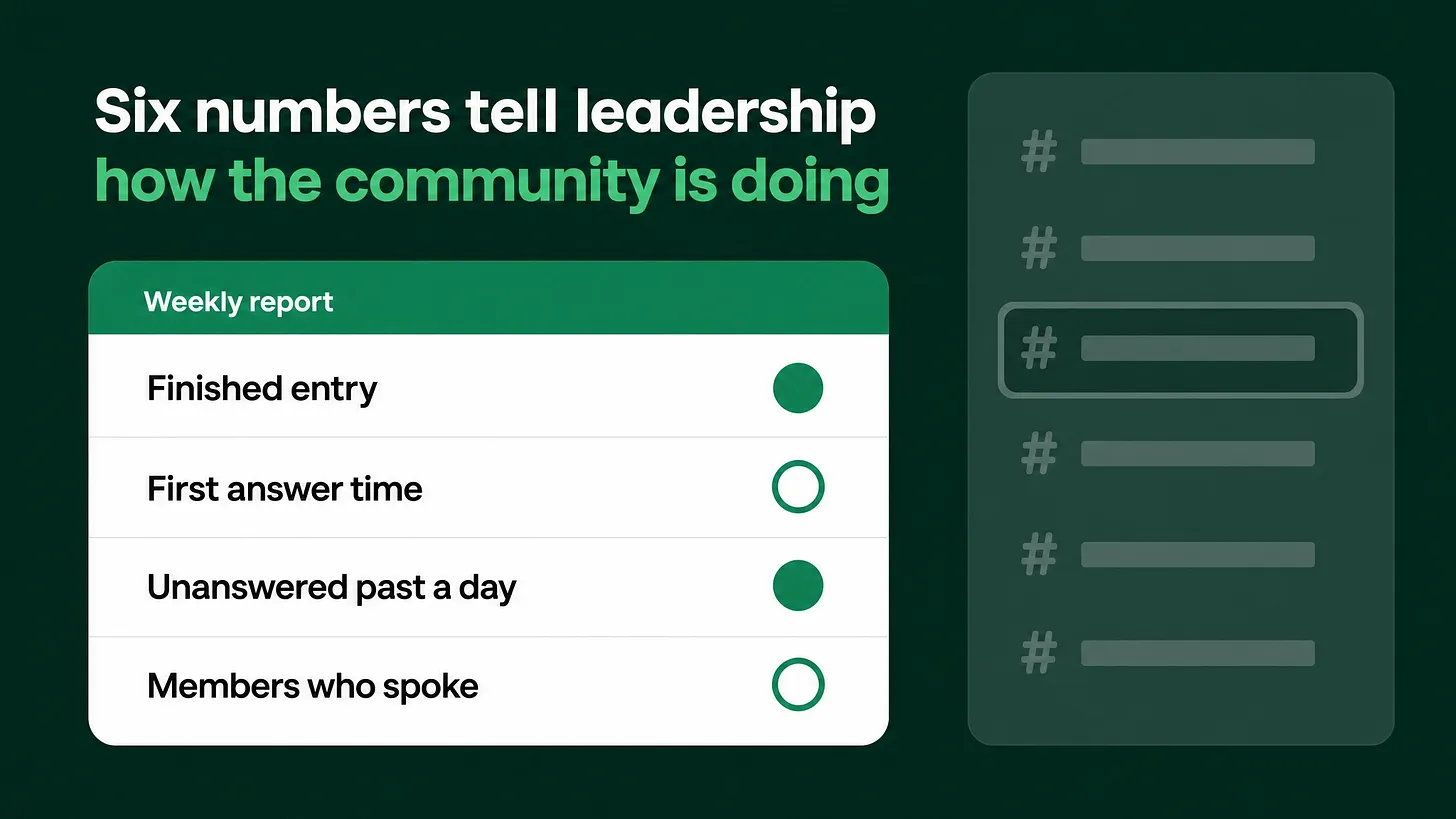
| Founders read their own community every day because nothing else tells them whether it is working. The fix is a one page weekly report with six lines, each carrying an owner, a target set in advance, and the action triggered when the number misses. That is how to report on a Discord community to your leadership team without anyone opening the server. |
|---|
The answer, before anything else
One page. Sent the same day every week. Six lines. Each line holds a number, the name of the person who owns it, the target that was agreed before anyone measured anything, and one sentence saying what happens when the number misses. That is the entire report. No screenshots, no highlight reel, no member count sitting on its own like a scoreboard. Everything below is how to fill those six lines in, and why the last part of each line matters more than the number in front of it.
Why the founder becomes the reporting system
When nobody has written down what good looks like, the only instrument available is somebody's judgement, and the person with the most at stake volunteers for the job. So the founder opens the app. Reading a server is a bad instrument, and it is worth being specific about why. It samples one or two channels at a random hour. It weights whatever happened in the last twenty minutes. It shows you the members who talk and hides the ones who arrived, looked around and left. It cannot tell you whether a wait time got better or worse than last month, because nobody was holding the earlier number. Worst of all, it never finishes. There is no version of reading a community where you reach the end and close the loop, which is exactly why the habit turns into dread.
The dread is not caused by the platform. It is caused by an open loop with no instrument attached to it.
A report closes the loop. Not because it is prettier than reading, but because it ends.
The six lines
| Line | The question it answers | What a miss triggers |
|---|---|---|
| Finished entry | Of the people who joined this week, how many completed the entry steps and posted once | Onboarding review before any further growth spend |
| First answer time | How long a member waited for a first human reply, middle case and worst case | Coverage change: who is on, and when |
| Unanswered past a day | How many member questions are still sitting with no reply after a full day | Routing fix, and a named owner for the queue |
| Members who spoke | How many distinct members posted or reacted at all this week | Programming review: is there a reason to come back |
| Moderation load | Actions taken, escalations, and repeat cases | Automation and policy review |
| Decision caused | One business decision traceable to something a member said | Feedback loop review |
Finished entry is first because it is the only line that tells you whether growth is worth buying. Joins are easy. Completion is the number that shows whether the front door works, and communities lose a large share of new members in the first day or two when entry is unclear or the first reply is slow. Report the two figures side by side, always, because a rising join count with flat completion is a leak with a marketing budget pointed at it. First answer time needs two values, not one. The middle case tells you what a typical member experiences. The worst case tells you what your unluckiest member of the week experienced, and that is the person who tells other people about it. An average alone hides both. Unanswered past a day is a count, and it should be a short list of links rather than a number on its own. A question with no reply is the single most expensive thing sitting in a community, because it teaches everyone reading it what happens when they ask. Members who spoke replaces total members, which measures nothing after the first month. Distinct participants tells you the size of the room that actually exists. Read it as a share of the people who finished entry, not of everyone who ever joined. Moderation load is a staffing line disguised as a safety line. Rising actions with steady membership means either the entry gate is admitting the wrong people or a rule is unclear enough to be broken honestly. Both are fixable, and neither is fixable by asking the team to try harder. Decision caused is the line that keeps the community attached to the business. One decision, named, with the member input that caused it. A week with no answer is not a crisis, but a month of empty weeks means the community is absorbing cost and returning nothing that reaches a roadmap.
The part that makes it a report
Six numbers on a page is a dashboard, and dashboards get skimmed and abandoned. What turns it into an operating document is the third column: if it misses, we do this, written in advance and in plain words.
A number with no decision attached is trivia. It generates a comment in a meeting and nothing else. A number with a decision attached does two useful things at once. It makes the miss unarguable, so no one spends the meeting negotiating whether the number is bad. And it converts the report from a status update into a trigger, which means the community keeps improving in weeks when nobody has the attention to think about it.
Write the action small enough to actually happen. "Rewrite the first two entry steps and retest with five new joiners" is an action. "Improve onboarding" is a wish.
Set the targets before you look
This sequence matters more than it sounds. Choose the target, then measure. Reverse the order and you will quietly grade yourself against whatever you happen to see, which is how a slow reply time becomes normal over a couple of quarters. The targets are yours to choose, and the right number depends on what you sell and what you promised. A community attached to a paid product carries a different obligation than a free room for enthusiasts. Pick a first answer time you would be comfortable reading aloud to a customer. Pick an entry completion rate you would defend in a board meeting. Write both down, date them, and leave them alone for a quarter.
⚠️The most common failure is not a missed target. It is a target nobody wrote down, which means every result reads as acceptable.
The page itself
COMMUNITY WEEKLY REPORT        Week ending: [date]

LINE                    THIS WEEK   LAST WEEK   TARGET   OWNER    IF IT MISSES
Finished entry          [ / ]       [ / ]       [ ]      [name]   [one sentence]
First answer time       [mid/worst] [mid/worst] [ ]      [name]   [one sentence]
Unanswered past a day   [count]     [count]     [ ]      [name]   [one sentence]
Members who spoke       [count]     [count]     [ ]      [name]   [one sentence]
Moderation load         [actions]   [actions]   [ ]      [name]   [one sentence]
Decision caused         [one line]  [one line]  n/a      [name]   [one sentence]

MISSES THIS WEEK: [line names only]
ACTION TAKEN:     [what was done, one line each]
Last week sits beside this week on purpose. A single week is noise. Two weeks side by side is a direction, and direction is the only thing a leadership team can act on.
Who reads it, and how
The report has one job in the room: surface the misses and confirm the action. Everything that hit its target gets no discussion time at all. This is the discipline that keeps the meeting short enough to survive, and short enough to survive is the same thing as still running in six months. Two habits to kill early. The first is asking for screenshots, which drags the whole team back into reading the room and undoes the point of the report. The second is adding a line every time someone gets curious. A report that grows to fifteen lines gets skimmed, and a skimmed report is a report nobody owns.
What the report will expose
Within a few weeks the report stops being about the numbers and starts pointing at missing machinery. Entry completion nobody can measure means there are no defined entry steps to complete. A first answer time nobody can produce means there is no queue, just channels people happen to watch. A moderation line that swings wildly means escalation paths were never written down. Reporting is one layer of a community operation, and it is the layer that makes the others visible. The full set is larger: onboarding and the first two days, response coverage, channel and role architecture, support routing, moderation load and escalation paths, automation coverage, documentation, and the feedback loop back into the product. You can build the report by yourself this month and it will work. What it will also do is tell you honestly which of those other layers you have never built, which is a far more useful thing to know than a member count.
Run it this week
Start with three lines, not six. Finished entry, first answer time, and unanswered past a day. Name an owner for each, choose a target for each before you look at any data, and write the sentence that says what happens when it misses. Send it Friday. Send it again the next Friday with last week's numbers beside it. Add the other three lines in week three, once the habit holds. The version that gets sent every week beats the version that was designed properly and sent twice.
*The founders who stop dreading their community are rarely the ones with the calmest rooms. They are the ones who built an instrument, handed each number to a person, and decided in advance what a bad week would cost. Read the page, not the room. More at *danieljeong.org