How to Measure Discord Event Success: Count Who Comes Back, and Give Each Format Two Runs
Headcount grades your announcement, so record turnout against intent, a one-tap rating and return, then keep, change or drop each format after two equal runs.

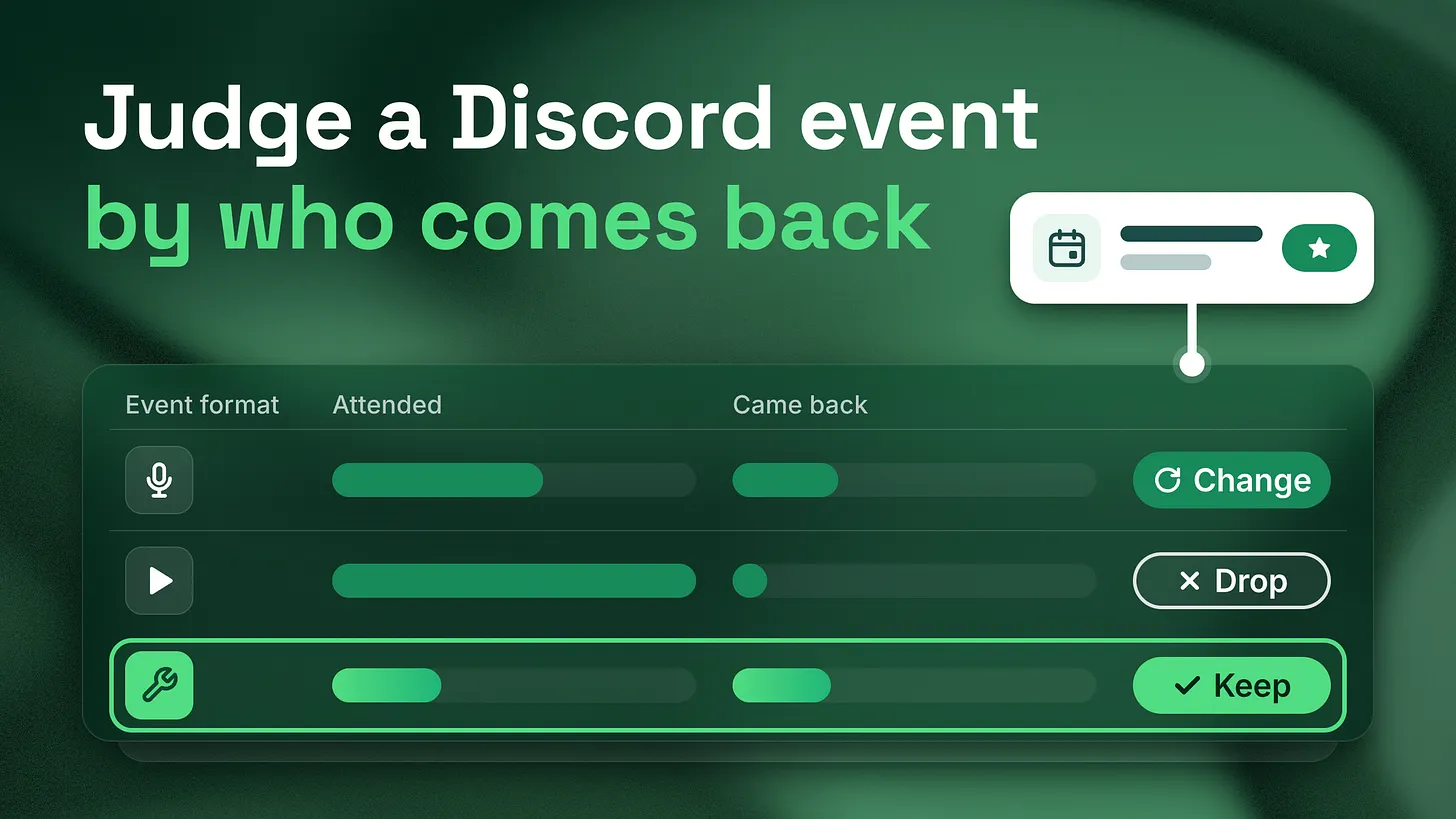
Headcount tells you the announcement landed. If you are working out how to measure Discord event success, record three numbers per event: turnout against the members who pressed Interested, a one-tap rating at the close, and who came back and posted that week. Give each new format two runs, then keep it, change one thing or drop it.
Record what attendees do next
Most teams grade a community event by counting the people in the room. A more reliable measure of a Discord event is what those people do afterwards: whether they come to the next run, and whether they post in the server during the week that follows. Record three numbers for every event, give each new format exactly two runs under the same conditions, and then keep it, change it or drop it. The three numbers are turnout against intent, a one-tap rating, and return. Five terms appear throughout:
- A
formatis a type of event, such as a question session, a watch-along or a hands-on workshop. - A
runis one occurrence of a format. - A
Scheduled Eventis Discord's built-in event listing, which members open to see what is planned and when. - The
event channelis the text channel where the chat for that event happens. - A
staff channelis a channel only your team can see. I managed BlueWillow's Discord through its rise from about 1K to 1.7M members, and this is how I judge events now.
Three reasons headcount misleads
Headcount is tempting when you run a creator or ambassador programme. It is the figure leadership asks for first, and it costs nothing to collect. It fails as a verdict for three reasons.
- It measures the invitation. Attendance on the day depends mostly on how many members saw the announcement, how many reminders went out and whether the hour suited them. An average event announced five times will outdraw a strong event announced once. The number is grading your announcement.
- It rewards novelty. The first run of anything draws the curious. A guest speaker draws people who came for the guest. Neither crowd tells you whether the format deserves a place on the calendar every month.
- It cannot tell a regular from a tourist. A member who has attended every session counts as one. A member who looked in once and will never return also counts as one. A programme lives on its core of active creators, and headcount records those two people as the same thing. The cost shows up in the schedule. A format that drew a crowd once stays on the calendar for months, because nobody wants to cancel the biggest event the server ever had. A small workshop that the same handful of members attend every time, and leave ready to make something, gets cut for low numbers.
A full room shows the announcement worked. Members returning shows the event worked.
Number one: turnout against intent
This number separates the invitation from the event, which is the separation headcount cannot make. When your team creates a Scheduled Event, members can register interest ahead of the day. According to Discord's help center (2023), members can press "Interested" on an event and are notified when it starts. Just before the start, note how many members pressed Interested. After the event, set that figure beside the number who attended. Read the pair like this:
- Many interested, few attended. The idea appealed and the hour did not work. Move the slot before you touch the format.
- Few interested, many attended. People arrived through a reminder or a friend on the day. Next time, point the announcement at the event listing so interest is registered earlier.
- Both low. The topic did not reach the members it was meant for. Check the goal line, covered further down. Turnout against intent diagnoses the invitation. It never decides the fate of a format alone.
Number two: a one-tap rating at the close
During the final minute, while attendees are still present, post one message in the event channel.
Thanks for coming. One tap, please: how useful was this hour for you?
1 = not useful        5 = very useful

One question, and a sentence is plenty:
What would have made this worth more of your time?
Put the five number emoji under the message yourself, so each attendee only has to tap one. Record the average and the number of people who rated. What to ask as an event closes, and how soon to ask it, is a subject of its own that I have written about separately. Be fair about what this number can do. A single rating means very little. The people who stay to the end and tap are the people who liked the session enough to stay. The group is small. A workshop's average cannot be compared with a watch-along's, because different members came for different reasons. The rating has one sound use: comparing run two with run one of the same format. The format, the slot and the question are all the same. If the average moves by a clear margin between those two runs, something inside the session moved it. The open question tells you what that was, and it tells you which single thing to change if a change is needed.
Number three: return
Return is the number that decides. It has two parts. Came back. Of the people who attended run one, how many attended run two? Count people by name. Twenty attendees at each run could be the same twenty or forty different members, and those are opposite results. Posted that week. Of the people who attended a run, how many posted anywhere in the server during the seven days after it? This shows whether the event sent members back into the community or was an hour that left no trace. According to Discord's help center (2024), the Members page shows a message count for each member, and the page works on desktop or in a browser. Note each attendee's count on the day of the event and again seven days later. If the count went up, they posted. For a long attendee list, check every third name and keep to that rule each time, or have an automation bot do the counting. Return carries more weight than the rating for a simple reason. A tap costs a second. Coming back costs an hour, and the member pays it without the pull of something new. That makes it the stronger evidence of what the first hour was worth.
Keeping the attendance record
Neither return figure exists without a list of names. At the midpoint of every event, one staff member writes down every name present and posts the list in the staff channel. Do it by hand, or have an automation bot record who is in the room. The midpoint is deliberate. The opening minutes include members who look in and leave. The closing minutes hold only those with a free evening. The middle is the fairest picture of who was there for the event itself. Head each list with the format, the run number and the date. Name one person as its owner before the event starts, because a task left to whoever happens to be hosting is usually missed.
The two-run test
Every new format runs exactly twice before anyone judges it. Hold three things equal across the two runs:
- The same day and time slot. Otherwise you are testing the slot.
- The same amount of promotion. Use the same announcement and the same number of reminders. How to promote an event is a separate topic, and the only rule here is equal treatment.
- The same length, and the same host where possible. Two is the smallest test that works. One run cannot separate the format from the novelty of a first outing, and the came-back figure only exists once there is a second run. Going past two with no decision is how weak formats settle into the calendar. Make the decision a few days after the seven-day post check on run two.
Keep, change or drop
You need lines for good and weak before the numbers arrive. The two below are a starting point and not a standard. Set your own after a few formats, then leave them alone, because lines that shift from event to event stop meaning anything.
- Rating is good when the run-two average sits at 3.5 or above on the five-point scale and has fallen by no more than half a point since run one.
- Return is good when at least a third of the people at run one came to run two, and the share who posted that week held or rose.
| Rating | Return | Decision | What happens next |
|---|---|---|---|
| Good | Good | Keep | The format gets a regular slot. Keep recording the three numbers. |
| Good | Weak | Change one thing | Members enjoyed the hour and had no reason to come again. Change one thing, such as making each session build on the last, and run it twice more. |
| Weak | Good | Change one thing | Members return for the group or the habit, and the hour itself falls short. Change one thing, such as the length or the structure, and run it twice more. |
| Weak | Weak | Drop | Retire the format and tell the server. |
Change one thing only. Two changes at once leave you unable to say which one moved the numbers. I also allow a format a single round of changes. After four runs in total it is kept or dropped. Say the decision in the server, in the channel where events are announced. A format that quietly disappears teaches members that events here get abandoned. A format that is changed or retired in public, with the reason, teaches them that events are tested and that their ratings were read.
We ran the watch-along twice this month as a test. Thank you to
everyone who came and rated it. Ratings were good, and few people
returned for the second session. We are changing one thing: each
session will now build on the one before. Two more runs, then we
decide again and tell you here.
The goal line comes before the schedule
Before any event is scheduled, write one sentence that says which company goal it serves.
This event exists so that (which members) (do what),
which supports (company goal).
For a creator programme, a finished line might read: this workshop exists so that new ambassadors publish their first piece, which supports the goal of more active creators each quarter. If the sentence cannot be written, the event is not scheduled. An event with no goal line can only be judged on attendance, and that returns you to headcount. The goal line also sharpens the posted-that-week check. When the goal is published work, look at whether attendees posted in the channel where work is shared, and note that beside the general figure.
Pace: one test at a time
Three rules keep testing from taking over the calendar.
- One new format under test at a time. Two tests share the same members and the same announcement space, and neither result comes out clean.
- One fixed recurring event that is never the one being tested. Members need one event that does not move while others come and go.
- A monthly review of the scorecard. I allow thirty minutes, with the programme owner and whoever kept the attendance lists. The monthly review answers three questions. Which formats have a decision due? Has any kept format seen its return fall on two runs in a row, which puts it back under test? Which format is tested next, and what is its goal line?
The scorecard to copy
Fill in one block per run. Keep the blocks in a single document so the monthly review reads from top to bottom.
EVENT SCORECARD

Format:
Goal line:           This event exists so that ...
Run:                 1 or 2 (3 or 4 after a change)
Date and slot:
Pressed Interested:  noted just before the start
Attended:            names at the midpoint, list in the staff channel
Rating:              average ___ from ___ raters
Open answers:        the one theme that came up most
Came back:           ___ of the ___ people at the previous run
Posted that week:    ___ of ___ attendees, checked seven days later
Decision:            keep / change one thing / drop (after run 2)
Said in server on:

Example, with sample figures to show the layout only:

Format: Workshop     Run: 2     Pressed Interested: 14     Attended: 11
Rating: 4.4 from 7 raters (run 1 was 4.2 from 6)
Came back: 8 of 10     Posted that week: 9 of 11
Decision: keep
The larger job: engagement rhythm
Measuring events and deciding which formats stay is one part of engagement rhythm, the recurring schedule of events and prompts that gives members a reason to return each week. Engagement rhythm sits beside community reporting, which is how results reach leadership, and onboarding, which is how a new member first learns that events exist. You can run the measuring from your next event with a staff channel and one document. The scorecard tells you which events have earned a slot. Arranging those slots across a week, turning the scorecard into a report, and getting new members to their first event are the neighbouring layers. Attendance tells you who heard about an event. The names that appear on the second list tell you who thought it was worth an hour. More at danieljeong.org.