How to Measure Discord Community ROI Using Only Your Own Numbers
Five returns, the mechanism behind each one, and the consent flow that keeps the spend data clean.

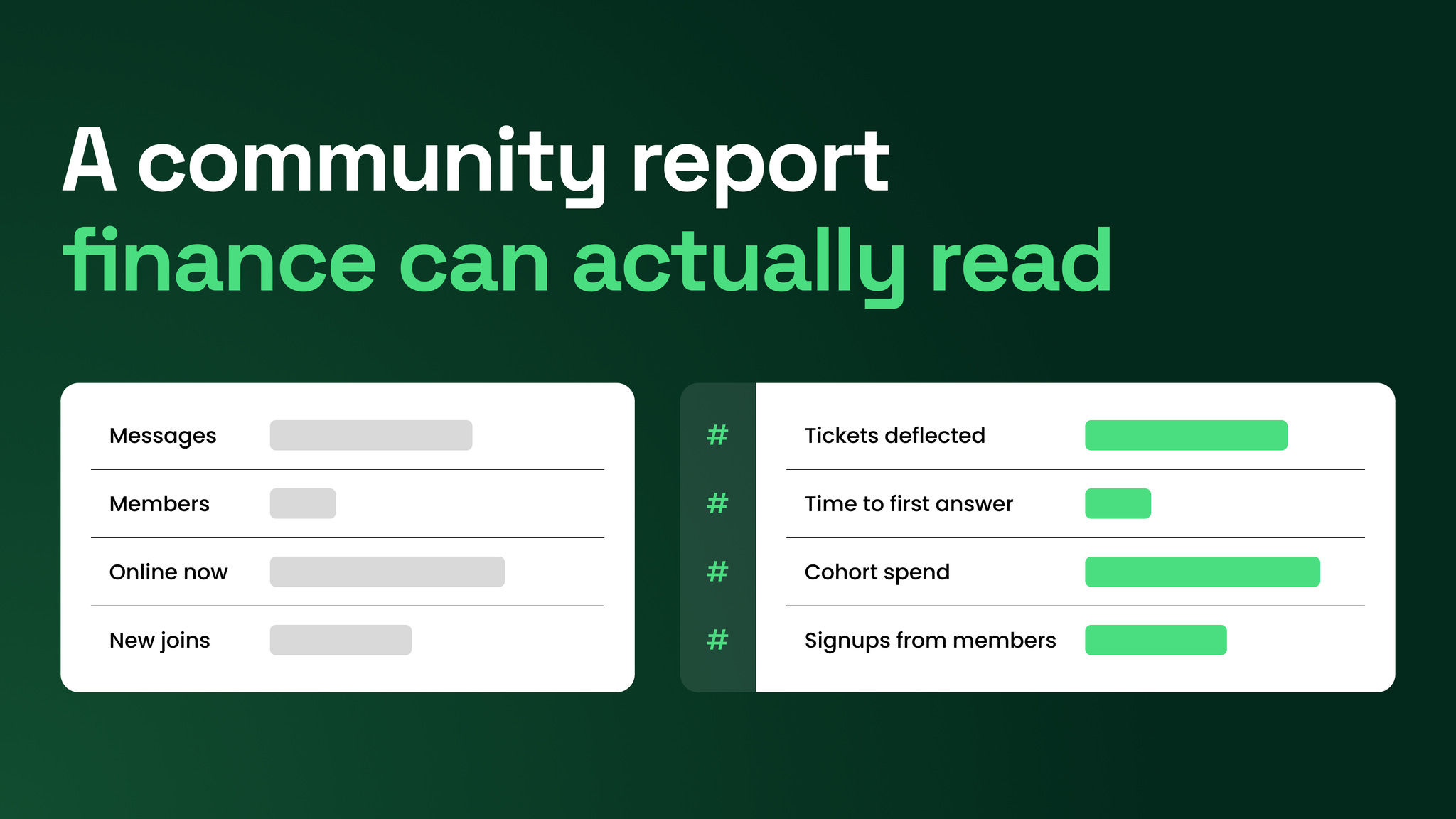
| To measure Discord community ROI, report five returns instead of activity counts: activation, support savings, retained spend, honest signal, and deal influence. Every figure comes from systems the company already owns, and any figure that does not exist yet stays blank and marked measured monthly, not assumed. |
|---|
The report that does not survive a finance review
You already know the community is doing something. Members answer each other before your team is awake. A request from a Tuesday thread turns up in the roadmap six weeks later. Renewal conversations go easier at accounts where three of the engineers sit in your server. Then budget season arrives. The slide you bring says member count, messages per day, and engagement is up. Finance reads it and asks what the line item costs and what it saves. In most companies nobody has worked that out, so the community survives on goodwill, and goodwill has a shelf life. The unit is wrong. Messages per day tells you the room is warm. It tells you nothing about what the room is worth. A finance team evaluates a line item against cost avoided and revenue retained, and a report written in activity counts never reaches those terms. So it gets filed as a morale program, and morale programs are the first thing cut when every line goes under review. I run Discord and Reddit communities for companies that want the channel to earn its budget. I managed BlueWillow's Discord through its run from 1,000 to 1.7M members, the second-largest server on Discord at the time, holding 15% engagement, and I have worked across 155+ communities in AI, SaaS, Web3, eCommerce and gaming. What follows is the reporting structure, the mechanism sitting behind each line, and the consent flow that keeps the spend data clean enough to show a finance team.
Two rules that hold the whole report together
Every number belongs to the company being measured. Your loaded cost per ticket. Your activation event. Your cohort spend. I do not import anyone else's benchmark into a client report, because a borrowed figure is the first thread a finance team pulls, and once one number turns out to be somebody else's, the rest of the page loses its standing.
Where a number does not exist yet, the report says measured monthly, not assumed. An honest blank reads better than a confident estimate. The first real figure in each row belongs to you and it arrives in month one or month two, not in a proposal.
Those two rules cost you the impressive opening slide. They buy you a report that holds up in the room where it matters.
Why an owned room reaches differently than a rented feed
Before the returns, the structural point underneath them. On a public platform, distribution is decided by a ranking system you do not operate. You can improve your odds, and you cannot set the outcome. Reach resets with every post, and the price of it moves without your input. That is rented access to an audience you assembled. In a server, distribution is a property of the room. A message posted in a channel is delivered to the people who joined that channel. A role mention reaches everyone holding that role. No ranking step sits between what you publish and who receives it, and the cost of reaching the same hundred people next week is the same as it was this week.
Same hundred members. On a public feed, some fraction of them see the post, and which fraction is not your decision. In your own server, the announcement lands with all hundred.
This is why the returns below are measurable at all. You cannot build a reliable operating number on top of a channel whose delivery you do not control.
Return one: activation
The mechanism. A new member arrives at a moment that ends two ways. In the unguided version, they land in a channel list with no instruction, read a few messages, understand that nothing here is addressed to them, and go quiet. In the guided version, they answer one question at the door, get routed to the two channels that match their answer, see a first action stated plainly, and complete it in the same session. Same person, same minute, two endings. The first 48 hours decide which one you get. After that window the member has already formed a view about whether the room is for them, and reversing that view costs far more than getting the entry right. What gets measured.
| Line | What it reports |
|---|---|
| First-action completion | Share of new members who complete a defined first action within 48 hours |
| Time to first action | Median time from joining to that action |
| Product activation overlap | Share of new members who reach your product's own activation event |
The first action is yours to define, and it should be something the member can complete without waiting on a human: an introduction post, a role selection, a first question asked. All three lines start at measured monthly, not assumed and carry real figures from the first full month.
Return two: support savings
The mechanism. A question answered in a public channel does two things a ticket cannot. It never enters the support queue, and it stays visible for the next person who asks the same thing. Ticket systems are private by design, so every answer inside them is written once and read once. A community answer is written once and read for as long as the channel exists. This is the return that translates most directly into a number, because the second input already sits in your finance system.
tickets deflected × your loaded cost per ticket = monthly support savings
Both inputs are yours. The deflection count comes from tracking which questions were resolved in the community without a ticket being opened. The loaded cost per ticket is a figure your support organisation already calculates, or can. I supply neither of them. What gets measured. Deflected question volume, the dollar value of that volume at your own cost per ticket, and median time to first answer. That last line exists as a guard. Deflection can be manufactured by letting questions go unanswered until people give up, and a falling time to first answer alongside a rising deflection count is what proves that has not happened. Any split I show you between deflected and escalated before your first month of data is labelled illustrative. The real split is measured monthly.
Return three: retained spend
The mechanism. A member who has verified their account and taken part in the room has a reason to come back that does not depend on a discount. They ask before they churn. They see what is being built next. They have a relationship with a name rather than a support address. What gets measured. A cohort comparison: verified community members against everyone else, same product, same period, same currency. Here is the part most reports leave out, and the part that makes the number survive scrutiny.
A cohort comparison is a comparison. It is not proof of cause. Members who join a community may already be your more committed customers, which means some of the gap was there before they arrived.
Saying that out loud does not weaken the line. It is what allows a finance team to use it, because they were going to identify the selection effect themselves, and it is better that your report identifies it first. Any chart I show before your own data exists carries the word illustrative on it, and that word does not come off.
Return four: honest signal
The mechanism. Feedback quality is a function of what the platform pays for.
| Where the feedback happens | What the platform rewards |
|---|---|
| Public platforms | Visibility. An opinion is a performance with an audience, and the sharper version of it travels further |
| Your server | Nothing. Identity persists, there is no anonymity, and no vote score accrues to a strong opinion |
In a server the same member is still there next week under the same name, talking to people who will remember what they said. There is no score to raise and no crowd to win, so exaggerating costs the member something and pays them nothing. What you hear is closer to what people actually think, which makes it usable as product input rather than as sentiment to manage. What gets measured. Volume and content of feature requests, recurring complaint themes grouped by subject, and the time between a member raising an idea and a visible decision being posted about it. That last line is the one that keeps the signal flowing. Ideas raised into silence stop being raised.
Return five: deal influence
The mechanism. In developer, AI and technical B2B markets, the people in your community are frequently the people who evaluate your product, recommend it internally, or quietly rule it out. A champion in your server carries you into a procurement conversation you are not invited to and never see. What gets measured, and what does not.
| Reported | Not reported |
|---|---|
| Signups that originated in the community | Direct revenue attribution on enterprise deals |
| Named accounts with active members present before an opportunity opened | Claimed causation from any single member's presence |
| Showcase activity and referral mentions | Pipeline value assigned to the community line item |
I will not claim direct revenue attribution on enterprise deals. The buying process is long, it involves people who never touch your community, and any model that assigns a percentage of a closed deal to a Discord presence is a model I would not defend under questioning. I report the influence signals. Your CRM confirms them or it does not.
How the spend gets measured, with consent at every step
Retained spend is the only return that needs to connect a community identity to a commercial record, so it is the only one that needs a consent flow. Four steps, in order.
- The member opts in, inside the server, to link their account.
- The member creates the link themselves. They initiate it, through your own signed-in property, using their own credentials.
- Your system stores a mapping between a community ID and a customer ID that your commerce system already holds.
- Reporting queries that mapping at the cohort level. Individual spend is never surfaced in a report.
The bot never sees billing. Discord never shares it. The member creates the link.
Consent is revocable and the mapping is deletable on request, which means the population being measured can shrink. That is the correct behaviour for a system handling commercial data, and it is worth more than the handful of records it costs you.
What lands on the one-pager
One page, monthly.
- Tickets deflected and their dollar value at your own cost per ticket
- Median time to first answer
- Verified-member cohort spend against everyone else
- Community-sourced signups
- Showcase activity
Blanks stay blank in month one, marked
measured monthly, not assumed, and fill in as the measurement starts producing. A report with two real lines and three honest blanks is a stronger document than a report with five estimates, because the two real lines can be checked.
What month one actually looks like
The report described above does not arrive complete. It arrives in pieces, in a sequence set by what each line depends on.
Week one is definition work and produces no numbers at all. You decide what the first action is, agree with support on what counts as a deflected question, and confirm with finance which loaded cost per ticket figure is the accepted one. That last conversation matters more than it sounds. If you pick the cost figure yourself and finance uses a different one internally, your saving line is wrong before it is ever printed.
Week two puts the counting in place. Questions resolved in the community get tagged so they can be counted later. The entry flow gets a defined first action attached to it. Anything that cannot be counted automatically gets counted by hand this month, because a manual count that is honest beats an automated one that is measuring the wrong event.
Weeks three and four produce the first real figures, and they will be smaller than you hoped. That is normal and it is worth saying out loud in the report itself. A first month of real deflection data is a baseline, not a result, and its job is to give month two something to be compared against.
Cohort spend is the slowest line and it should be. Consent takes time to gather, the population starts small, and a comparison drawn on a handful of linked accounts is not worth showing. I leave that row at measured monthly, not assumed until the linked group is large enough that the comparison means something, and I say so rather than showing an early number with a disclaimer under it.
What finance will ask, and the answers that hold
Three questions come back almost every time. It is worth having the answers ready before the meeting rather than during it. "How do you know those tickets would have been opened?" You do not know, precisely, and the honest version of the line accounts for that. What you can show is the question volume resolved in the community, the fact that those askers did not subsequently open tickets on the same subject, and the trend over several months. A single month proves very little. Six months of a stable pattern is a different kind of evidence, and it is the kind that accumulates without any additional claim from you. "Could we get the same result from better documentation?" Sometimes, for some questions, and it is a fair challenge. Documentation answers the questions somebody already knew how to ask. A community also catches the questions people cannot phrase yet, the ones that start with a description of a symptom. Both are worth having, and the report should show which questions arrived in each form rather than arguing the point in the abstract. "What happens to these numbers if we stop?" This is the question the whole report exists to answer, and it is the one I will not overstate. Deflected questions return to the queue at some rate nobody can predict in advance. What the report gives you is the size of the thing at risk, measured in your own currency, so the decision to continue or stop is made against a figure rather than a feeling. Answering these three in the report itself, before anyone asks, is what separates a document that gets read from one that gets interrogated.
Where reporting sits in the larger system
Reporting is the last layer of a community operation, and it only reads well when the layers beneath it exist. Those layers are onboarding and the first 48 hours, role and channel architecture, support routing, moderation load and escalation paths, automation coverage, documentation, and engagement rhythm. Activation cannot be measured until an entry flow defines a first action. Support savings cannot be counted until questions are routed somewhere countable. Cohort spend needs a verification step before there is a cohort to compare. Everything in this article can be built by your own team, in the order the returns are listed. What the list gives you is an accurate picture of the size of the job, which is a different thing from the one-line answer most people start with when they ask whether the community is worth the money. The community already shapes buying decisions either way. The only question is whether anyone is steering it. Every operating channel eventually gets asked to show its arithmetic. The ones that survive the question are the ones that were already keeping the books before anyone asked. danieljeong.org