How to Measure Community Sentiment by Platform Instead of One Overall Score
An averaged brand score hides the single room doing the most damage, and the fix is a manual read of a hundred mentions per platform with the reason behind every negative one written down.

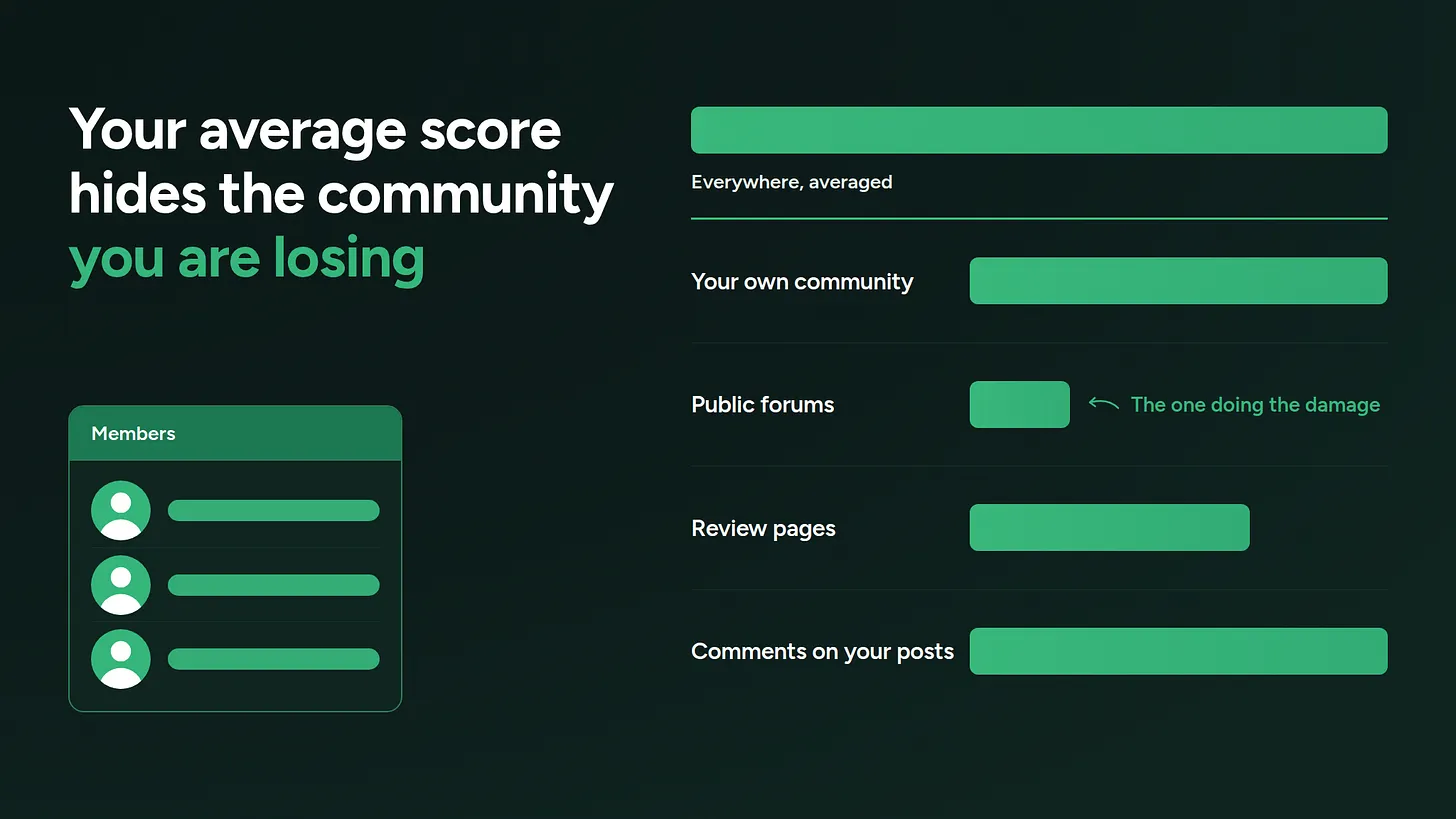
| How to measure community sentiment by platform starts with abandoning the single brand-wide number. Read a hundred recent mentions in each place your name appears, sort them into positive, neutral and negative, and write down the reason behind every negative one. Two platforms with identical scores routinely need completely different work. |
|---|
The number you are reporting is the wrong shape
Ask most companies how members feel about them and you get one figure. It is usually high, it is usually true, and it is close to useless for deciding what to do next. A brand sitting at ninety percent positive across every surface it is measured on can simultaneously have one room where the same grievance surfaces weekly, raised by people who used to spend money and no longer do. The average absorbs that room completely. It is one input among thousands, and arithmetic does exactly what arithmetic does.
An average is a summary of everywhere. Nobody experiences your brand everywhere.
The practical consequence is that the number cannot be acted on. It goes up, it goes down, and no decision follows from either movement, because there is nothing inside it that says where to spend.
Step one: list every place, including the ones you do not run
Start with an inventory rather than a metric. Write down every space where your company name gets used. The community you own. Public forums. Long-running fan groups on older platforms, which are frequently the largest and most overlooked. Review pages. The comment sections under your own posts, which almost nobody counts as a sentiment surface and which is often the most honest one you have. Include spaces you have no presence in and no control over. Especially those. The rooms you do not run are where the unmoderated version of your reputation lives.
Step two: read one hundred mentions by hand
This is the step that gets outsourced to a tool, and outsourcing it is what produces the useless number in the first place. For each platform on your list, read one hundred recent mentions yourself. The actual posts, not a dashboard summary of them. It takes an afternoon per platform and it is the only part of this exercise that cannot be skipped. Sort each mention into one of three piles.
- Positive. Somebody said something good, unprompted.
- Neutral. A question, a factual statement, a mention with no feeling attached.
- Negative, with a reason. Something is wrong, and you write down what. The third pile is where the entire value sits, and the reason is the part that carries it.
Why the reason matters more than the count
Take two platforms. Both come back at seventy percent positive. Identical scores, identical volume. On the first, every negative mention is about shipping times. That is an operations problem, it is expensive, and it will not move quickly. On the second, every negative mention concerns a defect you fixed two years ago and never announced anywhere those people were reading. That is a communications problem, it costs a single well-written public post, and it can move this month.
| A score tells you how much negative sentiment exists. Only the reason tells you whether the fix takes a quarter or an afternoon. |
|---|
This is why the manual read is not optional. Automated sentiment classification is genuinely good at the three-way sort and consistently poor at the reason, because the reason is often implied rather than stated and frequently sits in the replies rather than the original post.
Step three: record five things per platform
One row per platform, five columns, dated.
| Field | What it captures |
|---|---|
| Platform | The specific space, not the network it sits on |
| Volume | How many mentions you found in the window |
| Split | The three-way sort across positive, neutral, negative |
| Top negative reason | The single most repeated cause, in plain words |
| Can you reply there | Yes, no, or not asked yet |
That final column is what keeps this from becoming a wish list. A weak score in a space whose moderators have refused you entry is still worth knowing and cannot be addressed the same way. You act on it through product changes and through better answers in rooms where you are welcome, rather than through a post you are not permitted to make.
Record not asked yet honestly. Most teams discover several rooms in that state and have never sent the message that would resolve it.
Step four: date it and repeat the same way
A baseline you cannot reproduce is an anecdote. Write the date on the sheet. Note the exact window you read, the exact method, and who did the reading. Repeat every quarter with the same method, even when a better method occurs to you, because a comparison between two different methods measures the methods rather than the sentiment. After two quarters you can say something a single score never supports: this specific room got better, that one did not, and here is what we did in each.
What teams usually find
Three results come up often enough to expect them. The weakest platform is rarely the one leadership worries about. Attention concentrates on the loudest surface, and the loudest surface is usually somewhere with high volume and reasonable sentiment. The damage is normally in a smaller, older, quieter space that nobody has read in a year. The top negative reason is frequently already solved. Something was fixed, and the fix was announced in the room you own, where the people affected had already stopped reading. This is the cheapest win available and it sits unclaimed in most companies. At least one significant room turns out to be one you have never spoken in. Not banned, not hostile. Simply never contacted.
What to do with the sheet
Take the loudest reason on the weakest platform and answer it in public, in the place people are saying it. One reason, one platform, one post. Then leave it alone until the next quarter's read. Sentiment moves slowly and reacting to it weekly produces noise rather than progress. Everything else on the sheet becomes a prioritised list rather than an anxiety. You know which rooms are healthy, which are damaged, why each damaged one is damaged, and where you are permitted to act.
Where this sits in the bigger picture
Community reporting and sentiment measurement form one layer of the operating system a community runs on, and this article covers that layer completely enough to install without help. The layers around it are separate builds: onboarding and the first forty eight hours, response time, role and channel architecture, support routing, moderation load, escalation paths, documentation, automation coverage, and engagement rhythm. Measurement sits underneath most of them, because a community you cannot describe accurately to your own leadership is one you will be asked to defend on member count, and member count is the number that tells you least. Most companies know their overall score and could not name the room that is quietly costing them the most. The read that closes that gap takes a few afternoons and does not require a tool anyone has to buy. More at danieljeong.org.