How to Fix an Inactive Developer Discord With a Promise Audit
Every claim your public pages make about the community is a commitment. The audit checks whether a room, a person and a reply window exist behind each one.

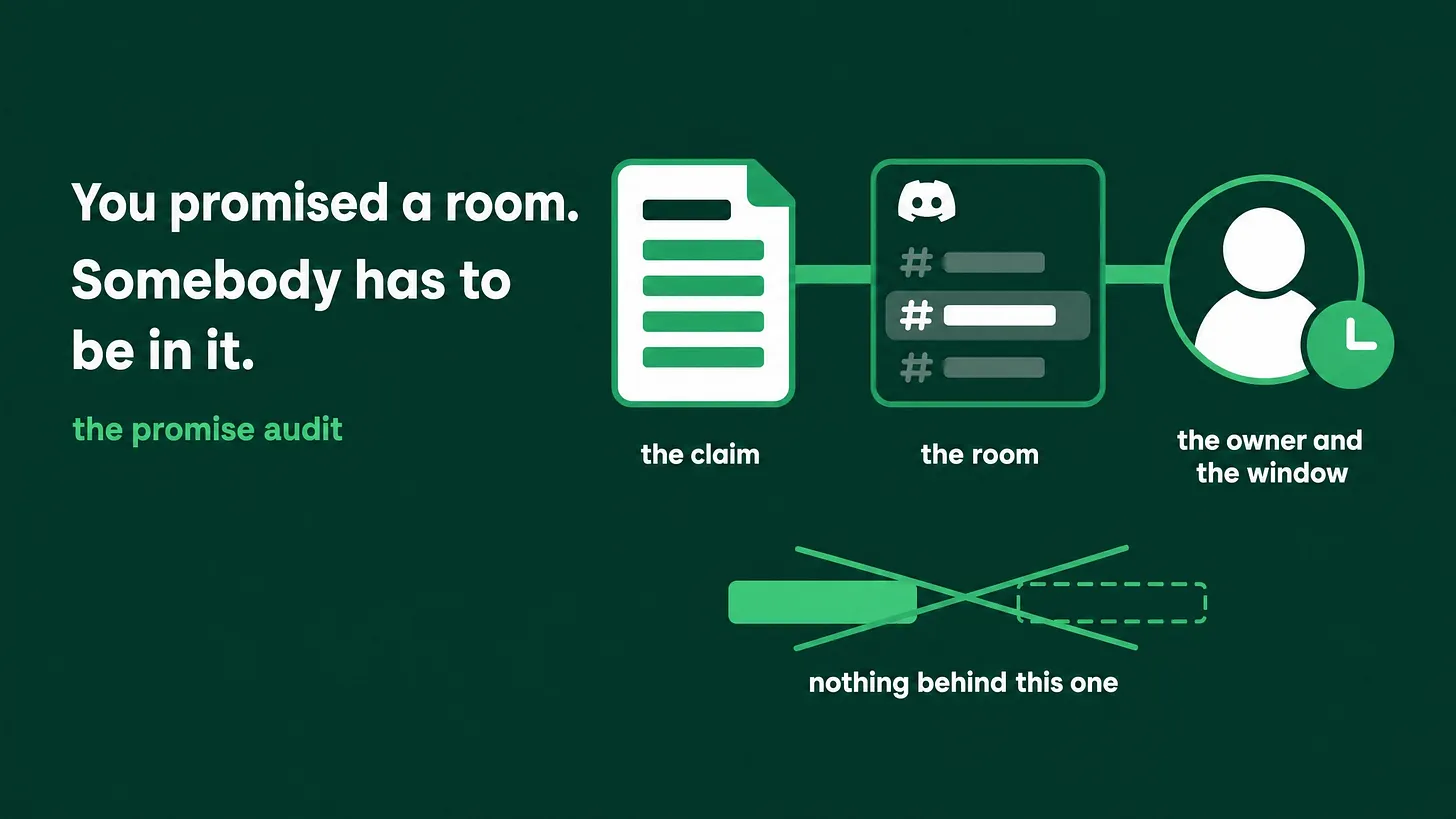
📌 An inactive developer Discord is usually a set of published promises with nothing behind them. Collect every public claim about your community, map each one to a visible channel, assign an owner by name, publish a reply window, then check the last visible evidence in each room. Build what is missing or remove the claim.
Where to start
Not in the server. On your website. The reason a developer community sits quiet is almost never that engineers do not want to talk. It is that the sentence which brought them in has no room, no owner and no reply time behind it. Fixing that is a five part audit you can finish in an afternoon.
The sequence that produces silence
- A public page promises answers, peers, access to the team.
- Developers arrive and ask real questions.
- Nothing comes back, or something vague arrives days later.
- Those threads stay visible forever.
- Every later arrival reads them and decides not to bother. Step four is the part teams underestimate. An unanswered public thread is durable evidence, while a busy day in chat leaves nothing behind. Silence compounds because it is written down.
The five parts
Collect. Every sentence on every public surface that tells a developer what they get here. Product pages, docs, developer portal, footer, social profiles, conference slides, onboarding emails. Route. The exact channel that keeps each promise. A channel hidden behind a show all channels toggle does not count as a route, because most arrivals never touch that setting. Owner. One person, named, this month. Not a team. Not a rotation that exists only in conversation. Window. The reply time you are prepared to publish. Same working day, two working days, or an honest statement that the room is unstaffed. Evidence. Open the room and read the last thing that happened. Date of the last answer, date of the last event, newest unanswered thread.
| Promise | Route | Owner | Window | Last evidence |
|---|---|---|---|---|
| ask questions | support channel | engineer | 2 days | oldest open thread |
| peer help | discussion chan. | comm. lead | same day | last peer answer |
| talk to the team | office hours | engineer | weekly | date of last session |
| join the hackathon | program board | programs | dated | are dates current |
The evidence column is the only one your members can see, which makes it the only one that has ever mattered.
The decision the audit forces
Every row with an empty route gets one of two outcomes:
- Build it. Channel created, owner attached, window published, visible in the default channel list.
- Remove the claim from the public page. Put it back when you can staff it. Deleting a claim reads as a retreat internally and lands as integrity externally. An unkept promise is more expensive than a promise never made, and developers have a long memory for the difference.
A room with a promise and no owner turns into a public archive of questions your company ignored.
Two things the audit always uncovers
Rooms nobody can see. The project showcase exists, is thin, and sits outside the default view. So the promise of seeing what other developers build is kept on paper and broken in practice. Fill it and surface it, or close it. Missing proof. Every developer arriving asks silently whether anyone credible is here. One channel of recent finished work answers that faster than any marketing page, and it conveniently populates your evidence column for the next audit.
Three numbers to track afterwards
| Number | Why it is the right one |
|---|---|
| Promises with no owner | Should be zero. Anything above zero is a scheduled failure. |
| Age of the oldest unanswered question | The clearest health signal a developer community produces. |
| Member to member answers per week | The only metric showing the community is carrying load for you. |
Repeat the audit quarterly. Marketing ships new pages without telling the community team, so fresh promises appear without anyone deciding to make them.
The layer this belongs to
The audit is the diagnostic layer of a community operating stack that also spans onboarding and the first forty eight hours, role and channel architecture, support routing and response time, moderation coverage, automation and executive reporting. It builds none of those. It tells you which to build first, ranked by what you have already promised in public. One spreadsheet, one afternoon, no budget. It routinely explains a year of flat numbers.
Developers do not need a livelier community. They need the one you advertised to actually be staffed. More at danieljeong.org.