How to Fix a Toxic Discord Community Without Mass Banning Your Most Active Members
Hostility in a community is usually a symptom of unpredictable enforcement and an unanswered complaint, and both of those are fixable without losing the people who still show up.

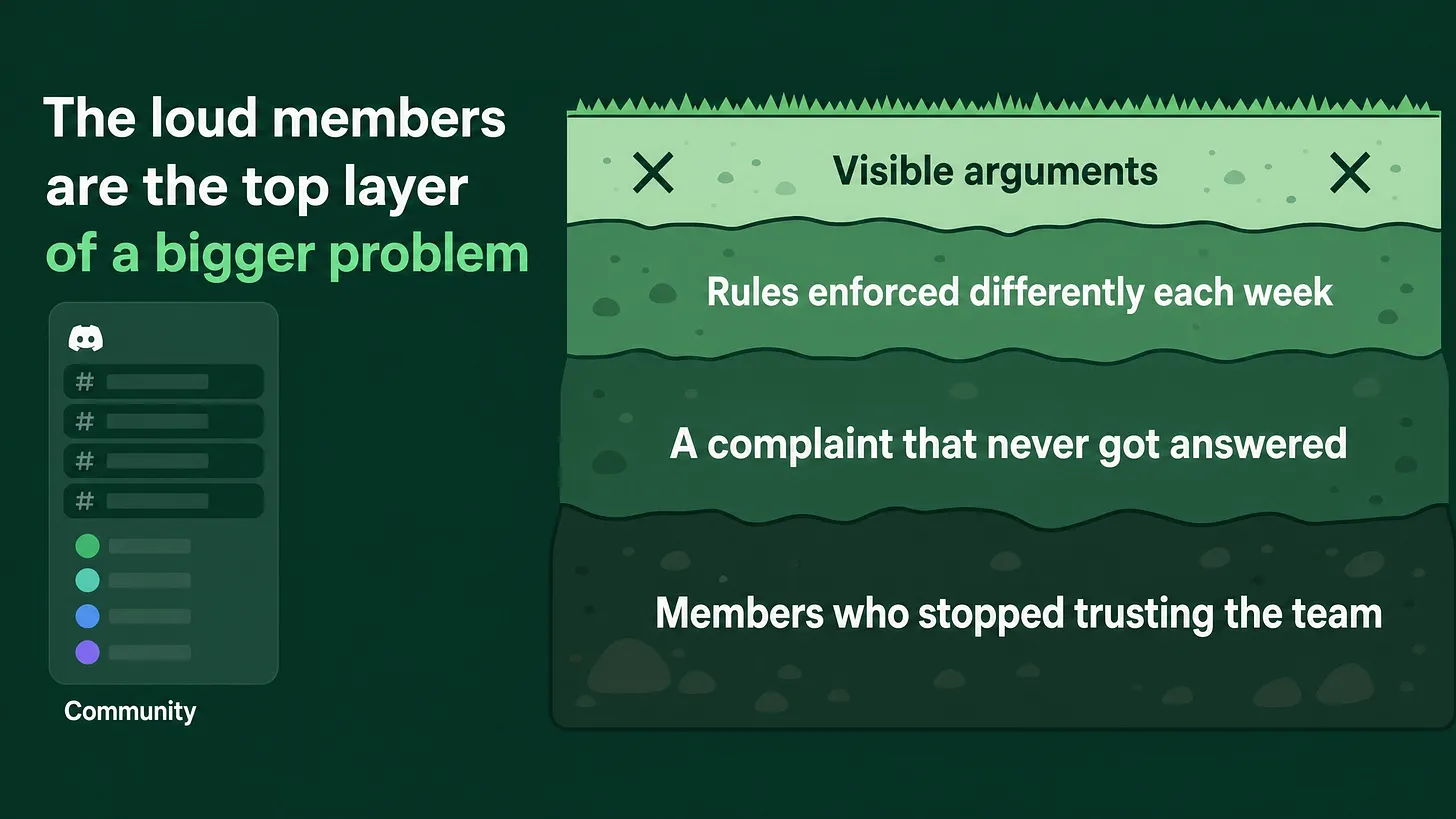
| How to fix a toxic Discord community starts by not banning your way out of it. Hostility usually comes from enforcement members cannot predict and a complaint nobody ever answered in public. Answer the complaint once, publish four behaviors with exact consequences, and enforce them identically for two weeks before removing anyone. |
|---|
The common advice is wrong
The usual prescription for a hostile community is to remove the loudest people and reset the tone. It works for about nine days. Here is what actually happens. You remove four or five names. The channel goes quiet, which reads as success. Then the remaining members, who watched those removals and could not predict them, stop posting anything with an opinion in it. A month later you have a calm server nobody talks in, and the first person to say something critical becomes the new problem. The case against mass removal is not a moral one. It is that removal treats the participants as the cause, and in most communities they are not. They are the layer you can see.
The people arguing in your server are rarely the reason your server argues.
Underneath, two things are almost always true, and both of them are yours to fix.
Cause one: nobody can predict what happens to them
A member posts something sharp about the product. It stays up. Next week someone posts something milder and it gets removed. Neither of them was told why. This is the single most common source of hostility in a community, and it almost never gets named as one, because from inside the team it does not look like inconsistency. It looks like judgment. One moderator was busy. Another had context the first one lacked. A third thought the member was joking. From the member's side it looks like a rule that changes depending on who is watching. That produces three predictable behaviors:
- Testing. People probe the boundary because they cannot see it. Every probe that survives moves the line further out.
- Grievance. Whoever finally gets hit compares their case to one that was not, decides they were singled out, and now has an argument to make.
- Audience. Other members watch the exchange and learn what enforcement is worth here. That sequence converts an ordinary member into an opponent, and it does not require anybody to have behaved badly.
Cause two: an unanswered complaint that never went away
The second cause is a specific grievance that was never addressed in public. A price change with no explanation. A feature promised on a date that passed. An outage nobody acknowledged. A ban that looked personal. When a complaint like that gets no straight answer, it does not disappear. It relocates. It shows up inside unrelated threads, in the tone of otherwise routine questions, in the reason a new member gets told the team does not listen. The community relitigates it constantly because it was never actually closed. You can usually find it in an afternoon. Read the last thirty days of your busiest channels and count what people are actually arguing about, not what the arguments are attached to. One complaint tends to sit under most of them.
Step one: answer the complaint once, in public
Name it directly, in a normal post, in the channel where people already are. Four parts, and no others:
- What happened.
- What you got wrong.
- What changes.
- What does not change, and why. The fourth part is the one teams skip, and it is the one that buys credibility. A community can accept a decision it dislikes when it is stated plainly. It cannot accept being managed around. Then do the thing that makes this work: when it resurfaces, link to that post rather than reopening the debate. Holding the same argument a second time tells everyone the first answer was provisional.
Step two: publish four behaviors and their consequences
Not a code of conduct. Four lines.
| Behavior | What happens |
|---|---|
| Spam, scams, unapproved promotion | Message removed, no warning |
| Personal attacks on another member | 24 hour mute, first time |
| Repeating it after a warning | 7 day mute |
| Sharing private information about someone | Permanent removal |
Four is the number because the value of this list is entirely in whether a member can hold it in their head. A document with nineteen clauses is a legal artifact, and nobody consults a legal artifact before posting. They consult their memory of what happened to the last person.
The important design choice is that the consequence is fixed and stated, not a range. "Up to a permanent ban" restores the unpredictability you are trying to remove. 24 hour mute does not.
Criticism of the product, the team or you does not appear on this list, and should not. A community where complaining is a moderated offence produces silence, not health, and you will not be able to tell the difference from a dashboard.
Step three: enforce identically for two weeks
This is the step that decides it, and it is harder than it reads. For two weeks, the four rules get applied the same way every single time. Including when the person is a long standing regular. Including when they are right. Including when enforcing it is going to cost you a thread you were enjoying, or annoy someone whose goodwill you rely on.
⚠️ One visible exception costs more than ten enforcements gain. Members do not average your behavior over time. They remember the case that did not match.
What you are rebuilding here is not tone. It is predictability. Members relax when they can tell in advance what will happen to them, and a community full of relaxed people looks nothing like the one you have now. Make the moderator's job mechanical during this window. Same phrasing on every action, a short public note where the removal happened, no debate in the channel about whether it was fair. Debate about a rule belongs in a place you nominate, after the action.
Step four: bring the quiet people back, in that order
Most of your community went silent long before it turned hostile. Those people are still there, reading. Do not run a broad reactivation announcement. In a room that has recently been unpleasant, a cheerful group ping reads as tone deaf and gets ignored by exactly the people you want. Instead:
- Pick ten former regulars who have not posted in a month.
- Message them individually, referencing something they actually contributed.
- Ask a low stakes question with an easy answer.
- Give them something to reply to in public within the week, in a thread that is already friendly. The order matters. Do this before the enforcement is consistent and you are inviting people back into the same room they left.
Step five, and only now: removal
Some people do need removing. After steps one through four, the list is short, usually one or two names, and every removal maps to a consequence you already published. That mapping is the entire point. A removal that matches a published rule teaches the community that the rules are real. A removal that does not match anything teaches them that the rules are decorative and the team acts on mood, which is where you started.
How to tell whether it worked
Member count and message volume both lie here, because both go up when a community is arguing. Watch these instead:
- Arguments stop referencing the old grievance.
- The same behavior gets the same response twice in a row, from two different moderators.
- Members answer each other's questions before a moderator arrives.
- Someone posts a criticism and the thread stays civil without intervention. The fourth one is the real test. A healthy community is not one where nobody complains. It is one where a complaint can be made and handled in public without the room catching fire.
Where this sits in the bigger picture
Moderation load and enforcement consistency are one layer of the operating system a community runs on, and this article covers that layer completely enough to install without help. The layers around it are separate builds: onboarding and the first forty eight hours, role and channel architecture, support routing, escalation paths, documentation, automation coverage, engagement rhythm, and the reporting that tells leadership what changed this month. Fixing enforcement first is the right sequence regardless, because every other layer you build sits on top of whether members believe the rules mean anything.
Communities do not usually collapse because the wrong people joined. They come apart when nobody can tell what the rules are any more, and rebuilding that is slower and less dramatic than a ban wave, which is exactly why it holds. More at danieljeong.org.