How to Delegate Discord Community Management Without Losing Control of the Room
How to Delegate Discord Community Management Without Losing Control of the Room

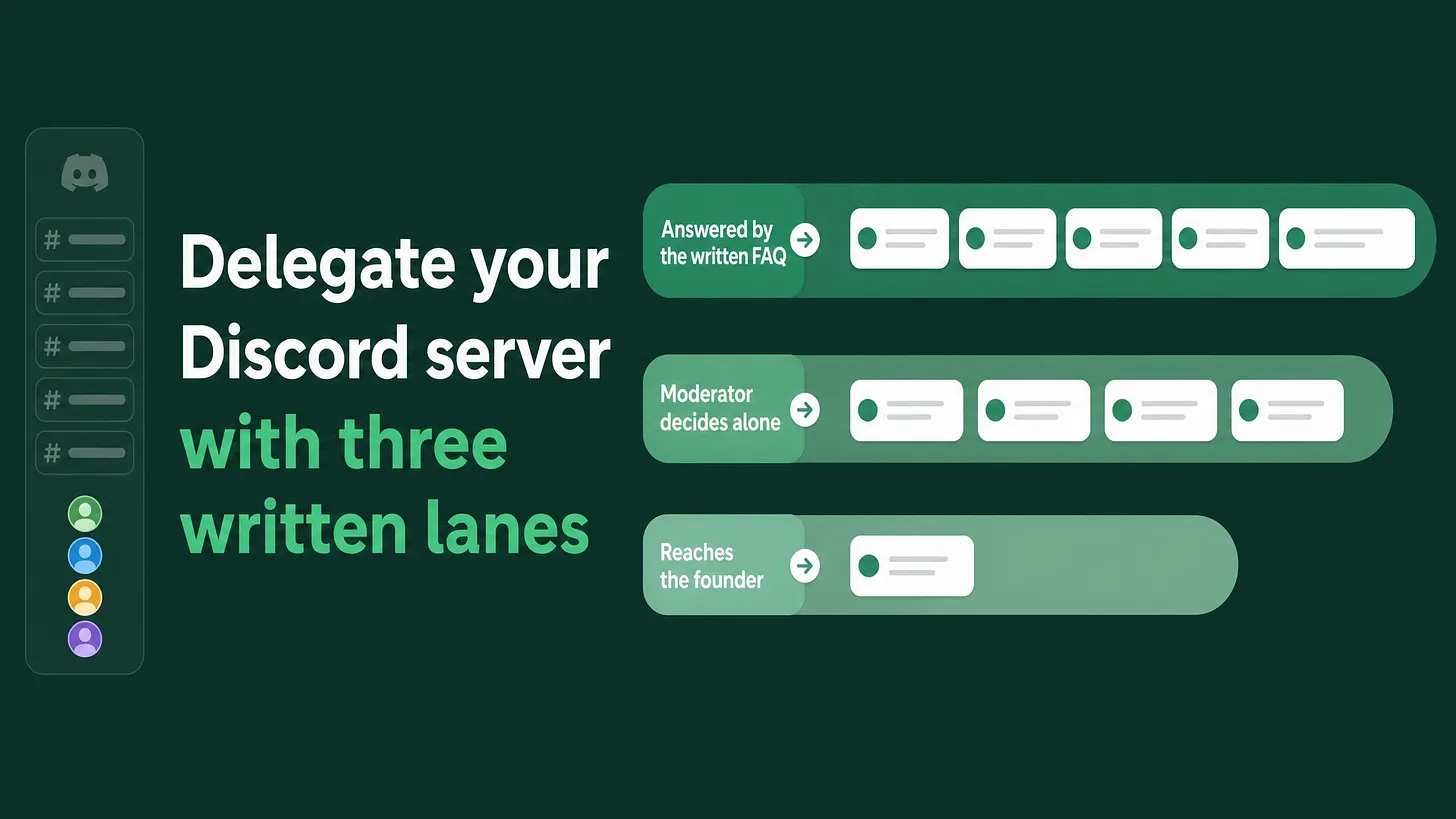
| How to delegate Discord community management comes down to one document: the list of decisions your moderator is allowed to make without asking you. Sort every incoming message into three lanes, already answered in writing, moderator decides alone, comes to you. Write the middle lane first and set a response window so your silence counts as approval. |
|---|
The short answer
You delegate Discord community management by writing down the decisions your moderator makes without asking you, and then living with those decisions. That document is the job. The tooling, the second moderator, the shift rota, all of it only works once the document exists. Most founders hand over the role and skip the document. The moderator gets the buttons and none of the boundaries, so they check with you before pressing any of them. Can I delete this. Can I mute him. Should we say something about the outage. You answer, and the server stays exactly as heavy as it was before you hired anyone. The fix is a sorting system. Every message that arrives goes into one of three lanes: it already has a published answer, the moderator handles it alone, or it comes to you. You will write the middle lane first, because the middle lane is the one that does not exist yet.
Access is not authority
Handing over the moderator role transfers buttons. It does not transfer permission to press them. Picture the first fortnight of a new moderator. A member posts a screenshot accusing the company of ignoring a refund. Someone drops a competitor link in the main channel. A regular asks whether the launch date is still real. Two people start arguing in a support channel and one of them is a paying customer. Every one of those has a correct response and none of them arrive with a rule attached. The moderator has two options. Guess, and risk being told off in front of the team. Or ask, and risk nothing at all. So they ask.
An unanswered question about authority becomes a message you answer personally.
This is why founders who have already hired help still describe their own server as a weight they carry. The headcount changed. The decision load did not move.
Lane one: the answer already exists somewhere
Start with the easiest pile, because clearing it buys you attention for the harder work. Lane one is every question whose answer already exists somewhere a member can reach without asking a person. Pricing. How access works. Where a file lives. What happens after a purchase. What the refund window is. Which channel a bug report belongs in. These do not need a human. They need a location and a habit. Put the answers in one place members can find on their own, then make the moderator's first move a link rather than a retype. Two things decide whether this lane holds:
- The answer has to be findable by someone who does not know your internal vocabulary yet. Write it in the words a new member would actually type.
- The answer has to be current. A stale published answer is worse than no answer, because the moderator stops trusting the library and comes back to asking you. Anything in lane one that members keep asking out loud is a sign the answer is hidden rather than missing. Move it, do not rewrite it.
Lane two: the moderator decides alone
This is the lane that does not exist in most servers, and its absence is why the other two never hold. Lane two is a written list of actions your moderator takes without checking in. Not guidelines. Not principles. Specific things, phrased as permissions. A starting version reads like this:
- Remove spam, scam links and unapproved self promotion
- Mute or time out a member who has already been warned once
- Pin a correction when wrong information is spreading
- Close or lock a thread that has run its course
- Move a conversation into the channel it belongs in
- Send a billing or account problem straight to support
- Answer any product question that already has a published answer
- Welcome, tag and route a new member without asking
- Approve a member introduction or a community share
- Issue a goodwill gesture up to a ceiling you set in writing That last line carries more weight than it looks. A moderator who can settle a small complaint on the spot ends the conversation there. A moderator who has to ask turns a two minute annoyance into a thread that eventually reaches you anyway, slower and angrier. Set the ceiling as an amount you are comfortable losing without being consulted. The size of it matters far less than the fact it is written down.
Lane three: the short list that reaches you
Lane three has to be short and specific or it quietly swallows the other two. Define it by category, never by severity. Severity is a judgment call, and judgment calls get escalated by default. A workable list:
- Anything legal, including threats, disputes and takedown requests
- Anything that would change a policy you have already published
- Anything involving a partner, an investor or a press contact
- A public accusation about the company that has started collecting replies
- An outage or incident the team has not acknowledged yet
- Anything a moderator has already flagged twice without resolution Notice what is absent. Member drama is not on the list. Arguments, hurt feelings and personality clashes are lane two work. They feel urgent, they generate the most noise, and they are the exact category founders keep quietly taking back.
Give lane three one destination and one shape
An escalation that arrives as a direct message at eleven at night is not a system. Give lane three a single private channel and a fixed format, so you can read it in under a minute and answer in one line.
WHAT HAPPENED: one sentence, no backstory
WHERE: channel name and message link
WHO IS AFFECTED: one member, a few, or public
WHAT I PROPOSE: the action I will take
DEADLINE: when I act if I hear nothing
The last two fields do the real work. A moderator who escalates with a proposal attached has already done the thinking, and your job drops to approving or redirecting. A moderator who escalates a blank problem has handed their job back to you with extra steps.
The two rules that stop this collapsing
Every escalation ladder that fails, fails on one of these. Silence is approval. Set a response window and put it in writing. If you have not answered inside it, the action the moderator proposed goes ahead and the outcome belongs to you rather than to them. Without this rule the whole structure reverts to founder dependency inside a month, because waiting becomes the moderator's safest move. Every lane three item gets written down and demoted. When you resolve something, the resolution becomes a rule. The next time that situation appears it is lane two, or lane one. Run the review once a week and the list of things that reach you shrinks without anyone forcing it.
A lane three list that is the same length in month three as it was in month one is not being maintained. The measure of this system is how much smaller that list gets.
Install it in one week
- Days one to three. Log every message that reached you and where it came from. No sorting, no fixing, just a list.
- Day four. Sort the log into three piles: already had a published answer, needed a decision any trained person could make, genuinely needed you. The middle pile is usually the largest by a distance.
- Day five. Write lane two from that middle pile. Ten lines is enough to start. Include the goodwill ceiling.
- Day six. Create the escalation channel, paste the format above into its topic, and set your response window.
- Day seven. Send the document and say the sentence plainly: you do not need to ask me for anything on this list. Then brace for the part that decides whether it works. Inside the first fortnight your moderator will make a lane two call you would have made differently. If you overrule it, you have taught them that the list is decorative and every one of those decisions comes back to you. Let it stand, and change the list afterwards if the outcome was genuinely wrong. The list is the thing you are allowed to edit. Their authority is not.
When you actually need this
The lanes are overhead at small size and survival at large size.
| Community size | Who answers | What happens without written lanes |
|---|---|---|
| Around 100 members | You, personally, and that is correct | Nothing breaks yet |
| Around 1,000 | You plus one moderator | Every decision routes through you and response times slip |
| Around 10,000 | A moderator team working from documentation | Moderators contradict each other in public |
| Around 100,000 | Automation plus a moderation framework | Escalations get lost and repeat incidents get handled from scratch |
The practical trigger is simpler than any number. The moment you are no longer the fastest person to respond in your own server, you are the bottleneck, and the lanes should already be written.
Where this sits in the bigger picture
Escalation paths are one layer of the operating system a community runs on, and this article covers that layer end to end. The other layers are their own builds: onboarding and the first forty eight hours, role and channel architecture, support routing, moderation load, documentation, automation coverage, engagement rhythm, and the reporting that tells leadership what the community actually did this month. You can install the lanes this week without touching any of those. It is worth knowing they exist, because a clean escalation ladder sitting on top of a broken entry flow just routes confusion faster.
The servers that feel calm are rarely the quiet ones. They are the ones where everybody already knows which decisions are theirs. Written rules are what let a founder walk away from the app for a day and come back to a room that ran itself. More at danieljeong.org.