How to Choose Moderators for a Discord Community: Pick on Conduct, Then Run a Limited Trial
The five signs that the wrong people hold the moderator role, the two tests that predict a good one, and a short trial that shows you the answer before full permissions go out.

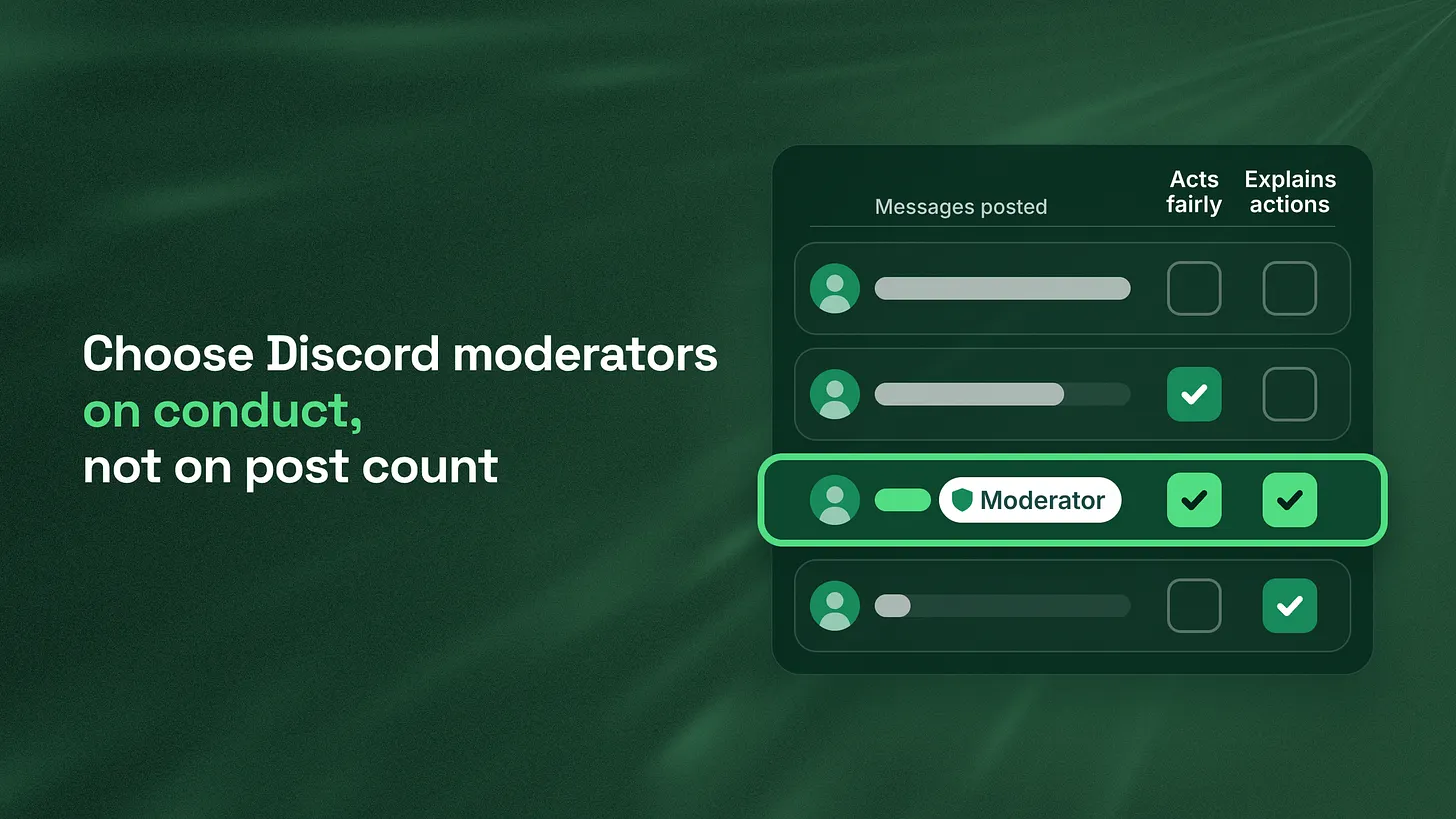
TL;DR
If you are working out how to choose moderators for a Discord community, stop choosing on activity. Pick on conduct and on how clearly a person explains their actions. Then run a fixed trial with limited permissions and a required note for every action, and keep a written record of what you saw.
The short answer
Choose moderators on two things you can observe before anyone gets a title. The first is conduct. The person treats every member by the same standard and takes nothing for themselves from the community. The second is communication. When they act, they can explain what they did and why, in words a stranger would follow. Then test both with a short trial that has limited permissions, and write down what you saw. The rest of this piece covers the signs that your current selection is failing, the cause, and each step in detail. A few terms, explained once:
- A moderator is a member with permission to act on other members' messages or accounts, for example by removing a message.
- A timeout is a Discord feature that temporarily stops a member from posting.
- A staff channel is a channel only the team can see.
- The community guidelines are the written standards every member agrees to follow. I served as Head Discord Moderator for Google Developers and managed BlueWillow's Discord through its rise from about 1K to 1.7M members, and this is the method I use today.
Five signs the wrong people hold the role
A wrong pick shows up in the server long before anyone on the team says it out loud. These are the five signs I check for.
| Sign | What you see | What it means |
|---|---|---|
| Actions with no explanation | A message disappears or a member is timed out, and nothing in the staff channel says why | Nobody else on the team can review or defend the decision |
| Uneven treatment | A regular gets a friendly reminder for the same thing that got a newcomer removed | The standard depends on who the member is |
| Self-promotion | A moderator shares their own offers, their own links or their friends' projects where an ordinary member would be stopped | The role is being used for personal gain |
| Silence when questioned | A member asks why their message was removed and gets no reply, or a reply that only repeats the decision | The moderator cannot or will not explain themselves |
| Staff hear it from members | The team learns about an incident from a complaint, hours after a moderator dealt with it | Information is not reaching the people responsible for the community |
One of these, once, is something to coach. The same sign repeating from the same person points back to how that person was chosen.
A member who understands why their message was removed usually stays. A member who gets no answer usually tells other members about it.
The cause: choosing by message count or tenure
Most teams pick the member who posts the most, or the member who has been around the longest. It feels fair and it is easy, because activity is the one thing about a member that everybody can already see. Activity measures how much someone enjoys the community. It does not measure how they behave when they hold power over other members. The second quality only becomes visible when you look for it on purpose. Heavy posters also carry two specific risks. They have the most friendships in the server, so they face the most situations where the person breaking a guideline is a friend. They also have the most opinions on record, so other members already see them as one side of old arguments. A few of them post constantly because they want standing, and a title gives them more of it. Tenure has the same weakness. A long-standing member knows the history of the server. Knowing the history says nothing about whether they would apply the guidelines evenly. None of this rules out an active member. Plenty of good moderators post a lot. Activity is not evidence for or against a candidate, so it cannot be the reason you pick them.
Test one: conduct
Conduct is about what a person does when they have an advantage over someone else. Two questions settle it. How do they treat newer or less popular members? Read their replies to beginner questions, to people who post in the wrong channel, and to members the regulars find annoying. You are looking for the same patience they show their friends. Warning signs are sarcasm aimed at newcomers, pile-ons they joined, and in-jokes made at a new member's expense. Have they ever used the community for personal gain? Look for their own links dropped into unrelated threads, services offered to members in private messages, and friends' projects pushed in places where promotion is not allowed. A single link in a channel made for sharing means nothing. A habit of steering discussion toward something they benefit from is exactly what a moderator title would amplify.
Test two: communication
A moderator's decisions get read by people who were not there. Other staff read them the next morning. The affected member reads them. Anyone who scrolls up reads them. The test is whether the candidate's existing messages are clear to someone with no context. Pick five of their longer messages and read each one cold. For each message, ask whether you can tell what they are responding to, what they are saying, and what they want to happen next.
If you have to scroll up to understand a candidate's message, their moderation notes will need the same scrolling. Staff will stop reading them, and the note requirement will fail without anyone deciding to drop it.
Check tone under disagreement as well. Find a thread where someone pushed back on them. A good candidate explains their reasoning a second time in different words. A weak one repeats the same point more forcefully or leaves the thread.
Where to look before you ask anyone
Everything above can be checked without telling the candidate. There are three places to look.
- Their message history in the server. Use Discord's search to filter by their name. Skip their most popular posts and read their replies to other people, because replies show how they treat members.
- How they respond when corrected. Find a moment when a staff member or another member told them they were wrong, or asked them to move a discussion elsewhere. See whether they adjusted, argued or went quiet. A moderator gets corrected by the team and challenged by members every week, so this reaction matters more than any answer they give you later.
- Whether they already help without a title. Look for answered questions, people pointed to the right channel, and problems flagged to staff in private instead of confronted in public. Someone who does the work with no title wants the work. Do this reading before you mention the role to anyone. Once a member knows they are being considered, their behaviour changes and the history stops being a fair sample.
Four scenario questions to ask
Ask these in writing. A written answer tests communication at the same time as judgment.
1. A friend of yours in the server breaks a guideline in front of other
   members. What do you do, and what do you say to them?

2. You remove a message. The member disputes it in a public channel.
   What is your next message?

3. Two long-standing regulars are in a heated argument. Neither has
   broken a guideline yet. What do you do?

4. You see another moderator act in a way you think was wrong.
   What do you do?
Strong answers share a few features. On the first question, the candidate takes the same action they would take with a stranger and tells the friend so. On the second, they give the reason once and move the discussion to a private space, without arguing in front of an audience. On the third, they step in early with a calm message before anyone needs removing, and they tell staff. On the fourth, they raise it with that moderator or the team lead in the staff channel. Weak answers also look alike. They include "it depends who it is", a wish to win the argument, punishment as the first move, and no mention of telling the team.
The trial
Past messages and written answers are a forecast. The trial is the evidence. Write the terms down and share them with the candidate before it starts.
TRIAL MODERATOR TERMS

Length          A fixed period with an end date, for example four weeks
Permissions     Time members out and remove messages. Nothing else.
Not included    Kicking, banning, editing roles or channels
Note rule       Every action gets a short note in the staff channel
                on the same day
Reviewer        One named person reads every note
Outcome         On the end date the role is confirmed, extended once,
                or removed
Said up front   The trial can end without the role, and that is no
                judgment on you as a member
In Discord, build this as a separate role for trial moderators that holds only the permission to time members out and the permission to manage messages. Both actions are small and easy to reverse. A timeout expires, and one removed message is a minor loss. A ban is much harder to take back, which is why it stays with full staff. Each note follows the same four lines:
Who:                   the member involved
What I did:            the action taken
Why:                   which guideline, in one sentence
What I told them:      the message sent to the member
The notes are the test. Conduct shows in who gets acted on and who does not. Communication shows in whether the reviewer can follow the note without asking a question. Name one reviewer, because a task shared by the whole team tends to be done by nobody. Once a week, the reviewer checks five things: ✅ Every action in Discord's audit log, the server's built-in record of staff actions, has a matching note. ✅ Each note makes sense without a follow-up question. ✅ The same behaviour got the same response, whoever the member was. ✅ Each affected member was told why. ✅ The role was never used for the candidate's own links, offers or friends.
Write down what you saw
Keep a short record for every candidate. It lets you explain the decision to the candidate, and it lets whoever leads moderation after you see how each moderator was chosen.
| What to record | Example entry |
|---|---|
| Conduct before the trial | Patient with beginners in the help channels. No self-promotion found. |
| Communication before the trial | Messages clear without context. Explained calmly when corrected. |
| Notes during the trial | Every action had a note. Some notes needed a follow-up question. |
| Consistency during the trial | Timed out a friend for the same thing as a newcomer. |
| Decision | Confirmed, with the date and the reviewer's name. |
The exit when the trial shows a poor fit
Some trials end without the role. Handled in this order, the exit stays quiet.
- Decide on the end date, or sooner if something serious happens, such as the role being used for personal gain. Do not let a trial drift past its date.
- Tell the candidate in a private message before the role changes. Name what you observed in two or three sentences, using the notes.
- Thank them for the time they gave, and say plainly that they are welcome as a member.
- Remove the trial role the same day.
- Tell the staff team in one line. Make no public announcement, because the trial was never announced as permanent. What keeps this calm is the sentence the candidate read at the start. A person who agreed that the trial can end without the role is hearing an outcome they expected. If there is one specific thing they could improve, name it and offer a second trial on a stated date. Avoid a vague "maybe later", which leaves the person waiting on a promise nobody intends to keep.
Where selection sits in the larger system
Choosing and testing moderators is one part of moderation load and escalation paths. Moderation load is how much work reaches the moderators. An escalation path is where a decision goes when it is above a moderator's level. That system sits alongside onboarding, support routing, documentation, automation coverage and reporting. This piece covers selection completely enough to run without help. A well-chosen moderator still depends on the layers around them: guidelines written clearly enough to apply, somewhere to send the hard decisions, and automation that takes the repetitive work off their hands. A moderator role is a small amount of power over other people, and how someone treats the members who can do nothing for them is the best preview of how they will use it. More at danieljeong.org.