How to Audit a Competitor Discord Server Before You Build Your Own
A two hour walkthrough of three servers, joined as an ordinary member, with the same five measurements taken in each one. What to copy, what to ignore, and what the gaps tell you.

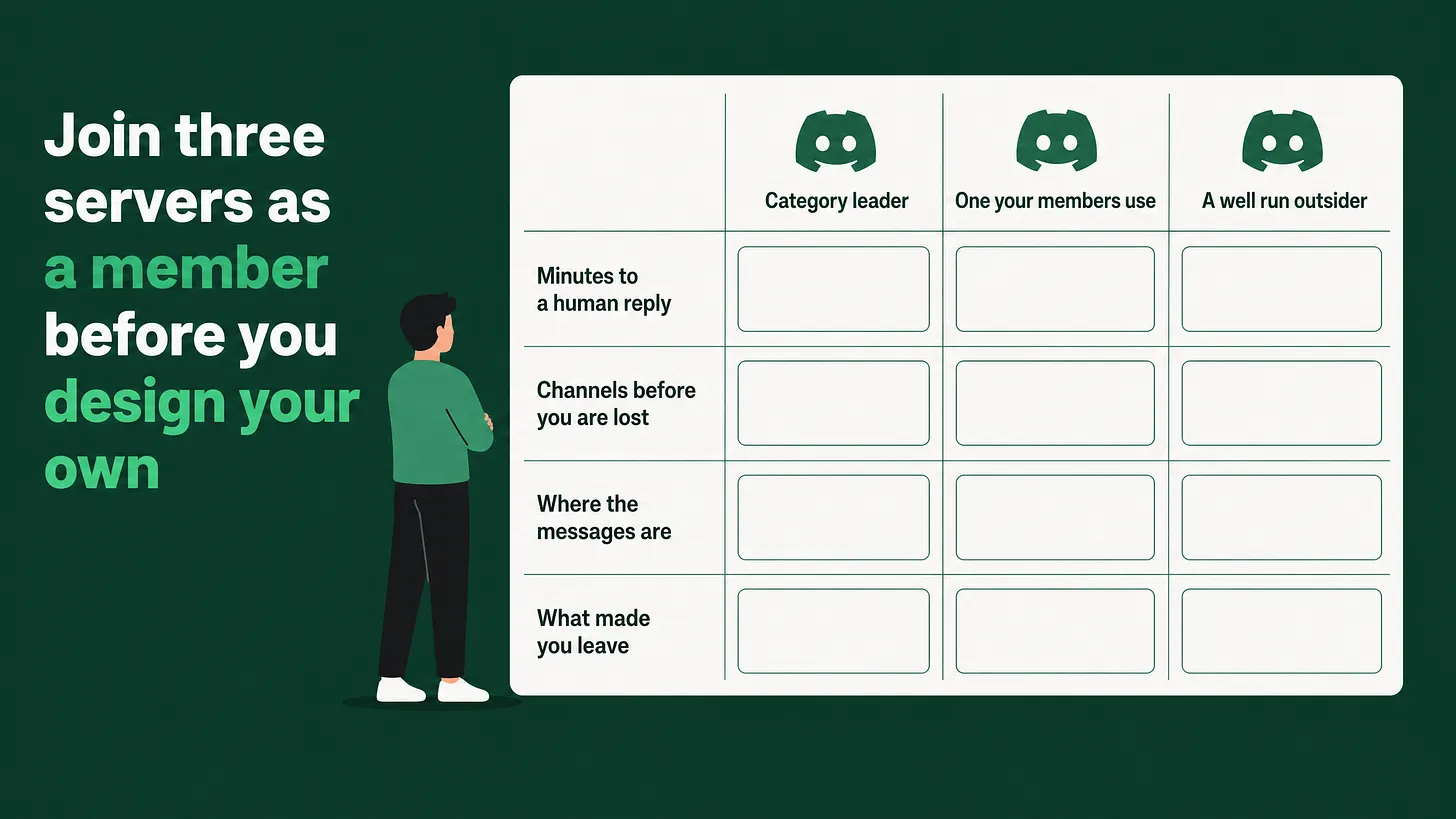
| How to audit a competitor Discord server: join three of them as an ordinary member for two hours, ask one real question in each, and record the same five measurements every time. Copy the mechanics you observed, ignore the decoration, and build your own plan around the gap none of the three filled. |
|---|
The short answer
Join three servers, act like a member, and measure the same five things in each. Pick the leader in your category, one your own members already use, and one well run server from a field unrelated to yours. Spend roughly forty minutes in each. Go through the gate, read what you are told to read, ask one genuine question, and write down five specific observations. Two hours total. That is the whole method. What follows is the sequence in order, what each measurement tells you, and how to turn the sheet into a build list.
Step one: choose the three, and make one of them an outsider
The choice of servers decides how useful the exercise is. The category leader shows you what your members will compare you to. Whatever they have been trained to expect is now your baseline, whether or not it is any good. A server your own members already use shows you the habits they will bring with them. This is often not a competitor at all. It might be a tool community, a learning community, or a large general server in an adjacent interest. A well run server from an unrelated field is where the actual ideas come from. Nobody in your category has copied it yet, so anything you take from it arrives as something new rather than as a match of the leader.
Studying only your competitors guarantees you end up with a slightly worse version of the same room. The outsider is what stops that.
Step two: join as a member, never as a strategist
Reading a server from the outside teaches you almost nothing, because the parts that matter are the parts you only meet by going through them. So go through them. Click the invite. Complete whatever gate exists. Read whatever the first channel tells you to read, in the order it tells you. Select roles if roles are offered. Resist opening the member list and counting things, because that is the behaviour of somebody evaluating rather than arriving, and it hides exactly what you came to see. Set a timer for forty minutes and stay in one server for the whole block. Switching between them breaks the comparison, because you stop reacting and start pattern matching.
Step three: ask one real question
This is the single most informative thing you will do, and most audits skip it. Ask something you genuinely want to know, in whatever channel seems correct, in the way a real member would write it. Then watch what happens to it. Does it get answered, ignored, moved, or buried? Does a staff member answer, or another member? How long does it take? Did you have to guess which channel to use? The answer path is the hardest thing to design and the easiest thing to observe, and you get it for the price of one message.
Step four: record the same five measurements
Use an identical sheet for all three so the results can be compared side by side.
| Measurement | What it tells you |
|---|---|
| Minutes until a human speaks to you | Whether anyone is actually present, or the room only appears staffed |
| Channels visible before you understand any of them | How much structure a new member is asked to absorb at once |
| Where the last twenty messages happened | Which channels are alive, as opposed to which ones exist |
| Who answered your question, and after how long | Whether support runs on staff, on members, or on luck |
| The exact moment you wanted to close the tab | The drop-off point you are about to build into your own server |
The last row is the one people underestimate. Write down the specific moment, not a feeling. A wall of rules. A forced role picker with thirty options. A general channel scrolling faster than you can read. Those are precise, and precise things can be designed around.
Step five: split what you saw into mechanics and decoration
Every observation goes into one of two columns, and only one of them is worth copying.
Mechanics, worth copying:
- The order things happen in at the entrance
- Where a question goes and who is expected to answer it
- How many channels are visible on day one
- What a member is asked to do first
- How rules and moderation are applied in public
Decoration, not worth copying:
- Channel naming style and emoji prefixes
- Category names and section dividers
- Banner art, icons and role colours
- Tone of the welcome message
- The number of channels in total
Mechanics transfer between communities. Decoration does not. A server that copies the decoration of a larger one reads as an imitation to any member who has seen both, and imitation costs more credibility than an unremarkable design ever would.
The trap of counting channels:
Channel count is the most frequently copied and least meaningful number in this exercise. Large servers have many channels because they accumulated them over years and because their moderation capacity can cover them. A new server that launches with the same count launches with twenty empty rooms, and emptiness is the single clearest signal that a community is not working. Copy the shape of the first five channels, never the total.
Step six: write down what none of them did
After three servers you will have noticed something absent from all of them. Nobody answered questions on weekends. Nobody told a new member what to do in the first minute. Nobody had a place where results were visible. Nobody made it possible to find an old answer. Whatever it is, that gap is worth more than everything else on the sheet, because it is the one thing you can be known for rather than compared on. Write the gap as one sentence, and treat it as the organising idea of your build rather than as a feature to add later.
Step seven: convert the sheet into a build list
Turn the observations into decisions in a single sitting, while the experience is still fresh.
- Write the first five channels a new member will see, in order.
- Write the answer path for one question: which room, who responds, within what time.
- Write the one thing a member is asked to do in their first minute.
- Write your version of the gap none of the three servers filled.
- Write the drop-off moment you observed and what you will do differently at that exact point. Five decisions is more than most teams reach after weeks of discussion, and every one of them is grounded in something you watched rather than something you assumed.
Where this sits in the larger system
The audit is one layer of the build, and it is the cheapest one to run. Around it sit the layers it feeds: channel and role architecture, onboarding and the first 48 hours, support routing, moderation coverage and escalation, the engagement rhythm that keeps the room active, and reporting that tells leadership what the community produced. The audit does not replace any of them. It removes the guesswork from all of them, which is why it belongs before the first channel is created rather than after the launch has already taught you the same lessons at a higher price. Block two hours this week and pick the three servers first. The exercise fails only when the choices are lazy.
You cannot design a room you have never stood in. Two hours of standing in one is worth a month of planning it. More at danieljeong.org.