How Long Does It Take to Set Up a Discord Community? The Four Phase Timeline
The building is the fastest part of the project. The date is set by decisions only you can make, and this is the order to make them in.

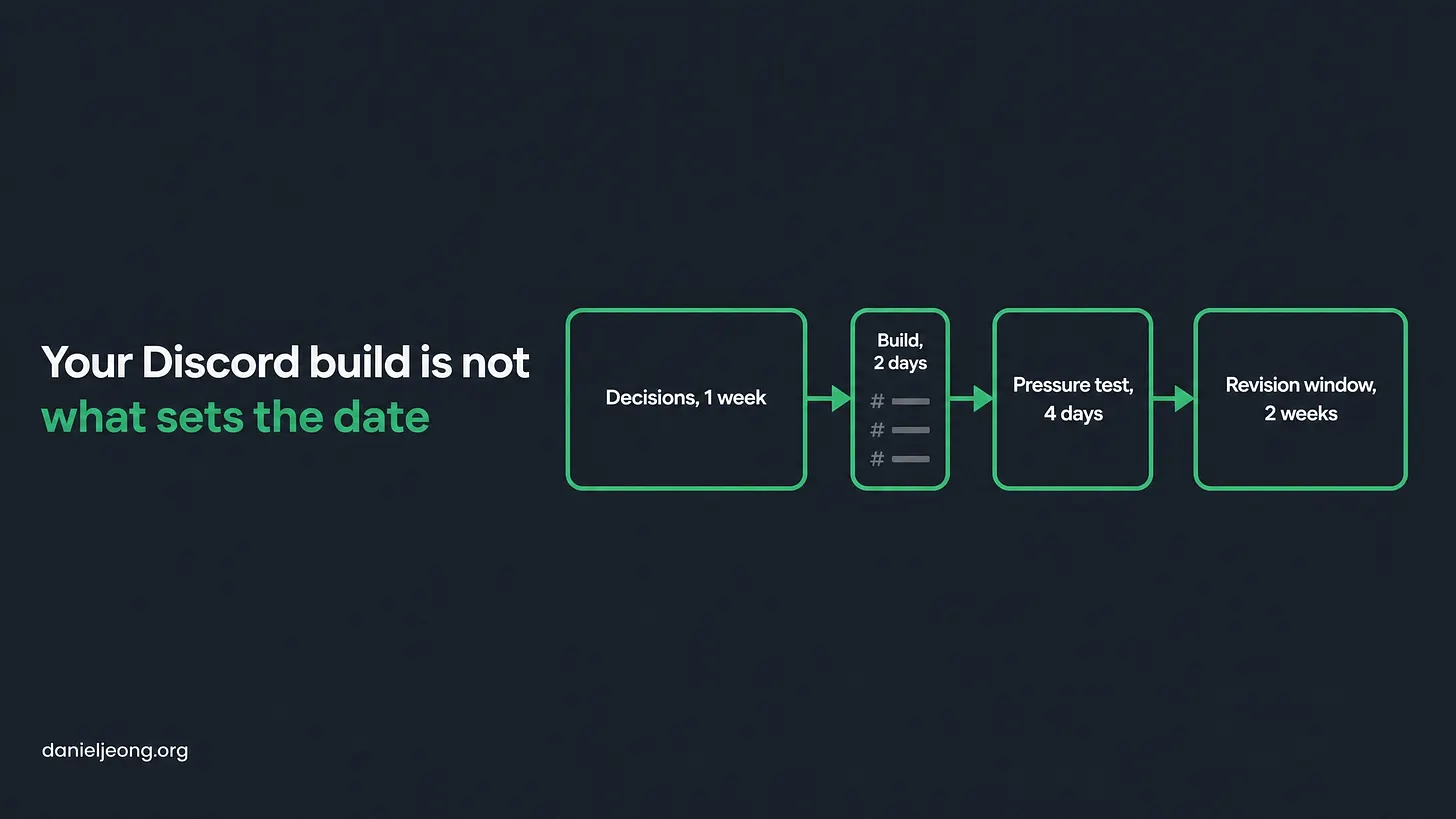
| 📌 How long does it take to set up a Discord community? Roughly three to four weeks end to end, of which the actual building is one to two days. The rest is a decision week, a pressure test with real strangers, and a bounded revision window. Projects that run to three months are usually waiting on a decision nobody owned. |
|---|
The answer, in the first paragraph
Three to four weeks from kickoff to a server you would happily send traffic to. Inside that, the building itself is one to two days of work. Everything else is deciding, testing with real people, and fixing what the test exposed.
If someone quotes you one day, they are quoting the build and leaving the project unscheduled. If someone quotes you three months, they have either found a genuine engineering requirement or they have absorbed your decision-making delay into their estimate. Both quotes can be honest. Neither one is a plan.
Here is the plan.
Phase one: the decision week
This is the phase that sets your date, and it is the phase most teams skip because it produces nothing visible.
Six things have to be settled before a single channel is created:
- One sentence describing what the server is for, written plainly enough that a member could repeat it.
- The person it is built for, described specifically. A creator who already earns from their audience is a different build from a developer evaluating your API.
- What you ask at the door. Every question you skip here is a segment you cannot serve later.
- What a new member does in their first forty eight hours, named as one concrete action.
- Who answers when that member replies, and during which hours.
- Which channels have a named owner, because a channel without one closes itself within a month.
Give this week a single owner and a deadline. Distributed decision making without an owner is how a three week project becomes a three month one.
The output of phase one is a one page brief. It is short, boring, and the most valuable artifact in the whole project.
Phase two: the build
One to two days. Category and channel structure, roles and permission tiers, the entry flow, automated role assignment, the moderation gate, the support entry point, and any integrations that fire notifications into wherever your team already works.
The reason this phase is short is that the brief has already removed the questions. A builder who has to stop and ask what a channel is for is doing phase one work at phase two rates.
One thing worth deciding here rather than later: how ownership transfers. Whoever builds the server should be creating it inside your account or handing over full ownership at the end, and the date of that transfer belongs in the plan.
Phase three: the pressure test
Three to five days. Take five people who genuinely do not know your server and have them join as ordinary members while somebody watches.
Watch for four things:
- Where they pause before clicking anything.
- What they type first, and whether it lands somewhere staffed.
- Whether they can find the support entry point without being told.
- What they say the server is for, in their own words, after ten minutes.
That last one is the whole test. If five people give five different answers, the structure is communicating something other than what the brief says, and you fix it now rather than after launch.
Recruit the five testers during the decision week. Testers found on the day of the test are always colleagues, and colleagues already know what everything means.
Phase four: the revision window
Two weeks, with a close date fixed before it opens.
An open ended revision window is the single most common reason a finished server never launches. Requests arrive one at a time, each one small, and the server sits in a permanent state of nearly ready. Bound it: two weeks, a written change log, and a close date everyone agreed to in advance. Anything raised after the close date goes into a backlog reviewed monthly.
| Phase | Duration | Who blocks it | Output |
|---|---|---|---|
| Decision week | 5 days | You | One page brief |
| Build | 1 to 2 days | Builder | Working server, ownership transferred |
| Pressure test | 3 to 5 days | Five real strangers | Observed failure list |
| Revision window | 10 days | You | Change log, closed |
What actually turns three weeks into three months
Four causes, and only one of them is technical.
The first is an approval nobody scheduled. Legal wants to see the rules. Brand wants to see the assets. Neither request is unreasonable and neither was in the plan.
The second is a brand asset with no owner. Banners, icons and role art sit in a queue behind unrelated work, and the launch waits on a graphic.
The third is scope arriving through the side door. A feature described casually as a bot setting turns out to require custom development, a hosted service, and a maintenance owner. That is a separate project with its own budget, and treating it as a revision request stalls both.
The fourth is decision drift, where the brief is reopened after the build starts. Every reopened decision costs more than it did in phase one, because the structure has already been built around the previous answer.
⚠️ One question kills most of this: at kickoff, ask who has to approve the server before it opens, then invite those people to the pressure test.
What you are still not finished with
A server that passes the pressure test is a build, and a build is one layer of the operating model. Around it sit staffing and coverage hours, support routing and escalation, moderation workload, the engagement rhythm that gives people a reason to return, documentation so the same question is not answered twice, and the reporting loop that carries what members say back to product.
Each of those has its own timeline, and none of them are finished by the launch date. Knowing that in advance is what stops the launch from being treated as the finish line, which is the moment most communities quietly begin to decline.
Timelines slip in the places nobody assigned a name to. Assign the names first. More at danieljeong.org.