Discord Welcome Video for New Members: What to Record and Where to Put It
A ninety second screen recording in the first row of the channel list does more for activation than any amount of welcome text. Here is the script, the placement, and the before and after.

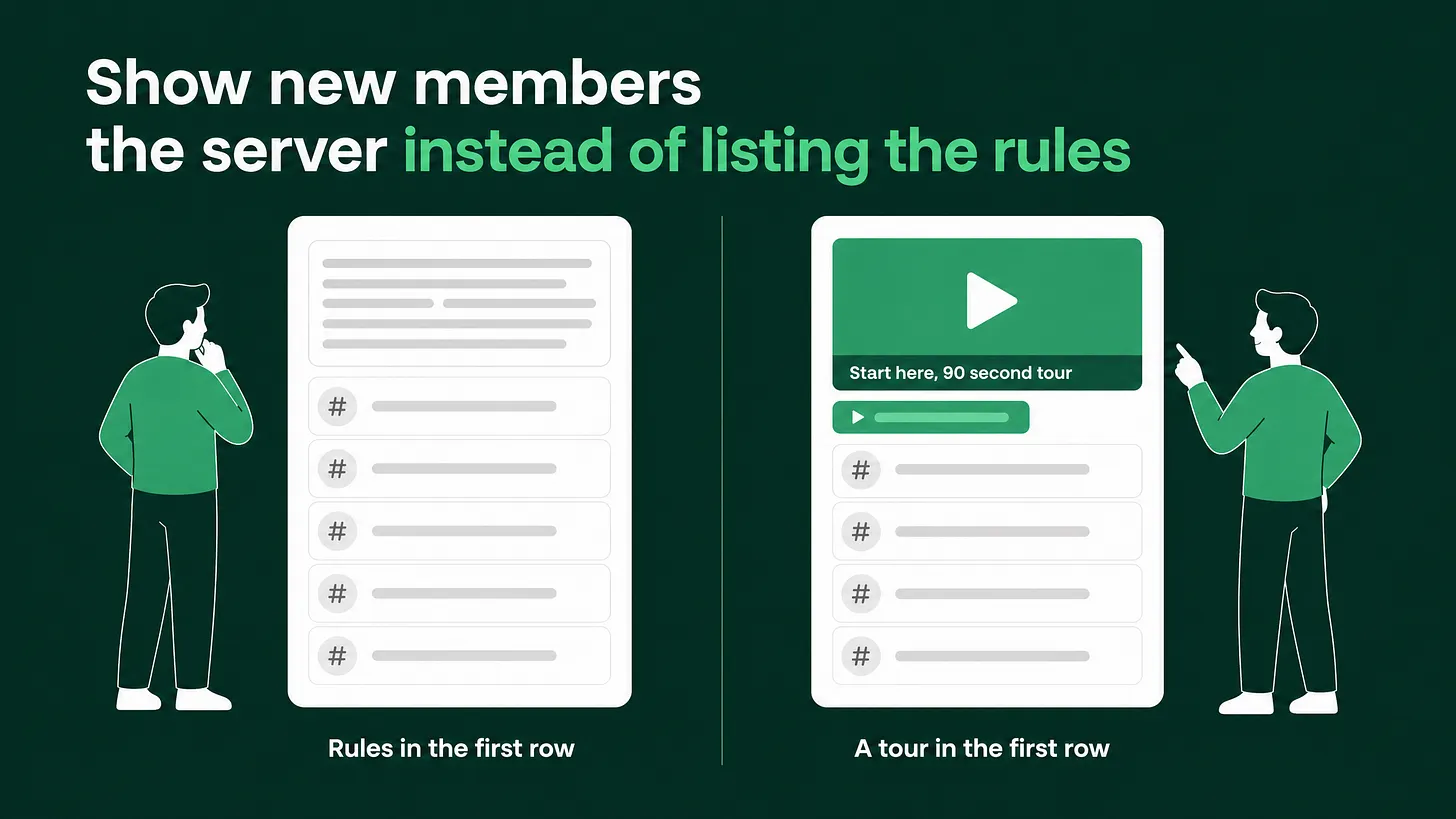
| A Discord welcome video for new members belongs in the first row of the channel list, runs ninety seconds at most, and is a screen recording of the real server with your voice over it. Show three destinations, thumbnail it with one readable line, and end on a single instruction rather than a summary. |
|---|
The short answer
Record your own server. Ninety seconds. Your voice, the real channels, three destinations, one closing instruction. Put it in the first row of the channel list, above the rules, with a thumbnail that says what the video shows. That is the whole build. What follows is the before state most teams are actually in, what changes when you make the swap, and the script.
Before: what a new member currently sees
Somebody clicks your invite. In the first few seconds they see a vertical list of channel names, a member count, and whatever sits in the top channel. In most servers that top channel is a rules document. Long, formatted, written for the rare person who intends to break something. Under it sits a welcome message with a paragraph of enthusiasm and a list of links. The new member scrolls the channel list. Every name is short and internal. Nothing tells them which of these twelve rooms is for them, what happens in this place, or what they are supposed to do in the next minute. So they do the rational thing and leave the tab open until they forget about it.
Nobody arrives at a community wanting to read a document. They arrive wanting to know whether this place is worth their attention, and that question is visual.
Product teams recognise this pattern immediately, because it is the same failure as a signup flow that drops a new user onto an empty dashboard. The product works. The first screen does no teaching.
Why rules in the first row cost you more than they protect
Rules are necessary and they are not an entrance experience. Somebody who intends to spam or harass is not deterred by a list. Somebody who is genuinely curious is asked to read a legal document before receiving a single reason to care. The channel that occupies your most valuable piece of screen space is therefore working for the smallest and least valuable audience you have. Keep the rules. Move them one row down. Nothing is lost, because the people who need to consult them go looking for them, and the people who were going to ignore them still will.
After: what the first row does instead
The first row becomes a short video, and the change is not cosmetic. A new member now sees a play button and one line telling them what they will learn. They watch, hear a human voice, see the actual rooms, learn where the useful thing lives, and finish with one clear instruction. Everything they needed to decide whether to stay is delivered in less time than it takes to read the rules headline. The secondary effect matters as much. The video teaches navigation. Because it shows the real channel list rather than a slide, the member recognises the layout when the video ends, and the first click stops being a guess.
What to record, shot by shot
Keep the structure fixed and the length short.
Ninety second server tour

  0:00  What this place is for, in one sentence.
        Say it while the channel list is on screen.

  0:10  Destination one. The single most useful room.
        Show it, scroll it, say what people get there.

  0:35  Destination two. Where to ask a question.
        Show a real thread and say who answers.

  0:55  Destination three. Where the events or drops live.
        Show one real example, not an empty channel.

  1:15  One instruction. Name the channel and the action.
        "Post one line about what you are building in
         introductions, and somebody will reply today."
Three destinations, because three is what a person retains from a first tour. A fourth turns the video into a directory and directories are what the channel list already is.
Why your own voice beats a produced voiceover?
A polished narrator makes the room sound like a marketing asset, and members calibrate their expectations to that. A real voice, slightly imperfect, with a real cursor moving across real channels, tells a new member that somebody is present in this server. That impression is the single most valuable thing the video delivers, and it is destroyed by production value. Record it on the machine you already use, in one take, with the door shut.
The thumbnail is a headline, not a still frame
A video card with a random frame behind it gets skipped for the same reason the rules channel does. It communicates nothing at a glance. Give the still image one short readable line naming what the video covers, something like a ninety second tour or where to start. Keep it large enough to read on a phone, and keep it to one line. This is the only piece of design work in the entire exercise, and it changes the play rate more than the content of the video does.
End on one action, never a summary
Most welcome videos end with a summary and a warm sign off. That returns the viewer to exactly the state they were in before pressing play: interested, and with nothing to do. Name one channel and one action. Post one line in introductions. Pick your roles in this panel. Open your first question in that forum. One instruction, stated as an instruction, in the last five seconds. A single action also gives you a measurable number. The share of new members who complete the action the video asked for is the only honest measure of whether the entrance works, and it is countable by hand.
Keeping it true
A tour is a description of a server, and servers change. Set one rule: whenever a channel named in the video is renamed, moved, or archived, the video gets re-recorded that week. That sounds like maintenance until you consider the alternative, which is a video confidently pointing new members at rooms that no longer exist. A wrong tour is worse than no tour, because it teaches a new member that nobody here is paying attention. Re-recording takes fifteen minutes once the script exists, which is the real reason to keep the script fixed and the production simple.
What to measure
Three numbers, all collectable without tooling. The play rate on the video tells you whether the thumbnail works. The completion of the closing action tells you whether the script works. And the share of new members who post anything at all in their first two days tells you whether the entrance is doing its job, which is the number a product team already cares about under a different name.
Where this sits in the larger system
The welcome video is one layer of the first 48 hours, and it is the layer that decides whether the rest gets used. The layers beside it are role selection that puts a member into the right lanes immediately, a first task small enough to finish on a phone, an introduction prompt that asks a specific question rather than inviting people to say hello, a follow up that arrives while interest is still high, and a way to see which of those steps people complete. Build the video alone and the entrance improves immediately. Build the rest without it and every step depends on a member who still does not know what the room is for. Open your own invite link in a private window this week and look at the first screen without explaining it to yourself. That is the whole diagnosis.
Nobody decides to join a community by reading. They decide by looking at it for four seconds. More at danieljeong.org.