Discord vs Telegram for Community: Why Running Both Halves Your Coverage
The overlap between two chat platforms is your own members, and the thing that actually doubles is the number of rooms your team has to answer in.

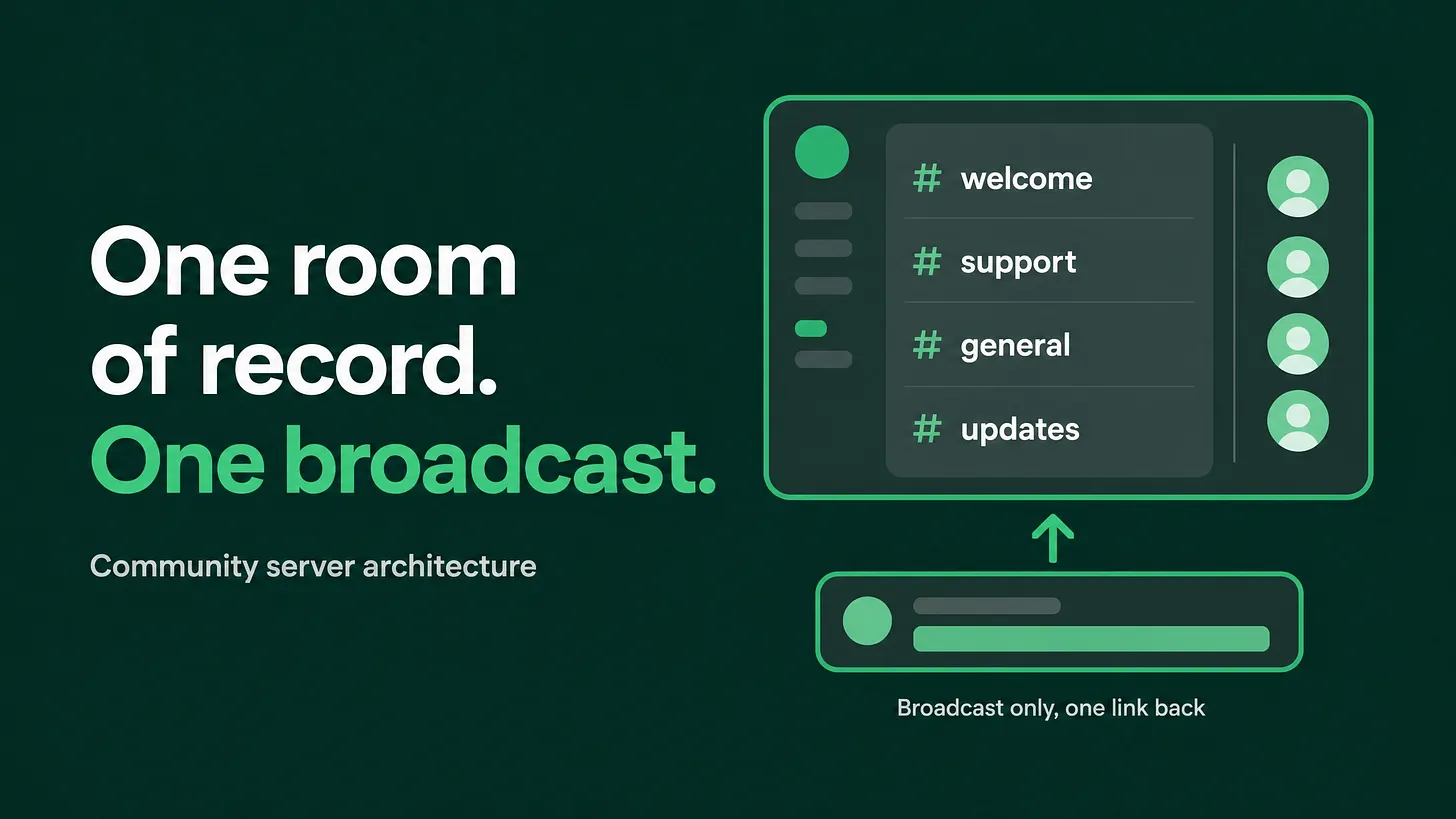
📌 The Discord vs Telegram decision is not about features, it is about coverage. Two staffed rooms split your answers, halve your response capacity and leave no searchable record. Pick one room of record for support, roles and history, make the other a one way broadcast with a single link back, and audit your last twenty questions in each to see which room your members are actually being served in.
The answer, stated plainly
Run one room, broadcast into the other. That is the decision, and here is why the alternative quietly costs you more than it returns. The reasoning behind launching on two platforms is always the same and always sounds correct. Part of the audience prefers one, part prefers the other, so serve both. It is generous thinking. It is also a promise made with hours nobody has counted. A community is not a place. It is a response capacity. The moment you open a second staffed room, you have not doubled anything except the number of places where somebody can be ignored.
What the second room actually costs
Three costs, and none of them appear on any dashboard. Answers split. A member asks a good question, someone gives a genuinely useful answer, and that answer now exists in exactly one of your two rooms. The other room asks the same question next week and gets a shorter, worse answer from whoever is around. Your best explanations stop compounding. Coverage halves. Your team has a fixed number of attentive hours. Spreading those hours across two rooms does not create more of them. It just means each room is covered half as well, and the room your team personally prefers gets the better half. The record scatters. Six months in, nobody can answer the question that matters most for planning: what does our community keep asking about. The history sits in two systems with different search behaviour, and in practice that means it sits nowhere.
⚠️ The tell is a support question that a member had to ask twice, in two places, because they were not sure which room was the real one. If that has happened, your members already know something your reporting has not caught up with.
Room of record versus broadcast surface
Stop comparing platforms on features. Compare them on the job you are asking them to do.
| Job to be done | Room of record | Broadcast surface |
|---|---|---|
| Support questions | Yes, with a routed path to someone who can answer | Never, redirect with one link |
| Access and permissions | Yes, roles and tiers control what a member can reach | No, everyone sees the same feed |
| Searchable history | Yes, this is the main reason it is the room of record | No expectation at all |
| Announcements | Yes, in one channel | Yes, this is its whole purpose |
| Published response standard | Yes, and you meet it | None, stated openly |
| Moderation coverage | Full, mapped to shift blocks | Minimal, one way traffic needs little |
A structured server with channels, roles, threads and searchable history is built for the first column. A fast linear chat app is excellent at the second. The mistake is not choosing the wrong platform, it is asking both to be the first column.
The decision rule
One room of record. One broadcast surface. No exceptions dressed up as pilots. The room of record is where work happens, where questions are answered inside a stated time, where access is controlled by roles, and where the history of your community accumulates into something you can search and report on. It earns the staffing because it returns the record. The broadcast surface is one directional by design. Announcements go out. Every message carries one link back. You publish no response promise there and you say so in the description, because an unstated promise is still a promise, and members hold you to it whether you made it consciously or not.
If you cannot staff a room to the standard you promise in the other one, you do not have two communities. You have one community and one room with your name on it that nobody is watching.
The audit that settles the argument
This takes an afternoon and it ends the internal debate faster than any opinion. TWENTY QUESTION AUDIT For each platform, take the last 20 member questions. For each question record:
| answered | yes / no |
| time to first reply | minutes |
| within stated standard | yes / no |
| answered by | staff / volunteer / another member / nobody |
| findable in 6 months | yes / no |
Read three numbers per platform: 1. percentage answered inside the standard 2. percentage answered by someone accountable 3. percentage a future member could find without asking again Bring both sets of numbers to the meeting where somebody says our audience is on both. The room of record chooses itself, and it is usually the platform your team was already covering properly.
Making the change without losing people
Consolidation goes badly when it is announced as a shutdown. Sequence it instead.
- Choose the room of record and say so internally first, in writing.
- Move the response standard so it applies only to that room, and publish it there.
- Change the second room's description to state that it is announcements only, with one link back.
- Answer questions in the second room for a short overlap period with the same reply every time: a short answer plus the link.
- Move anything worth keeping into the room of record as documentation, not as a copied conversation.
- After the overlap, stop answering in the second room entirely and let the description carry the expectation. Members do not resent a clear boundary. They resent guessing which room is real.
Where this decision sits
This is one decision inside the operating layer of a community: channel architecture, support routing, escalation paths, documentation and reporting. Every one of those layers assumes a single place where the work happens. Choosing the room of record is what makes the rest buildable, and skipping it is why teams with good people still describe their community work as chaotic. Once that choice is made, the remaining layers can be built properly instead of built twice.
Do this week
- Run the twenty question audit on both platforms
- Name the room of record in writing, internally
- Publish a response standard in that room only
- Rewrite the second room's description as announcements only, with one link back
- Set an overlap end date and hold it
Clarity is cheaper than effort. Most community teams are not short of commitment, they are short of a decision that would let their commitment land in one place. Make the decision, then let the work compound. More at danieljeong.org.