Discord Leveling Rewards for Creator Communities That Do Not Wreck Your Margin
Most leveling systems ship the scoreboard and postpone the rewards, then discover that free product at every rung scales with engagement.

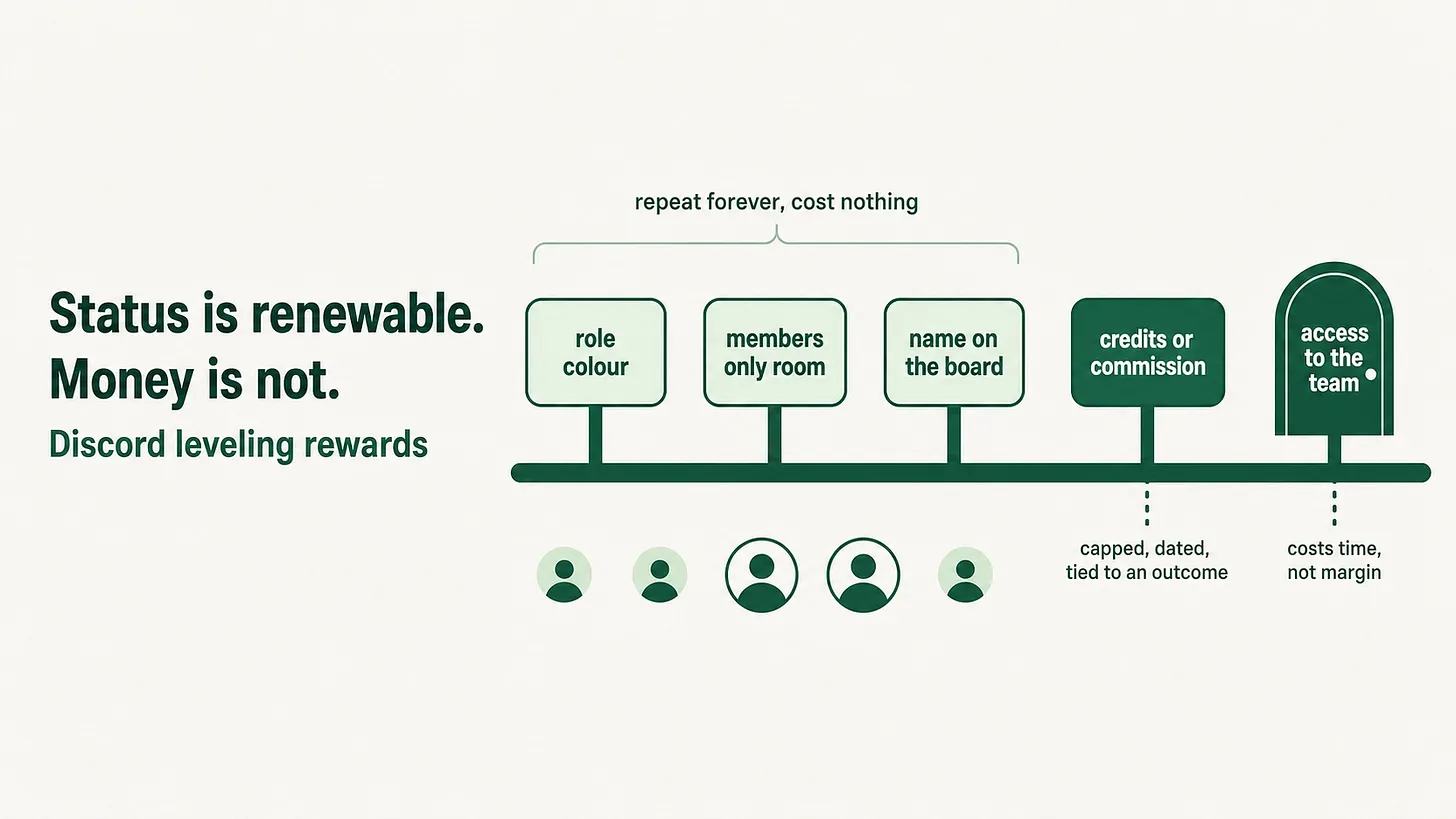
📌 Discord leveling rewards for creator communities work when status carries the ladder and money punctuates it. Status rewards like a visible role colour, a members only room or a name on a board cost nothing and can repeat forever. Paid rewards belong only at rungs that coincide with a business outcome. Award progress for contribution, not message count, and publish the ladder where members can read it.
The symptoms
You can diagnose a leveling system without opening the bot dashboard. Look for these instead. Members ask what a level gets them, in public, and the answer takes a moderator more than a sentence. Nobody in the community refers to their own rank unprompted. The leaderboard has the same handful of names it had two months ago. Someone is posting short filler messages in a quiet channel at a suspicious rate. The team has stopped mentioning levels in announcements, which is the clearest signal of all, because it means the people who built it no longer believe in it. If you recognise three of those, the system is not underperforming. It is decorative.
The diagnosis
Almost every one of these installs happened in the same order. The bot went in, the rungs got named, the XP curve got tuned, and the rewards were left for later. A level is a scoreboard. A reward is a reason to care about the score. Shipping the scoreboard first works until the first member arrives at a rung, receives nothing, and says so where everyone can read it. From that moment the numbers are public evidence that climbing does not pay.
The moment a member reaches a level and nothing happens, every level below it stops working too.
The second cause: rewards priced without margin math
The other half of the failure looks like generosity. Somebody proposes free product at each rung, or credits, or a cut of revenue. It is exciting in the meeting and it has a structural problem: the cost of the program scales with exactly the behaviour you are trying to increase. A community program whose expense grows with its own success gets quietly cancelled two quarters later, usually by finance, usually right after it started working.
Two classes of reward
Sort every reward you are considering into one of two buckets before you design a single rung.
| Class | Examples | Cost behaviour | Use it for |
|---|---|---|---|
| Status | Visible role colour, name on a board, members only room, early information, the right to post in the showcase channel | Near zero, unaffected by how many members earn it | Every rung of the ladder |
| Incentive | Product, credits, commission, physical merch, cash | Scales with participation, so it needs a cap and a date | Two or three rungs, chosen deliberately |
Status is the load bearing material. It is renewable, it is what most contributors actually want, and it works because other members can see it. Incentives are punctuation. They exist to make specific moments feel real, not to pay for participation.
Where paid rewards belong
Put them where climbing coincides with something the business gets. A member who brings in a customer, publishes work that other people find, refers another creator, or ships something using your product has produced a countable outcome. That is a defensible place to spend money. Message count number nine hundred is not an outcome. It is activity, and paying for activity is how you end up funding the person who talks the most rather than the person who helps the most.
💡 If a reward would embarrass you at a budget review when multiplied by every member who could earn it, it belongs at a capped rung with a date on it, not on the ladder.
What progress should actually count
A pure message counter measures presence. You want contribution, and the two diverge fast in a creator community. So weight it. Answering a question that a member marks as resolved. Posting finished work in the showcase channel. Turning up to the event and speaking. Bringing in a member who becomes active. Most bots can weight some of this, and none of them can judge quality, which is why the manual layer matters. Give each moderator a small monthly allowance of awards to hand out for things worth rewarding. The allowance keeps it scarce, which keeps it meaningful, and it gives your moderators a reason to actually read the channels they cover.
Status only works when it is visible
A badge nobody else can see is not status, it is a database row. Make sure the reward shows up in the places members look: colour in the member list, a separate hoisted section, a name in a permanent channel, an ability other members can watch being used. Some cosmetic options are gated behind server boosts. Check what your server currently unlocks before you promise a badge or a custom tag, because a reward you cannot deliver on schedule is worse than a smaller one you can.
Make the top rung access, not merchandise
The most valuable thing a company owns in a creator community is time with the people who build the product. Office hours with an engineer, a feedback session on a member's work, a direct line to the team for the top group. That costs time rather than margin, it cannot be resold, and it is what serious contributors ask for when you interview them. It also caps naturally, because only a few members can be in the room.
What to measure
Four numbers tell you whether the ladder is doing anything. The share of active members who have earned at least the first rung, which tells you whether the entry rung is reachable. The number of manual awards handed out per month, which tells you whether your moderators are using the mechanism or ignoring it. The cost per incentive rung, tracked as a real line item. And the retention of members above the second rung compared with members at zero, which is the only figure that tells you whether the program earns its existence. Publish the ladder where members can read it, then watch how often it gets referenced in ordinary conversation. That reference rate is the softest signal here and the one that moves first.
Where this sits in the larger system
A leveling ladder is one layer of a community operating stack that also includes onboarding and the first forty eight hours, role and channel architecture, support routing and response time, moderation coverage, automation, and the reporting rhythm that turns all of it into something an executive reads. It leans on role architecture, since every status reward is a role, and on moderation coverage, since the manual awards depend on humans reading channels. Build the reward policy before the XP curve. The curve takes an afternoon to tune. The policy is the part that decides whether anyone climbs.
Recognition is the cheapest thing a company can give and the hardest thing for a member to get anywhere else. Spend it generously and spend money carefully. More at danieljeong.org.