Before You Open a Discord: The Operating Guide for Founders and Heads of Marketing
A server is a product surface with an entry flow, a support path, and a staffing model behind it. Here is how to design one before you send the first invite.

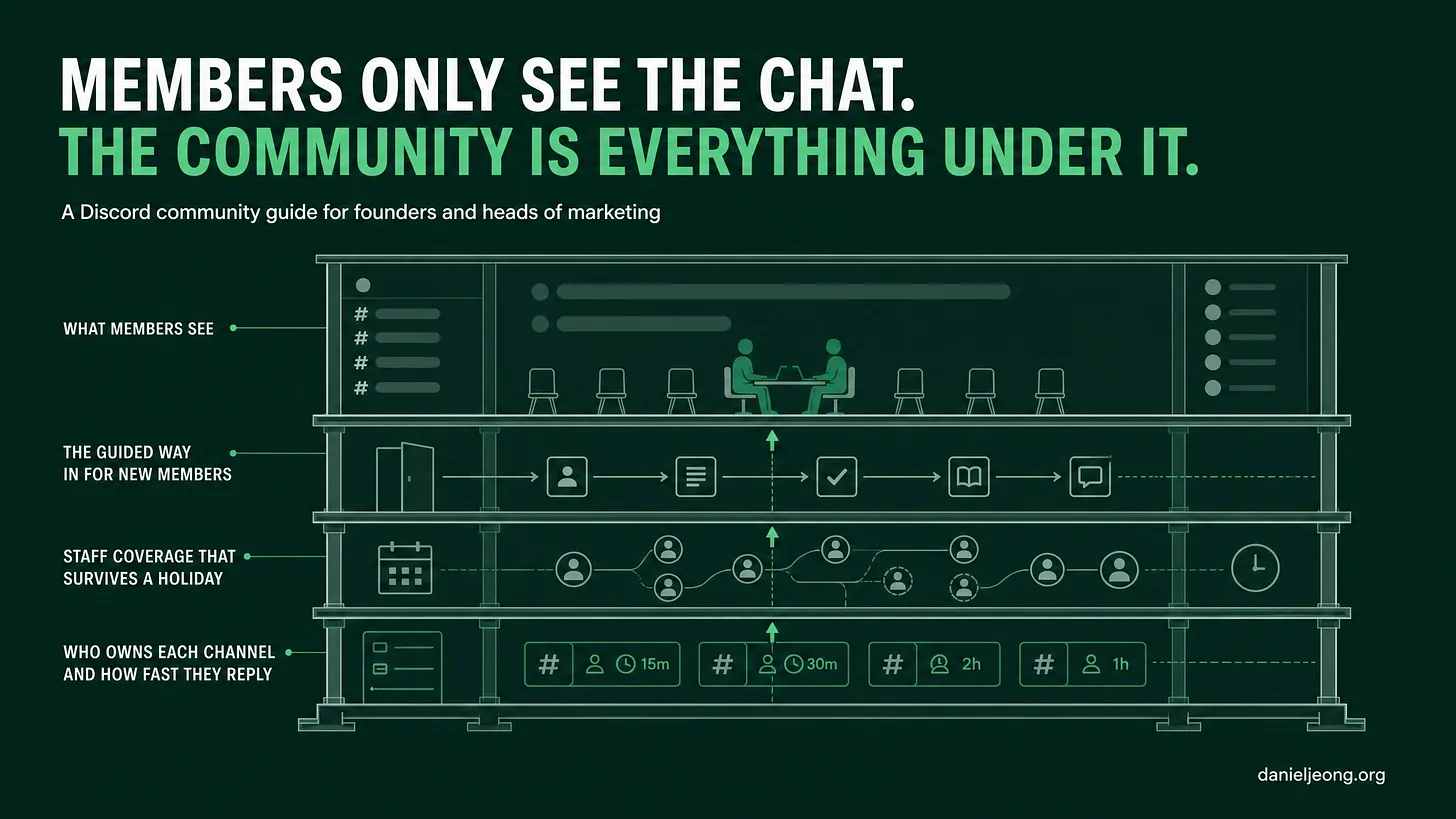
A Discord server holds the audience your marketing already paid to reach, which makes it retention infrastructure rather than a channel to fill. Design the entry path, the response window, and the staffing model before you name a channel. Measure time to first post and repeat participation, not member count.
The week the server goes up
A company decides it needs a community, and within a few days there is a server. Someone picks an icon, names a dozen channels, writes a rules post, and drops the invite into a newsletter. The first few hundred people arrive. For about a week it feels like it worked. There are hellos, a couple of threads, screenshots pasted into the internal team channel. Then arrivals slow, the hellos stop getting answers, and the server settles into the state most company servers live in, which is technically open and functionally empty. That is not a failure of enthusiasm. It is what happens when a room gets launched before a system gets designed. A server is closer to a product surface than to a social account. It has an entry flow, a permission model, a support path, a content rhythm, and an operations team standing behind all of it. Skipping the design work does not remove those requirements. It hands members the broken version of each one.
What the server is actually hired to do
The most common strategic error is treating a community as a growth channel. Discovery happens somewhere else. People find you through search, video, a podcast, an ad, a friend forwarding a link. By the time someone clicks an invite, your acquisition spend is already committed. A community is retention infrastructure. Its job is to take an audience that already exists and make leaving feel like a loss. That reframe changes who should own it, how it gets budgeted, and what it gets measured against. A channel gets judged on reach. Infrastructure gets judged on whether the thing built on top of it stays standing.
The server does not create the relationship. It decides how long the relationship lasts.
For a head of marketing this distinction is uncomfortable, because community usually lands on the marketing roadmap next to campaigns and inherits campaign metrics. Reach, impressions, sign ups, member count. Those numbers describe the top of the funnel. A community lives at the bottom of it, next to product adoption, support deflection, expansion revenue, and renewal.
The first day is the whole product
Communities lose a large share of new members in the first day or two, and almost always for the same reason. Someone arrives, sees an unfamiliar interface, cannot tell where to start, posts nothing or posts once into silence, and never opens the app again. Nothing in that sequence is about content quality. It is about entry design. A working entry sequence gives a member four things quickly:
- A guided path in, so the server sorts them by who they are and what they came for rather than dropping everyone into the same general channel
- A structured welcome that tells them what happens here and what happens next
- One obvious first action that takes under a minute and produces a visible response
- Contact with an actual human inside the first day
The entry questions you ask at the door are also the most underrated asset in the whole build. Role, company stage, what they are trying to solve. Those answers drive role assignment, channel visibility, and every relevant offer you make for the next year. Most servers ask nothing, then spend the following twelve months guessing who is in the room.
time to first postis the single metric that tells you whether entry works. Measure it from join to first message. If the median sits in days, the entry sequence is broken regardless of how good the community feels to the people running it.
Someone has to be home
Response speed does more retention work than programming does. A member who asks a question and waits six hours learns that this place is quiet. A member who gets a reply in twenty minutes learns the opposite, and the content of the reply matters far less than its timing. This is a staffing decision dressed up as a culture problem. Teams try to solve it with encouragement, then wonder why it decays the moment the person who cared most goes on leave. What actually fixes it is an owner per channel and a stated response window per channel, written down, with coverage that survives a vacation.
| Channel | Named owner | Response window | Review date |
|---|---|---|---|
| Introductions | Required | Under 1 hour | Quarterly |
| Support | Required | Under 2 hours in business hours | Quarterly |
| Open discussion | Required | Same day | Quarterly |
| Anything without an owner | Do not open it | Not applicable | Not applicable |
The last row is the one teams argue with. A channel with no owner still costs you something. It occupies sidebar space, splits attention, and quietly signals that this place is bigger than it is. Empty rooms make a community feel abandoned faster than a small channel count ever will. Automation carries the repetitive load here and nothing more. Role assignment, entry routing, common answers, moderation triggers, escalation alerts when a high value member posts. It should never carry the relationship. The moment a member can tell that the warmth is scripted, the warmth stops working.
Numbers that tell you something
Member count is the number that survives every quarterly review and explains nothing. It cannot separate a room of ten thousand lurkers from a room of eight hundred regulars, and only one of those is worth funding.
| Metric | What it exposes |
|---|---|
| Time to first post | Whether entry is doing its job |
| First week activation rate | Whether the first action is obvious enough |
| Repeat participation across 30 days | Whether the community has a rhythm worth returning to |
| Median first reply time | Whether staffing matches the promise |
| Share of members with a named owner contact | Whether relationships exist beyond the feed |
Pick two of these and report them next to revenue metrics. The point is not the dashboard. The point is that community stops being a vibe your leadership team has to take on faith.
Build for the size you are
The operating model changes as the room fills, and most of the pain in a growing community comes from running the previous stage's model one stage too long.
| 100 members | personal relationships carry it |
| 1,000 members | structured onboarding becomes necessary |
| 10,000 members | documentation systems become critical |
| 100,000 members | automation and moderation frameworks required |
| 1,000,000+ | full operational infrastructure and specialized teams |
I have run communities across that entire range, including one that scaled past a million members while staying genuinely active, and the pattern held every time. The founder who personally greets every member at three hundred people is doing the right thing. The same founder still doing it at three thousand is the bottleneck. Nothing broke. The model simply expired.
A short pre-launch sequence
If you have not opened the server yet, this is the order that works:
- Write the one sentence purpose. What does a member get here that they cannot get from your newsletter or your product
- Design the entry sequence, including the questions asked at the door and where each answer routes
- Define the first action a new member takes and make it produce a visible human response
- Name owners and response windows for every channel you intend to open
- Cut the channel list down to what those owners can cover, then cut it again
- Set the two metrics you will report and instrument them before launch
- Open the doors If the server is already live and quiet, run the same list backward. The problem is rarely the programming calendar. It is almost always sitting in steps two through four.
The part nobody can delegate
A founder or a marketing lead can hand off moderation, scheduling, design, and daily operations. What cannot be handed off is the decision about what this community is for and who it is for. Every structural choice downstream depends on that answer, and no community manager can invent it on your behalf. Get that sentence right, design the way in, staff what you open, and the room fills itself. Skip it, and you get the thing most companies have, which is a server with a few thousand members and a general channel where the last message is three weeks old.
Communities are built the same way products are, in layers, with someone accountable for each one. If yours is carrying revenue, it deserves the same design attention the product gets. danieljeong.org