Automation Should Carry the Load, Not the Relationship
The line between a bot that scales your community and one that quietly hollows it out.

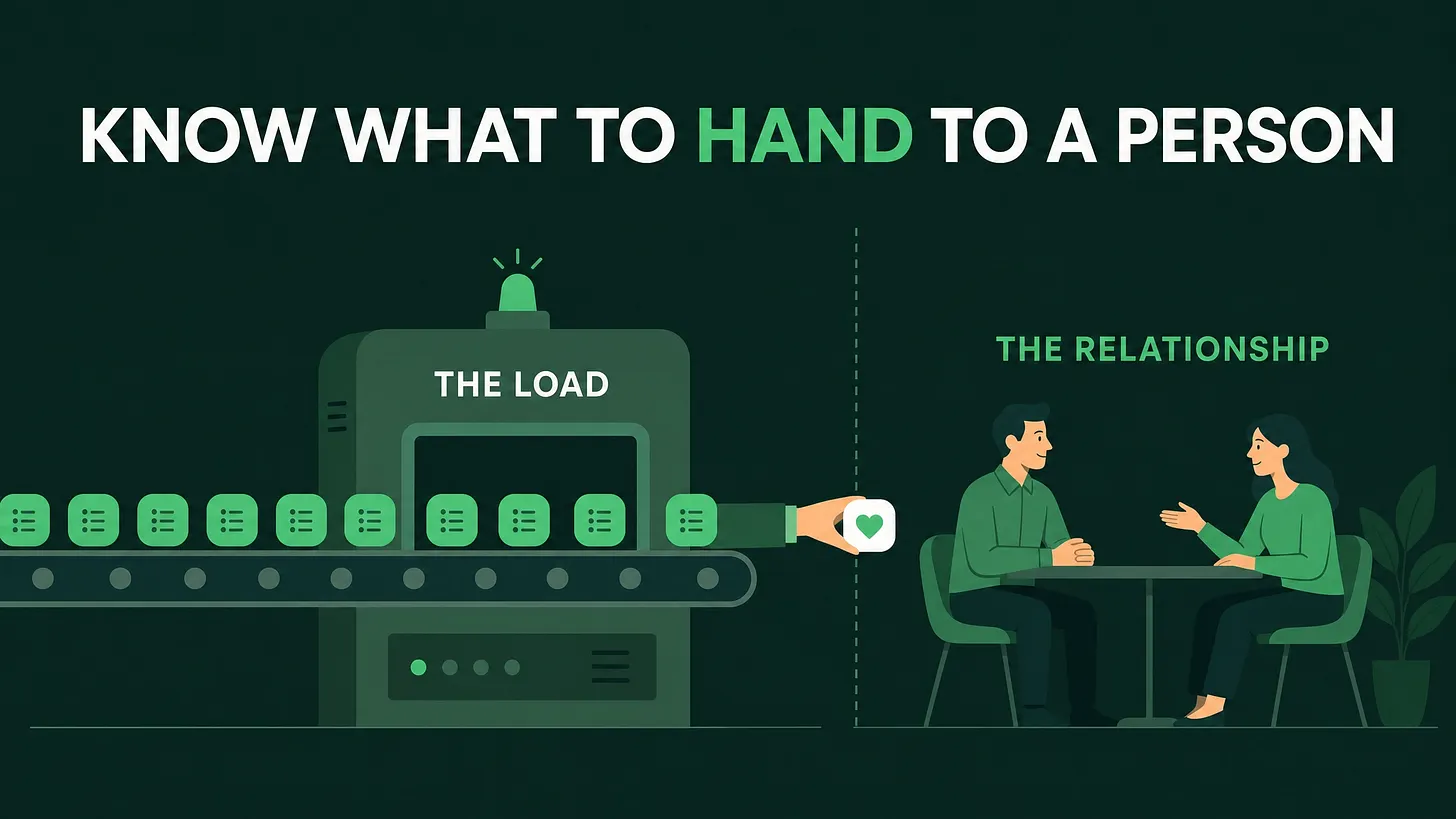
Automation is not the enemy of a warm community, but misused automation is. Draw one clear line: let automation carry the repetitive, low-judgment load, and keep humans on anything involving trust, judgment, or a real problem. The test is simple. If a member would feel dismissed by the automated reply, a person should have taken it.
The reflex that backfires
When a community gets busy, the instinct is fast and understandable. There are too many messages, too many new members, too many of the same questions, so the team reaches for automation to catch up. Nothing wrong with that instinct. The problem is where it usually goes. Teams tend to automate whatever is loudest, not whatever is safest to automate. The loudest thing is often the emotional message, the frustrated member, the person on the edge of leaving. Hand that to a bot and you have not saved time. You have taught a member that this place answers real feelings with canned text. That lesson is expensive, and it sticks.
Two jobs that look the same and are not
Inside every community there are two very different kinds of work, and they get lumped together because they both arrive as messages in the same channels. The first is load. High volume, low judgment, repetitive. Assigning roles, welcoming arrivals, pointing someone to the right resource, reminding people about an event. The second is relationship. Lower volume, high judgment, personal. A member who is confused and frustrated, a conflict between two people, a question with real stakes behind it.
Load is about throughput. Relationship is about trust. A tool that is great at one is dangerous at the other.
The reason automation feels risky to some leaders and irresistible to others is that both are reacting to this blur. The answer is not more automation or less. It is drawing the line between the two kinds of work and putting each on the right side.
What automation is genuinely good at
On the load side, automation is not a compromise. It is better than a human, because it is consistent, instant, and never tired. Members do not resent a machine for handling load well. They barely notice it, which is exactly the point.
| Give this to automation | Keep this with a person |
|---|---|
| Role assignment on entry | A member who seems ready to leave |
| First acknowledgment of a message | A conflict or a sensitive complaint |
| Routing a question to the right channel | A judgment call with real stakes |
| Reminders and simple, factual answers | Anything that needs empathy to land |
Everything in the left column is repetitive and predictable. Everything in the right column depends on reading a specific human in a specific moment, which is precisely what automation cannot do.
Where a bot becomes a wall
Here is the failure in one image. A member types something vulnerable, and a cheerful automated reply fires back with a link. Technically the message was answered. Emotionally, the member just learned that no one is really there. Instant is not the same as heard.
That is the difference between a door and a wall. Good automation is a door. It opens the way to a person, sets an expectation, and removes friction on the path. Bad automation is a wall. It stands between the member and a human and pretends to be the destination. The member on the other side of that wall does not complain. They just stop reaching.
The one-question test
You do not need a complicated policy to get this right. You need one question, asked before you automate anything. Would a member feel dismissed if a bot handled this? If the honest answer is no, automate it freely and enjoy the time you get back. If the answer is yes, or even maybe, that task belongs to a person. This single filter will keep you from the most common and most damaging mistake, which is letting efficiency quietly eat the relationship that made the community worth building.
Invisible when good, loud when bad
There is a reliable tell for whether your automation is helping. Good automation is invisible. Members move through onboarding, get pointed to the right place, and receive fast acknowledgments without ever thinking about the machinery. It feels like a well-run space, not a bot farm. Bad automation announces itself. It replies with the wrong tone at the wrong moment. It answers a feeling with a FAQ. It makes people feel processed. If members are joking about talking to a robot, the line has already been crossed, and the fix is not a better script. It is moving that interaction back to a person.
Design the handoff, not just the trigger
Most teams design the automated action and stop there. The real craft is in the handoff, the moment automation steps aside and a human steps in. That seam is where communities are won or lost. A clean handoff looks like this: Member posts a real problem
→ bot acknowledges instantly: "seen, a person is on this"
→ bot quietly routes and tags the right human
→ human picks it up while the member still feels held
→ automation logs it, human owns the conversation
Notice that automation never disappears. It carries the load around the human, buys the person time, and makes sure the member is never sitting in silence. What it does not do is try to be the person. The bot sets the table. A human shares the meal.
Protect presence, not just time
The deepest reason to get this right is not efficiency. It is that a community is a relationship business wearing the costume of a software product. People stay because they feel known. Automation can protect the time your team needs to make people feel known, or it can replace the very presence that does the work. Those are opposite outcomes from the same tool. Build the machine to defend your people's attention for the moments that matter. Let it absorb the repetitive weight so no one burns out on busywork. Then keep every human hand on the interactions where being human is the entire value.
Automation should give your team more room to be present, never a reason to be absent. Build it to carry the load, and guard the relationship with people. danieljeong.org